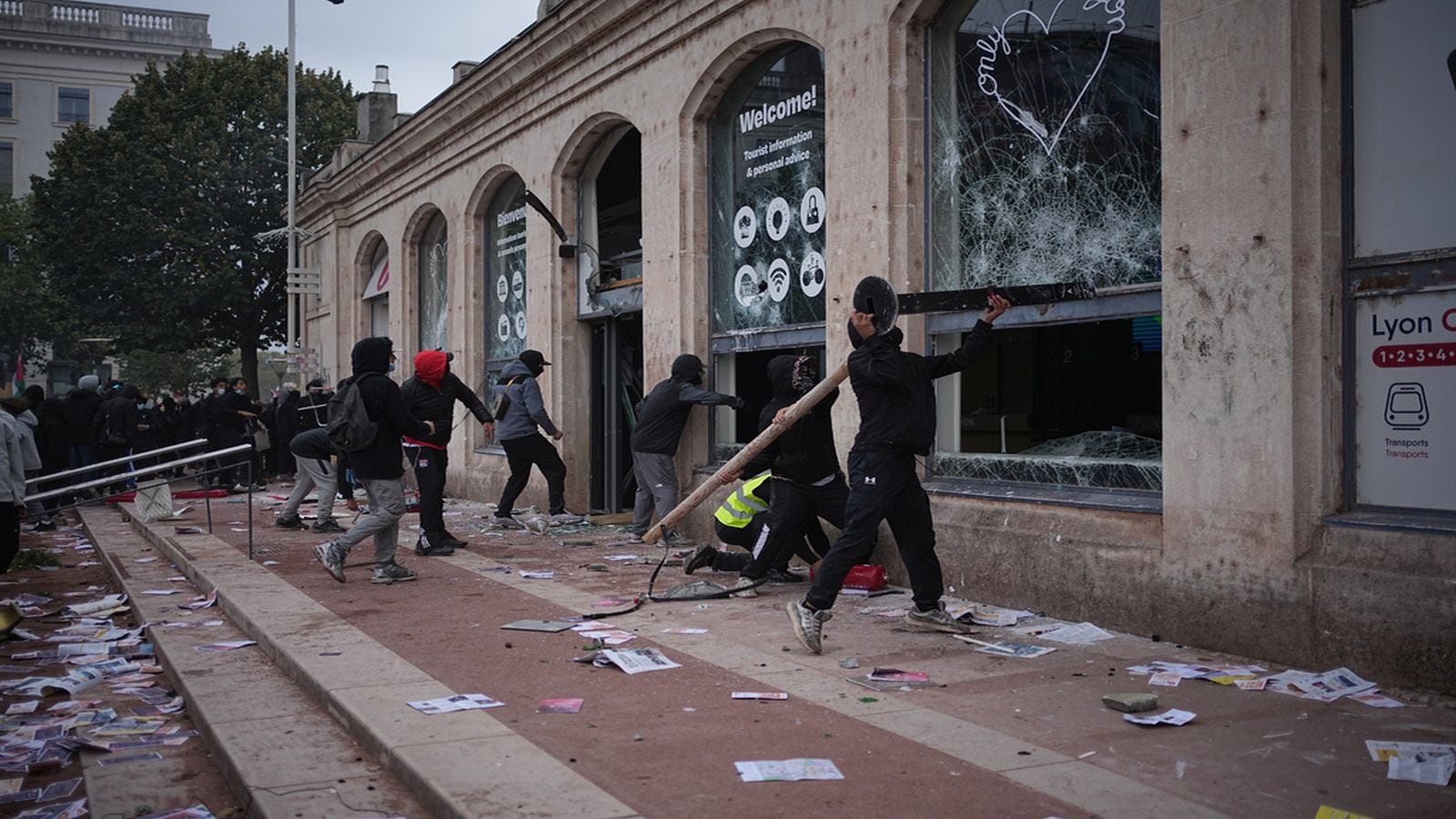
When France unrest erupts into burning town halls and ransacked storefronts, surface-level photo galleries treat the smoke as spectacle while missing the machinery underneath. During the mid-October 2026 demonstrations and riots that saw the historic town hall in Limoges gutted by fire and thousands of shops damaged or looted across cities from Paris to Lille and Bordeaux, the flashpoint combined student blockades, cost-of-living anger, and opportunistic street violence. Yet the real story sits at the intersection of strained municipal security, small-business vulnerability, and an insurance backstop that arrived too late to absorb the shock.
Having covered street politics and urban economies across Europe for more than two decades, I have learned to look past the loudest footage first. A burning municipal building makes an unforgettable headline, especially when a 143-year-old structure like Limoges's city hall loses its roof and exterior walls. Still, cameras rarely capture why one neighborhood gets heavily guarded while another block a few kilometers away is left exposed until glass is already on the pavement.
How Peaceful Marches Fractured Into Arson and Looting
Street anger rarely turns destructive in a vacuum. What began in September 2026 with high school blockades and student grievances over education and Parcoursup merged by October 17 with broader union marches, yellow-vest figures, and cost-of-living protests that drew hundreds of thousands of people across more than a hundred demonstrations. Peaceful marchers and aggressive factions often share the same boulevards until dusk falls and policing stretches thin.
Once a crowd fragments, three distinct dynamics feed off one another:
- Ideological agitators and black-bloc tactics: Hardcore groups use smoke, barricades, and projectiles to bait security forces and overwhelm local precincts.
- Opportunistic looters: Once shutters are bent or windows shattered, theft becomes detached from any political demand, targeting hair salons, bakeries, pharmacies, and chain stores alike.
- Policing allocation gaps: Crowd-control deployments face hard limits in manpower and geography, prompting sharp debate over whether central districts and western avenues received tighter protection than eastern neighborhoods and outer municipalities.
In parliamentary testimony following the October 17 violence, Paris Mayor Emmanuel Grégoire raised concerns over perceived disparities in law enforcement coverage between western and eastern parts of the capital. That argument gets to the core operational flaw of large-scale urban unrest. Police commanders have to choose between holding key institutional symbols, protecting major transit corridors, or dispersing smaller looting crews scattered across side streets.
Why Small Shops Pay the Heaviest Price
Photos of a blazing mairie symbolize an attack on the state, yet neighborhood shopkeepers absorb the most immediate financial blow. Commercial properties have historically accounted for the bulk of riot-related insurance payouts in France, far outweighing the cost of torched vehicles even when burning cars dominate evening broadcasts.
A mid-sized retail chain can absorb a smashed window or reroute inventory from a regional warehouse. An independent florist, a café owner, or a couple running a neighborhood hair salon cannot. When looters clear out registers, equipment, and stock in twenty minutes, the owner faces immediate cash-flow paralysis, physical safety risks while trying to defend the premises, and weeks of bureaucratic claims paperwork.
In street disorders, symbolic arson grabs the cameras, but small-business closures leave the longest scar on local tax bases and daily life.
Consider a hypothetical example to see how the math works on a single commercial street. Suppose a small bakery loses €25,000 in ovens, display cases, and inventory, plus three weeks of trade while glass and wiring are repaired. Even if an insurer eventually covers a large share of physical damage, lost foot traffic and higher deductibles still squeeze a business operating on thin margins. Across roughly 1,500 severely damaged shops and thousands more targeted or looted during the October wave, those individual hits compound quickly.
| Cost Dimension | What Happens on the Ground | Policy & Market Impact |
|---|---|---|
| Municipal & Public Buildings | Town halls, offices, and public equipment suffer fire or structural damage | Strains local budgets and disrupts civic services |
| Independent Retail & Cafés | Storefronts smashed, tills emptied, staff displaced | Prompts emergency state aid and partial unemployment funds |
| Insurers & Reinsurers | Thousands of property and business interruption claims filed | Initial estimates above €200 million; broader tail risk debated |
The Insurance Timing Trap Behind the Riot Bill
Here is a financial angle that superficial coverage almost always misses. French insurers face a hefty bill from the October 17 and 18 unrest—with industry federation France Assureurs estimating more than €200 million (around €207 million) in insured damage across over 5,200 claims, with businesses representing roughly 95% of estimated losses—while analysts have warned that broader riot exposures across waves of unrest can climb much higher.
France had already legislated in February 2026 for a public-private riot insurance framework involving compulsory coverage and a state-guaranteed pool administered through reinsurer CCR. Yet the timing was awkward: the new mechanism was not yet active when the October violence broke out. As a result, losses fall back on traditional layers—primary carriers, reinsurance panels, specialist strikes, riots, and civil commotion policies, and potential state-liability claims.
| Wave of Unrest | Approximate Insurer Cost Benchmark | Key Lesson for Risk Managers |
|---|---|---|
| Autumn 2005 Suburban Unrest | Roughly €200 million | Concentrated suburban flashpoints still ripple nationwide |
| 2018–2019 Gilets Jaunes | Around €220 million | Recurring weekend protests test policing endurance and retail |
| 2023 Urban Riots | Around €730M–€793M across ~15,600–16,400 claims | Commercial property and municipal buildings drive major payouts |
| October 17–18, 2026 Unrest | Over €200 million (€207M estimated) across 5,200+ claims | Rapid commercial hits arrive before new state backstop activates |
Major carriers have moved to extend reporting deadlines—stretching the usual five-working-day reporting window to 30 days—while government officials have pointed to support funds for affected businesses and partial unemployment measures for workers at shuttered shops. Even so, insurance backstops are not a cure-all. If public-private pools price risk too bluntly or delay payouts, small merchants bear the liquidity strain first, and insurers face sharper earnings volatility whenever street protests curdle into property destruction.
Policing Tactics, Accountability, and What Remains Unresolved
No serious observer of French public order pretends the trade-offs are easy. When authorities deploy heavy force to stop arson and looting, critics and civil-rights watchdogs point to injuries, heavy-handed tactics, and criminal probes into alleged excessive force by officers and gendarmes. When containment is looser or forces are stretched across multiple cities, critics accuse the state of failing to protect citizens, firefighters, and local merchants.
Both criticisms can be partly true at once. Crowd control in dense European cities operates on a razor's edge, especially when grievances over cost of living, public services, and education collide with organized street disorder and fast-moving social media rumors. Until governments pair faster economic relief and clearer policing deployment with dependable, transparent coverage for damaged shops and civic buildings, every new wave of France unrest will leave the same charred beams and boarded windows behind.