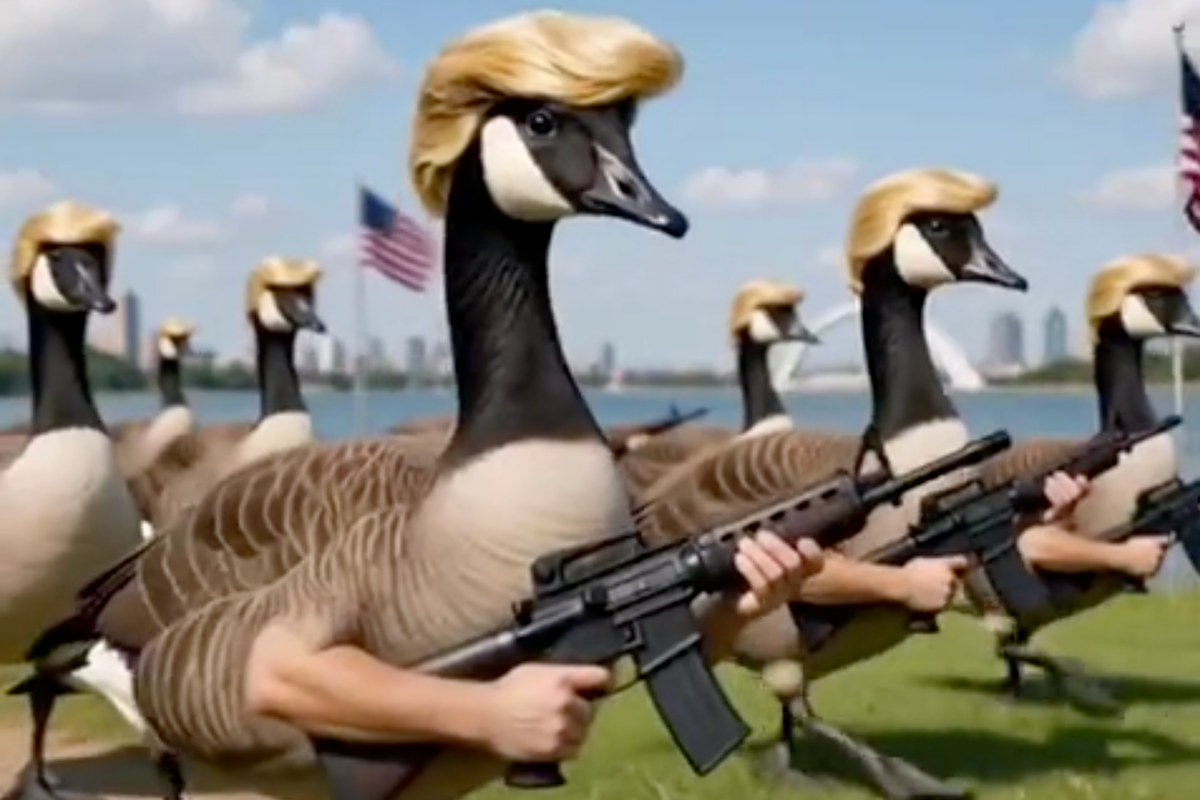
President Donald Trump recently shared an artificial intelligence-generated video on Truth Social depicting an armed squadron of mutant Canada geese—complete with human arms, assault rifles, and the administration leader's signature blond hair—patrol-marching along a shoreline meant to represent a newly christened Lake America. Set against the theme song of Hawaii Five-O and culminating in celebratory fireworks over a digital silhouette of Toronto, the thirty-four-second clip serves as a bizarre visual companion to an escalating trade dispute with Canada and a unilateral decree attempting to rename Lake Ontario. Beneath the internet memes and the immediate wave of ridicule over whether the rendered birds are ducks or geese lies a calculated exercise in modern digital statecraft, where political provocation and synthetic media blur into a single weaponized aesthetic.
To understand why a head of state is distributing cartoons of armed waterfowl, one must examine the mechanics of contemporary trade retaliation. Late last week, bilateral negotiations between Washington and Ottawa collapsed over stubborn structural disagreements. The failure triggered a pre-planned sequence of economic hostility, featuring proposed fifty percent tariffs on Canadian imports matched dollar-for-dollar by Canadian Prime Minister Mark Carney. Ontario Premier Doug Ford publicly challenged the White House, questioning whether the trade penalties were intentionally designed to harm American households. The administration responded not with dry policy papers or standard diplomatic briefs, but with economic brinkmanship paired with targeted mockery.
The Mechanics of Synthetic Statecraft
Visual propaganda has always accompanied territorial and economic spats, but the generative era has fundamentally accelerated production speed. Instead of commissioning political cartoonists or waiting for an agency to draft a press statement, political operations now pull directly from decentralized online ecosystems. The video in question did not originate within an official government media bullpen; it was built by an external creator on X before being amplified by the executive office.
This crowdsourced loop creates a unique feedback dynamic.
- The political figure adopts grassroots digital artifacts.
- Traditional media outlets register shock and fixate on factual errors, such as misidentifying geese as ducks.
- Base supporters treat the absurdity as proof of unbothered strength and authentic defiance.
By leaning into surrealism, the administration bypasses conventional journalistic scrutiny. When critics point out the absurdity of renaming a major international waterway or arming migratory birds with digital assault rifles, they engage on terms set entirely by the offensive campaign. The substance of the fifty percent tariff, and its very real impact on manufacturing supply chains, logistics networks, and consumer prices, gets submerged beneath hours of commentary about animated poultry.
Historical Precedent for Cartographic Fiat
Renaming geographic landmarks to assert political dominance is an old tactic wrapped in a new digital package. Past administrations have toyed with semantic mapping, though rarely with the explicit goal of trolling a neighboring sovereign nation during a commercial freeze. The strategy relies on cognitive saturation. When the Gulf of Mexico was previously rebranded in political rhetoric, commercial tech mapping platforms faced conflicting pressures from users, local municipalities, and federal agencies.
Now, apply that same cartographic fiat to the Great Lakes. Lake Ontario borders the industrial heartland of Ontario, a province led by officials currently locked in a bitter political feud with Washington. The name change carries no legal weight under international maritime law or Canadian sovereignty, yet its utility is entirely symbolic. It functions as a digital flag planted firmly in foreign soil, designed to provoke an emotional reaction from northern neighbors while signaling total indifference to diplomatic norms.
The inclusion of the birds themselves—ironically recognizable to any North American as the aggressive, ubiquitous Canada goose—adds a layer of inadvertent or perhaps mischievous dark humor. For decades, citizens on both sides of the border have regarded these migratory flocks as loud, messy nuisances. Rebranding them as loyal defenders of a newly minted American lake transforms a shared ecological annoyance into an aggressive mascot for trade protectionism.
The Economic Reality Behind the Pixels
While digital commentators dissect the haircut on the AI-generated waterfowl, corporate boards along the border are scrambling to model the real financial fallout. Tariffs of fifty percent do not exist in a vacuum. Automotive components, agricultural goods, and energy supplies cross the border multiple times during standard manufacturing cycles. A sudden trade barrier of this magnitude acts as an immediate tax on domestic consumers, driving up inflation and forcing supply chain managers to find alternative vendors on compressed timelines.
The deployment of internet memes to deflect from these structural pressures represents a mature phase of modern populist communication. Governance has merged seamlessly with online entertainment. Policy decisions are rolled out concurrently with viral video clips, ensuring that political engagement remains anchored to emotional resonance rather than technical merit.
As the trade standoff continues and the rhetoric hardens, the boundary between official state policy and internet shitposting vanishes entirely. The digital ducks—or geese—will eventually fade from the social media algorithms, but the economic friction of the tariffs will remain long after the rendered fireworks clear over Toronto.
Lake America - Protected by Donald Ducks
This video provides context on Donald Trump's public statements and map presentations regarding the controversial renaming of Lake Ontario to Lake America amid trade tensions with Canada.