Los Angeles city and county officials recently dodged a devastating federal court receivership over homeless services by negotiating eleventh-hour settlement agreements and agreeing to strict bed-creation quotas. Rather than relinquishing control of billions in taxpayer funds to a court-appointed overseer, local leaders bought themselves time under the watchful eye of U.S. District Judge David O. Carter. The deal averts an immediate constitutional showdown over the city's failure to shelter its unhoused population, yet it leaves intact the fractured bureaucracy that created the crisis in the first place.
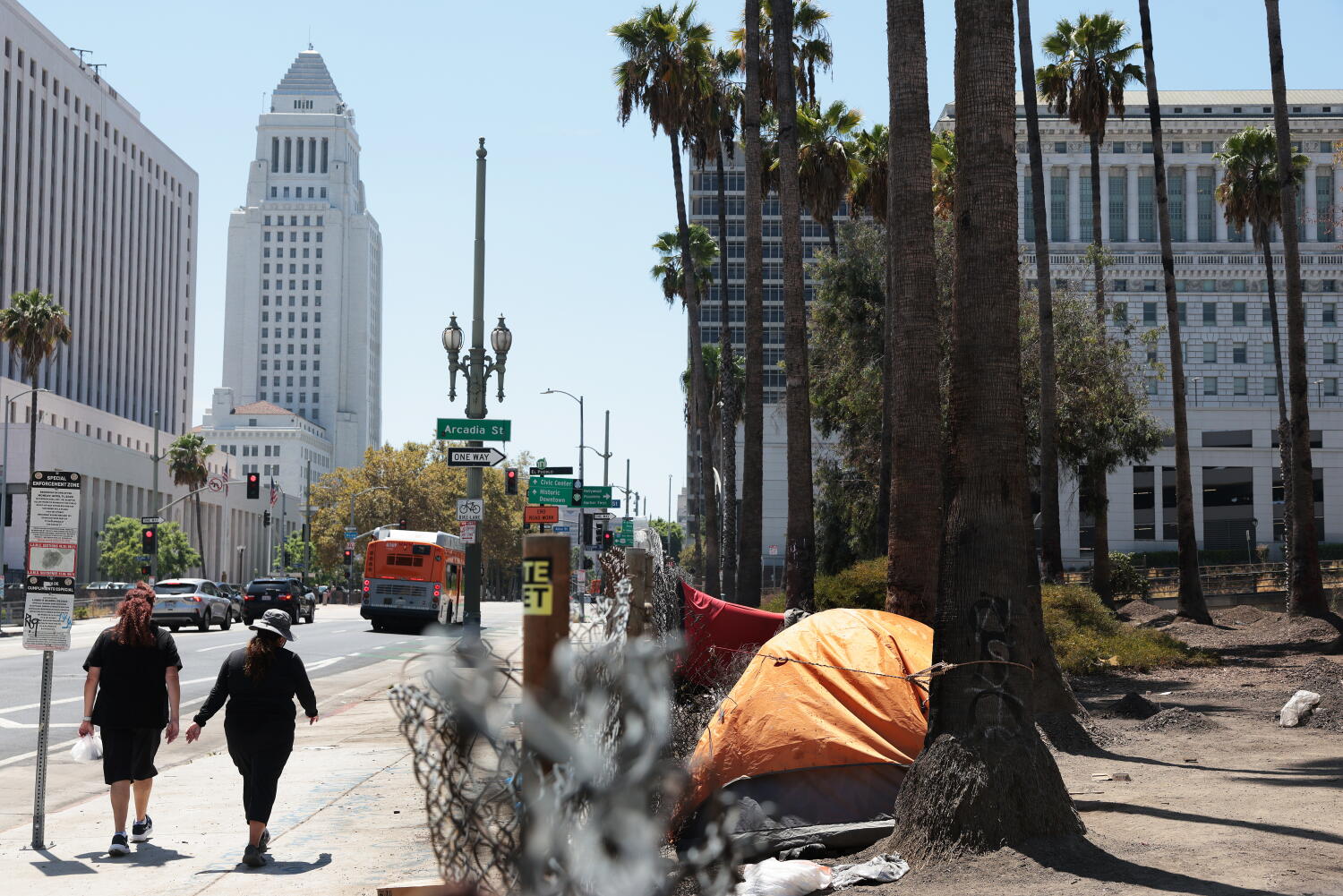
For decades, watching Los Angeles govern its streets has been an exercise in studying institutional paralysis. You have two massive, overlapping governments—the City of Los Angeles and the County of Los Angeles—operating on distinct budgets, answering to different constituencies, and possessing entirely separate legal mandates. When an encampment forms under a freeway overpass in Venice or along the concrete banks of the Los Angeles River, the resulting bureaucratic finger-pointing is almost predictable.
The city controls land use, zoning, sanitation, and local policing. The county controls the social safety net, including mental health treatment, substance abuse recovery, and general relief funding. For years, this division of labor served as the ultimate political shield. Whenever street conditions deteriorated, city hall blamed the county for failing to provide psychiatric beds and addiction treatment, while county supervisors blamed the city for blocking supportive housing developments and criminalizing poverty through sweeping encampment bans.
How the Federal Courts Cornered City Hall
That convenient stalemate shattered when a coalition of downtown business owners, residents, and community advocates—operating as the LA Alliance for Human Rights—filed a federal lawsuit in 2020. Their argument was simple and brutal. By allowing thousands of people to live and die on public sidewalks, the city and county had created a state-created danger, violating the constitutional rights of both unhoused residents and the broader public.
Judge David O. Carter, a former Marine and a jurist known for aggressive, hands-on intervention in public policy disputes, refused to let the case drown in standard municipal delay tactics. He held hearings inside Skid Row warehouses. He walked the encampments himself. He demanded line-by-line accounting of where hundreds of millions of dollars in voter-approved bond money had gone.
At one point, Carter issued a sweeping preliminary injunction ordering the city and county to offer shelter to every unhoused person on Skid Row within 180 days and placing $1 billion in city funds into escrow. Though an appellate court later overturned that specific injunction on procedural grounds, the message to local politicians was unmistakable. If they did not produce measurable results on the street, the federal judiciary was prepared to strip them of their authority.
Receivership is the nuclear option of municipal law. Under a receivership, a federal judge appoints an independent administrator with the power to bypass local zoning laws, override city council votes, rewrite budgets, and unilaterally award contracts. For career politicians in Los Angeles, losing control of the purse strings—and the immense political patronage that comes with billions in housing and service contracts—was an existential threat.
The Anatomy of the Settlement Compromise
To prevent a full trial that almost certainly would have exposed catastrophic financial mismanagement, the city and county cut separate deals. The numbers sound impressive on a press release. The city agreed to create enough shelter or housing beds to accommodate 60 percent of its unsheltered population within each council district, a commitment translating to roughly 12,915 beds over several years, alongside clearing thousands of sidewalk encampments.
The county, meanwhile, pledged to fund 3,000 new mental health and substance abuse treatment beds, alongside expanded outreach teams and subsidy programs. On paper, it looks like a historic truce. In practice, it is a high-wire act built on fragile assumptions.
Consider the math of shelter bed capacity versus street inflow. Creating 12,000 new beds over four years sounds substantial until you realize that for every two people housed in Los Angeles, roughly three more fall into homelessness due to skyrocketing rents, stagnant wages, and expired eviction protections. The settlement binds the city to an output metric—building or leasing beds—without solving the macroeconomic engine that continuously refills the sidewalks.
Furthermore, a "bed" in municipal accounting is a remarkably elastic concept. Under the terms of the legal agreements, a bed does not necessarily mean a permanent apartment with wraparound psychiatric care. It can mean a congregate shelter cot in a converted recreation center, a tiny home in a parking lot with shared bathrooms, or a temporary motel voucher. While getting someone off the asphalt is an immediate humanitarian gain, temporary shelters without permanent exit pathways quickly clog up, turning emergency triage centers into long-term warehouses.
The Hidden Friction Between City and County Mandates
Even with the threat of a federal judge holding them in contempt, the structural friction between the city and the county has not vanished. It has merely been papered over with Memorandums of Understanding.
To see how this friction plays out on the ground, consider a hypothetical example of a single outreach operation. Imagine a city councilmember orders a sidewalk cleanup in Hollywood to satisfy the settlement's encampment-reduction benchmarks. City sanitation trucks arrive, accompanied by police officers and city-contracted outreach workers who offer temporary motel rooms. Half of the people living in that encampment suffer from severe, untreated schizophrenia or methamphetamine addiction. A motel room key will not stabilize them; they need intensive clinical intervention. That clinical care belongs to the County Department of Mental Health. If the county does not have an open psychiatric bed or a mobile crisis team available at that exact hour, the city's operation stalls, or worse, the unhoused individuals simply scatter three blocks away into another neighborhood.
This disconnect is exacerbated by the Los Angeles Homeless Services Authority (LAHSA), the joint powers agency created in 1993 to coordinate efforts between the two governments. Rather than uniting the city and county, LAHSA often functioned as a buffer zone where accountability went to die. For decades, LAHSA lacked the legal authority to force city councilmembers to approve housing sites or compel county health departments to release clinical data.
Recent audits ordered as part of the federal litigation revealed glaring holes in LAHSA's financial tracking. Investigators found millions of dollars distributed to nonprofit service providers with minimal verification of outcomes, overlapping contracts where multiple agencies billed for the same clients, and a chronic inability to track how many beds were actually empty on any given night. When Judge Carter demanded an independent audit of the billions spent on homelessness, local leaders initially balked at the cost and scope before realizing that opposing transparency in open court was political suicide.
Why Spending Billions Has Not Cleared the Streets
Critics of Los Angeles's approach frequently point to the sheer volume of money thrown at the problem. Between Proposition HHH—a $1.2 billion bond passed by city voters in 2016—and Measure H—a quarter-cent county sales tax passed in 2017—taxpayers have poured unprecedented sums into the homeless industrial complex. Yet the visible crisis on the streets grew worse during the exact years those funds were deployed.
Understanding why requires looking at the mechanics of affordable housing development in California. Proposition HHH was designed to subsidize the construction of permanent supportive housing. However, the bond money only covered a fraction of total construction costs, forcing nonprofit developers to stitch together financing from state tax credits, federal loans, and private banks.
Every layer of financing brought its own regulatory hurdles, prevailing wage mandates, environmental review challenges, and local design approvals. By the time a project broke ground, inflation and supply chain bottlenecks had driven per-unit construction costs above $600,000, and in several notorious cases, past $800,000 per apartment. Taxpayers were paying luxury-condo prices for studio apartments that took five to seven years to open their doors.
While developers waited years for permits, the fentanyl crisis hit the West Coast. The cheap, synthetic opioid fundamentally altered the street population. Traditional shelter models—which often enforced curfews, banned pets, required sobriety, or prohibited partners from staying together—became utterly incompatible with the reality of severe addiction and trauma on the streets. People refused shelter offers not because they preferred sleeping in the rain, but because the available beds felt unsafe, overly restrictive, or clinically unequipped to handle withdrawal.
The Political Calculus Behind Avoiding a Trial
If the city and county truly believed their strategies were working, they would have welcomed a federal trial to vindicate their record. Instead, their legal teams fought tooth and nail to settle.
A trial in Judge Carter's courtroom would have placed mayors, county supervisors, and agency heads under oath, subjecting them to cross-examination over every delayed housing project, every unspent grant, and every audit failure. Discovery would have forced the release of internal emails showing how political expediency routinely trumped data-driven policy.
By settling, local leaders preserved their autonomy. They retained the right to select which neighborhoods bear the brunt of new shelter construction—a politically explosive issue in wealthy, single-family districts where homeowner associations routinely threaten lawsuits to block supportive housing. They kept control over which nonprofit contractors receive hundreds of millions in annual service renewals.
Yet this legal victory comes with a poison pill. Under the settlement agreements, the federal court retains jurisdiction to monitor compliance. Independent monitors now scrutinize quarterly progress reports. If the city falls behind on its district-by-district bed targets, or if the county fails to staff its promised mental health beds, the plaintiffs can drag them straight back before Judge Carter for contempt proceedings.
The Next Phase of the Legal Tightrope
The immediate threat of a courtroom takeover has receded, replaced by a grinding, multi-year compliance battle. Los Angeles Mayor Karen Bass declared a state of emergency on homelessness upon taking office, launching initiatives like Inside Safe to move encampment residents directly into leased motels. While the program accelerated the pace of street clearances compared to previous administrations, fiscal watchdogs have raised alarms about its long-term sustainability. Leasing entire motels at market rates and paying for 24-hour security and meals burns through cash rapidly without creating a single new permanent housing unit.
Meanwhile, California voters and state lawmakers are losing patience. Governor Gavin Newsom has increasingly tied state homelessness grants to strict accountability metrics, threatening to claw back funding from municipalities that fail to clear encampments or meet housing goals. The legal battle in Los Angeles is no longer an isolated local dispute; it has become the testing ground for whether American cities can govern their way out of extreme poverty without judicial intervention.
For the tens of thousands of people still sleeping on cardboard along Figueroa Street or beneath the 10 Freeway, legal settlements and jurisdictional truces mean nothing until a key is placed in their hand. City and county leaders successfully defended their turf in federal court, keeping the judges out of city hall, which means they now own every single failure on the sidewalks with nowhere left to hide.