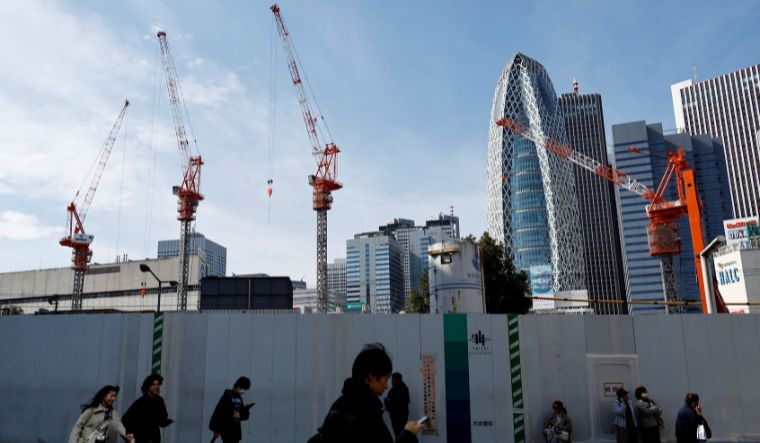
Japan is officially hunting for a backup capital, driven by estimates indicating a seventy percent probability of a magnitude-seven earthquake striking the Tokyo metropolitan area within the next thirty years. The newly passed legislation establishes a legal framework to designate an alternative administrative hub that can temporarily assume control if Tokyo’s government offices, parliament, and financial markets are completely paralyzed. Yet behind the urgent warnings of seismic disaster lies a calculated political maneuver involving coalition bargaining, regional favoritism, and bitter battles over national resources.
The strategy aims to solve a structural vulnerability that has terrified risk analysts for decades. Tokyo houses roughly twenty percent of the nation's entire economic output, hosts more than half of all listed corporate headquarters, and contains nearly thirty percent of the population. A direct hit to this hyper-concentrated core would sever communication lines, freeze financial transactions, and halt state machinery instantly. Creating a secondary operational center sounds like common-sense disaster planning. However, examining the mechanics of the law reveals deep fissures within Japan's political establishment.
The Architecture of Overconcentration
For decades, the central government promised to spread administrative weight outward. Those promises repeatedly stalled against the sheer gravity of Tokyo's gravitational pull. Capital flows, talent pools, and media conglomerates cluster tightly around the Kanto plain.
When a nation builds its entire economic engine inside a single seismic hazard zone, risk compounds invisibly until a crisis forces a reckoning.
Government ministries control budgets from Kasumigaseki, while major commercial banks operate yards away from corporate headquarters. If soil liquefaction or structural collapses incapacitate these square miles, the bureaucratic machinery has no parallel track. The new law attempts to fix this structural flaw by establishing statutory authority to relocate key functions during an emergency.
Designating a backup hub requires specific infrastructure benchmarks. Candidate regions must boast robust transport networks, adequate communications bandwidth, and sufficient administrative capacity to run a country remotely. Several prefectures have already thrown their hats into the ring.
The Contenders and the Osaka Factor
Fukuoka, Aichi, and Hokkaido have launched aggressive public bids to host the designation. Each region points to its geographic separation from Tokyo and its existing urban capacity as proof of readiness.
Osaka stands out as the frontrunner, fueled by its status as the nation's second-largest urban economy.
This is where public safety narratives collide with hardball politics. The push for the secondary capital law was a core condition demanded by the Japan Innovation Party during coalition negotiations with Prime Minister Sanae Takaichi’s Liberal Democratic Party. Critics argue the law is tailored specifically to benefit Osaka, serving as a back door to advance regional ambitions disguised as civil protection.
Opposition lawmakers delayed parliamentary proceedings for days, pointing out that rushing a national redundancy framework to satisfy coalition partners creates dangerous governance blind spots. Splitting administrative functions across hundreds of miles during a crisis can cause fatal communication delays. Command confusion during an active emergency introduces catastrophic risks that rival the original disaster itself.
The Illusion of Decentralization
Passing a statute is simpler than moving operational reality. Designing a backup capital requires continuous duplication of digital architecture, secure data pipelines, and physical office space that remains mostly vacant during peacetime. Maintaining redundant systems for rare catastrophic events demands immense public expenditure at a time when national debt ratios remain historically high.
Taxpayers in regional prefectures question whether funding a duplicate administrative center translates to actual economic growth or simply shifts wealth between urban nodes without fixing underlying demographic decline.
Japan's shrinking population means that pouring billions into massive concrete infrastructure outside Tokyo risks creating white elephants if local labor shortages prevent these regions from staffing the newly minted offices. The plan assumes that corporations and civil servants will willingly relocate or maintain dual footprints. Corporate boards remain hesitant to decentralize operations away from the financial networking hubs of the primary metropolis.
The legislative victory has cleared the path, but the hard choices lie ahead. Within twelve months, authorities must draft a basic policy defining exact functional splits, resource allocations, and trigger mechanisms for the backup zone.
The earth beneath Tokyo shifts continuously, and the political ground underneath the ruling coalition is fracturing just as fast.