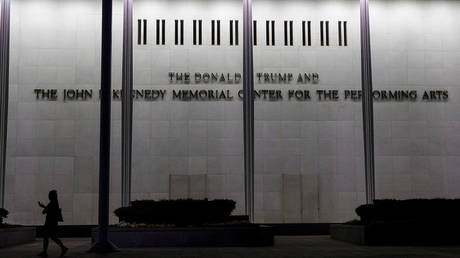
Months after a federal judge ordered Donald Trump's name stripped from the facade of the John F. Kennedy Center for the Performing Arts, the institution’s handpicked board of trustees has voted to put it right back up.
The board approved a resolution to append an inscription beneath the building’s primary title reading, "Restored and Renovated by President Donald J. Trump," alongside a plan to designate the surrounding property as "President Donald J. Trump Plaza." This maneuver follows a May ruling by U.S. District Judge Christopher Cooper, who declared that previous attempts to rename the national memorial violated federal statutes and infringed upon congressional authority. Rather than backing down, the leadership loyal to Trump has opted for a granular approach, testing the boundaries of the judiciary through linguistic and architectural technicalities.
To understand the weight of this standoff, one must look past the immediate political theater and examine the mechanics of the institution. Congress established the Kennedy Center as a living presidential memorial, a status that traditionally insulates public monuments from commercial or partisan branding. When Trump assumed the board chairmanship, he initiated a rapid consolidation of institutional power, altering programming, orchestrating leadership shake-ups, and pushing for a two-year closure of the main facility for sweeping structural overhauls.
Critics argue that the latest board vote is a transparent bid to circumvent a direct judicial order. Legal scholars have labeled the maneuver an exercise in legal evasion, noting that substituting a formal name change with a permanent facade inscription achieves the same symbolic objective by alternative means.
The Anatomy of a Boardroom Stand-off
The strategy relies on a distinction between renaming an institution outright and adding descriptive text to its architecture. The board’s resolution specifies that the primary title of the center remains intact, satisfying the literal wording of the congressional charter while injecting Trump's name into the physical visual field of every visitor. Furthermore, the resolution ties future additions to financial benchmarks, including a provision for a third line of text if an endowment fund dedicated to Trump reaches one hundred million dollars.
This approach transforms the physical plant of the cultural center into a battleground over administrative jurisdiction. The board defends the move by framing Trump's interventions as a rescue mission for a facility facing fiscal strain, citing his background in real estate development and fundraising as essential assets.
Opponents, including congressional members who sit on the board as ex-officio trustees, view the project as an assault on a bipartisan cultural trust. Litigation is virtually guaranteed to resume, setting the stage for an escalation in federal court where Judge Cooper will likely be asked to determine whether the secondary inscription violates the spirit and letter of his previous injunction.
Shuttering the Venue
Running parallel to the naming dispute is the board's renewed authorization to close the primary performing arts building for up to two years. The closure plan, which was also frozen by judicial intervention earlier in the year, is presented by management as a logistical necessity for comprehensive physical modernization.
Operations are slated to shift temporarily to secondary spaces like the REACH, while major signature events would relocate to external venues. Yet, ticket holders, donors, and resident artistic companies view the extended shutdown with deep skepticism. In an industry where continuity defines institutional survival, a multi-year blackout threatens to sever audience relationships that took decades to build.
The institutional friction highlights a broader ideological conflict over how public-private cultural flagships should be governed. When executive authority clashes with statutory mandates, the fallout extends far beyond Washington real estate. The future of the Kennedy Center now depends entirely on whether judicial oversight can successfully check an aggressive board determined to leave an indelible mark on the nation's capital, regardless of the legal cost.