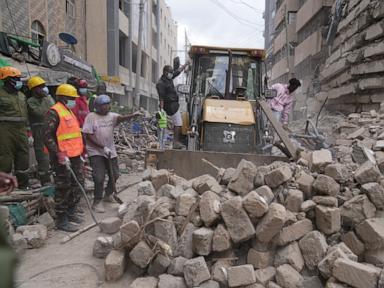
Four survivors pulled alive from shattered concrete on the third day after a building collapse in Kenya represent a rare, agonizing victory amid a systemic urban disaster. While rescue teams fight against the 72-hour survival window and desperate families gather behind police cordons, the real story lies far beneath the dust. These structural failures are rarely freak accidents or acts of nature. They are the predictable outcome of watered-down cement mixtures, bypassed municipal inspections, and an unchecked real estate boom that prioritizes rapid profit over human survival.
When a multi-story residential block pancaked in Nairobi or its rapidly expanding satellite towns, the immediate media focus naturally locks onto the human drama. The cameras capture the grit on the faces of Kenya Defence Forces engineers, the wails of relatives waiting for news, and the miraculous extraction of a survivor trapped in a void beneath a staircase. Yet once the heavy excavators clear the final slabs and the funerals conclude, the public attention evaporates. The underlying machinery that allowed an unsafe structure to rise six, seven, or eight stories high remains completely intact, ready to claim its next victims during the next heavy rainstorm. For a deeper dive into this area, we recommend: this related article.
The Anatomy of a Third-Day Rescue
Surviving seventy-two hours beneath tons of crushed masonry requires an improbable alignment of physics and biology. When a reinforced concrete building fails, it rarely disintegrates into uniform dust. Instead, rigid structural elements—such as load-bearing beams, door frames, and concrete stairwells—often snap and lean against one another, creating small triangular pockets of air known in urban search and rescue as void spaces.
Trapped victims inside these pockets face three immediate threats. Crush syndrome occurs when heavy debris compresses limbs for hours, trapping toxins in muscle tissue that can flood the kidneys and stop the heart the moment the weight is lifted. Dehydration sets in rapidly, especially when dust clogs the airways and ambient temperatures rise inside unventilated cavities. Finally, psychological panic accelerates oxygen consumption, turning a survivable pocket of air into a lethal trap within hours. For broader background on this topic, in-depth reporting can also be found on NPR.
Rescue operations in Kenya face severe logistical hurdles during this critical window. Heavy lifting cranes and acoustic listening devices are often delayed by gridlocked urban traffic and narrow, unpaved access roads built without emergency corridors in mind. By the third day, hope among waiting families usually curdles into quiet grief, making the sudden emergence of four living people both a triumph of human endurance and a stark indictment of how long it takes specialized equipment to reach the disaster zone.
Why Kenyan Buildings Keep Falling Down
To understand why structural collapses happen with grim regularity across Nairobi, Kiambu, Machakos, and Kisumu, you have to follow the money from the raw quarry to the final coat of paint. Kenya’s urban population has surged for decades, creating an insatiable demand for affordable housing. In working-class neighborhoods like Huruma, Pipeline, Kahawa West, and Ruaka, landowners face immense financial pressure to maximize every square meter of dirt.
The Mathematics of Corner-Cutting
In legitimate civil engineering, building a six-story apartment block requires deep foundation pilings, high-grade structural steel, and strict adherence to concrete curing times. Concrete does not reach its designed compressive strength overnight. Standard engineering protocols require contractors to let a newly poured floor slab cure for at least twenty-one to twenty-eight days before removing the wooden formwork and loading the weight of the next story on top of it.
Rogue developers treat those twenty-eight days as lost rental income. It is common practice on unmonitored sites to strip the supports after just seven days, pouring the next floor onto green, weakened concrete. Over several months, the cumulative weight of the upper floors exceeds the load-bearing capacity of the lower columns.
Material substitution compounds this structural weakness. Investigators combing through the rubble of collapsed Kenyan buildings repeatedly find the exact same forensic signatures:
- Substandard rebar: Developers frequently swap high-yield ribbed steel bars for cheaper, thinner twisted bars that lack the tensile strength to hold concrete together under stress.
- Diluted concrete ratios: Instead of the standard structural mix of cement, sand, and aggregate, unscrupulous foremen increase the proportion of river sand or quarry dust to stretch expensive bags of cement.
- Unapproved vertical extensions: A building originally engineered and approved for three stories often has four additional floors tacked onto the roof years later without reinforcing the ground-level foundations.
The Wet-Weather Trigger
Many collapses occur during or immediately after Kenya’s long and short rainy seasons. Rainwater does not knock down a sound building, but it acts as a ruthless auditor for a flawed one. Poorly drained construction sites allow water to pool around shallow foundations, eroding the soil beneath load-bearing footings.
At the same time, porous, low-grade concrete absorbs moisture like a sponge. This water saturation adds immense dead weight to upper floor slabs while corroding internal steel reinforcements. When the soil softens beneath an overloaded column, the building shifts by a fraction of an inch. In a brittle structure lacking proper steel ductility, that tiny shift triggers a catastrophic chain reaction, causing floor after floor to pancake straight down onto the ground.
The Regulatory Illusion and Enforcement Failure
On paper, Kenya possesses a comprehensive legal framework designed to prevent architectural disasters. The National Construction Authority (NCA), established to regulate and streamline the construction industry, requires every legitimate project to undergo rigorous vetting. Developers must submit architectural drawings, structural engineering calculations, and environmental impact assessments before breaking ground.
The breakdown happens between the approval desk and the active construction site. Corruption at the county and municipal levels allows developers to bypass the entire regulatory apparatus for the right price. A site flagged with a red "Stop Work" notice by an NCA inspector on a Tuesday afternoon frequently resumes pouring concrete by Wednesday morning after bribes change hands or political pressure is applied from above.
Furthermore, a massive loophole exists in how structural designs are executed. A developer may hire a licensed, reputable structural engineer to stamp the official blueprints required to obtain a county building permit. Once the permit is issued, the developer fires the qualified engineer to save on consultancy fees and hands the blueprints over to an unlicensed local artisan, known locally as a fundi, who alters column spacing and steel specifications on the fly.
The Audit Paradox
Following major collapses—such as the 2016 Huruma tragedy that killed more than fifty people, or subsequent disasters in Kiambu County—the Kenyan government routinely orders sweeping multi-agency audits of urban buildings. Inspectors fan out across dense neighborhoods, painting giant red Xs on hundreds of structures deemed unfit for human habitation.
Yet these crackdowns rarely yield lasting structural reform. Tenants living in condemned buildings often refuse to evacuate because they cannot afford higher rents elsewhere, and the state offers no temporary housing safety net. Landlords quietly paint over the red Xs at night, secure court injunctions that stall demolition orders for years, and continue collecting monthly rent from low-income families who have nowhere else to go.
The Counter-Argument Nobody Wants to Hear
Blaming greedy developers and corrupt county inspectors is easy, accurate, and completely insufficient. A hard look at Kenya’s urban housing market reveals an uncomfortable economic reality that complicates simple enforcement solutions.
Nairobi faces an annual housing deficit running into the hundreds of thousands of units. Formal, fully compliant real estate developments—built by Tier-1 contractors using certified materials, insured engineers, and legal financing—cost far too much for the average Kenyan wage earner. When strict enforcement shuts down informal construction without providing a viable, low-cost alternative, it chokes off the only housing supply that working-class families can actually afford.
This creates a silent, tragic collusion between landlord and tenant. Renters moving into a newly built, suspiciously cheap apartment block often notice the hairline cracks in the plaster, the uneven stairs, or the damp walls. They choose to ignore the warning signs because the rent fits their budget and the location is close to their jobs. Strict building codes cannot function in a vacuum when market economics punish compliance and reward shortcuts.
What Real Accountability Actually Requires
Prosecuting a single site foreman after four people are pulled from the rubble does nothing to stop the next collapse. High-profile arrests immediately following a disaster almost always stall in the Kenyan court system, bogged down by missing files, transferred magistrates, and endless procedural delays. Very few developers or county officials have ever served serious prison time for negligent construction deaths.
Breaking this cycle requires dismantling the financial incentives that make deadly construction profitable:
- Mandatory Structural Liability Insurance: Before any multi-story building can be occupied, developers should be legally required to purchase decennial liability insurance. Private insurance underwriters—not underpaid municipal clerks—would then conduct independent, ruthless inspections of the concrete strength and steel reinforcement, because the insurer bears the financial risk if the building fails.
- Asset Seizure Over Fines: Cash fines are simply factored into the cost of doing business by rogue developers. When an unapproved building collapses, the state must automatically seize the underlying land and freeze the personal assets of the directors behind the holding company to compensate victims and fund rescue operations.
- Digital Supply Chain Tracking: Cement and structural steel manufacturers in Kenya operate in a concentrated market. Implementing mandatory QR-code batch tracking on high-grade structural steel and bulk cement would allow forensic investigators—and prospective tenants—to verify whether a site actually purchased the materials specified in its engineering blueprints.
- Criminal Liability for Permit Sign-Offs: Every county engineer and NCA inspector who signs off on a building’s occupancy certificate must have their name permanently attached to that structure in a public digital registry. If the building fails due to code violations present at the time of inspection, the sign-off official faces automatic suspension and criminal negligence charges.
Until the financial cost of bribing an inspector and diluting concrete exceeds the profit of rushing an unsafe building to market, rescue workers will keep digging through the dust on the third day, praying to find pockets of air where there should have been solid ground.