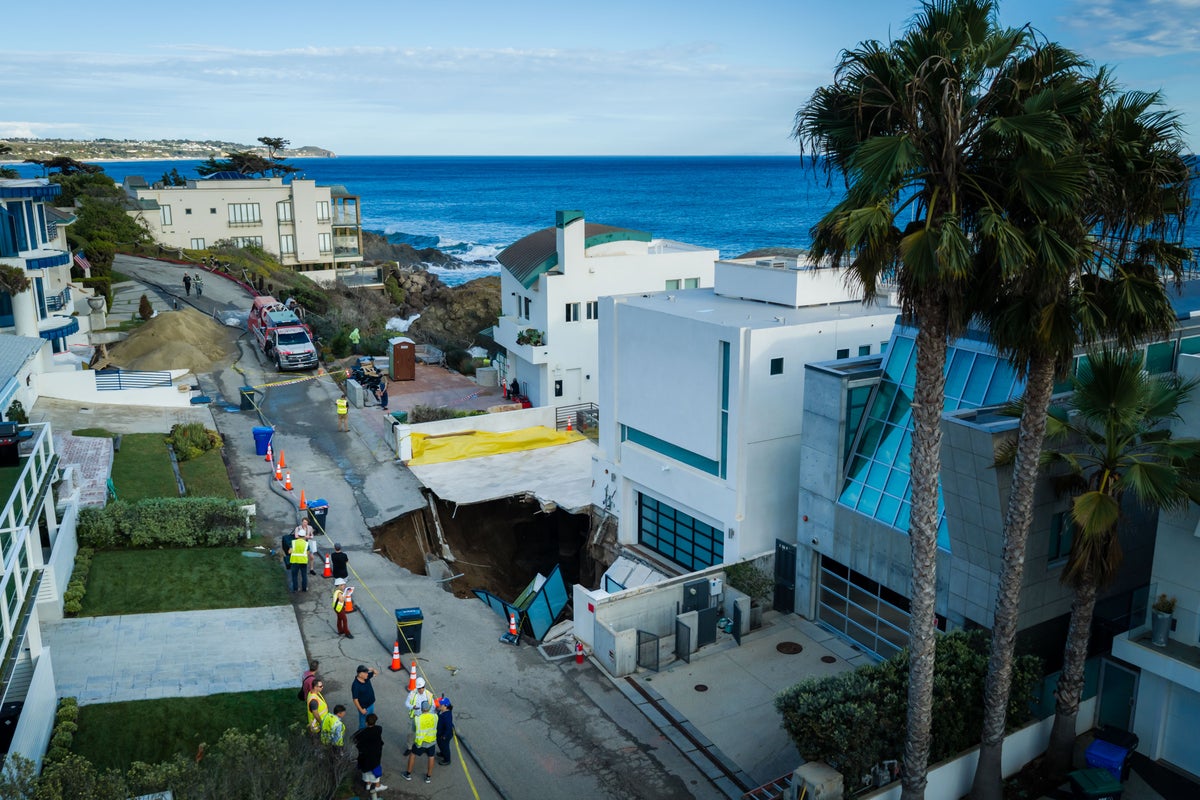
A thirty-foot crater yawned open on Sea Level Drive in Malibu, swallowing asphalt, a portable toilet, sections of privacy fencing, and a natural gas main. The property line belongs to actor Nicolas Cage, who acquired the four-story beachfront estate for ten and a half million dollars. Yet framing this event purely as a celebrity misfortune misses the structural reality of the California coastline. This collapse is a symptom of a larger, systemic vulnerability affecting high-end real estate built directly on shifting marine margins.
Emergency crews arrived before dawn following reports of a gas leak triggered by the structural failure. The Los Angeles County Fire Department found that the driveway of the four-thousand-square-foot contemporary residence had completely sheared away, leaving concrete slabs suspended over empty air and rushing ocean water. The city of Malibu subsequently red-tagged multiple homes on the street, barring entry because compromised roadways rendered emergency apparatus access impossible.
The immediate catalyst was heavy surf and coastal flooding driven by offshore storm systems, including the remnants of tropical weather churning up the Pacific. These high-energy swells batter the pilings and subterranean foundations of structures wedged tightly between the Pacific Coast Highway and the high-tide line. When waves scour the sand and undermine structural footings, subterranean cavities form out of sight. Eventually, the weight of a concrete driveway or retaining wall exceeds the load-bearing capacity of the hollowed earth below, resulting in sudden catastrophic failure.
Engineering homes on the Malibu shore requires managing an inherently hostile environment. Saltwater intrusion corrodes subterranean steel reinforcement within concrete foundations, weakening support systems over decades. Wave action continuously pulls sediment away from the base of sea walls and pilings, a process accelerated by rising sea levels and intense seasonal weather swings. Property owners often rely on hard engineering solutions like seawalls and riprap, which frequently exacerbate erosion on adjacent properties by deflecting wave energy sideways rather than absorbing it.
Real estate markets along the Pacific rim have historically treated such vulnerabilities as negligible risks compared to the prestige of direct ocean access. Million-dollar valuations routinely ignore the shifting geological timeline of sandy bluffs and barrier beaches. When a driveway collapses or a gas line fractures, the response is typically treated as an isolated municipal emergency rather than an indicator of permanent environmental limits. Utility companies shut off gas and water lines, municipal inspectors issue red tags, and contractors arrive with heavy equipment to pour more concrete into the void.
Fixing the surface damage does nothing to alter the underlying mechanics of coastal retreat. Each cycle of high surf and storm surge further destabilizes the subterranean geography of narrow residential enclaves. As infrastructure ages and storm intensities increase, the margin for error narrows significantly for properties perched at the edge of the continent. The crater on Sea Level Drive is not an anomaly. It is a preview of the physical limits facing luxury real estate when geography reclaims what was built upon it.