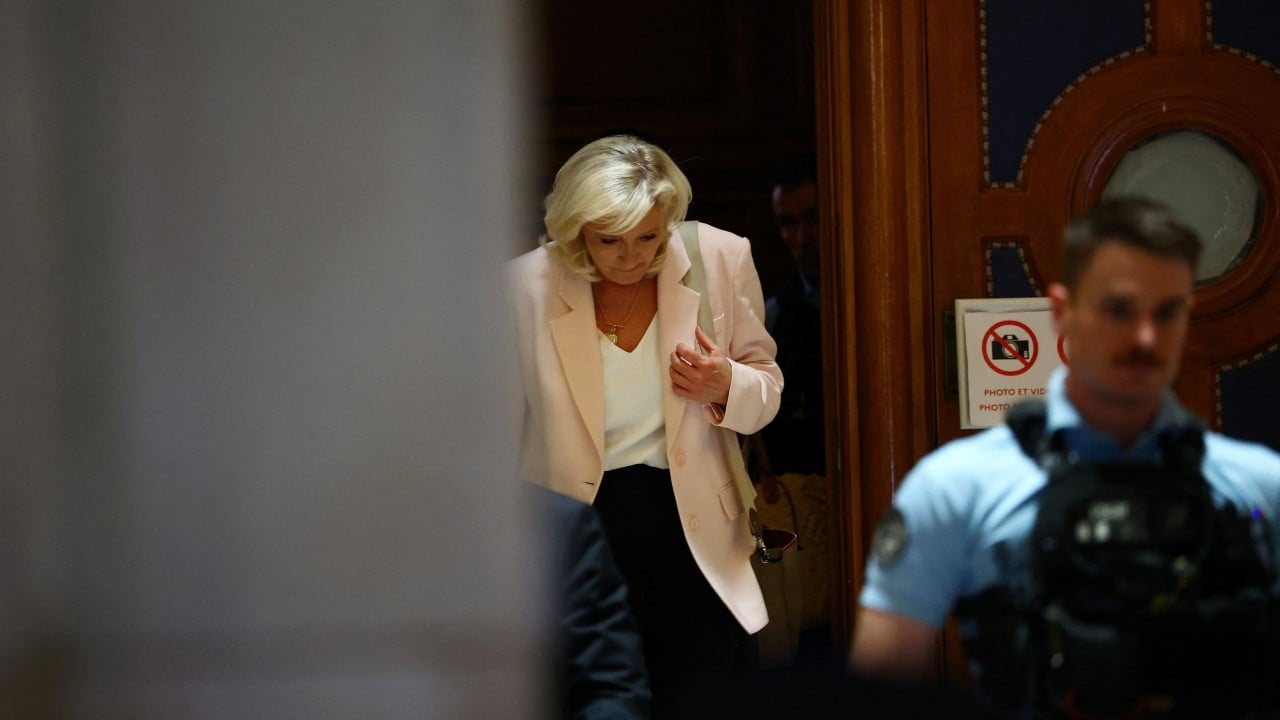
Marine Le Pen is officially eligible to run for the French presidency in 2027, but a Paris appeals court has handed her a golden ticket wrapped in barbed wire. By reducing her initial five-year ban from public office to a net fifteen months, which she has already served since her initial March 2025 conviction, the judiciary technically cleared her path to power. Yet, the court simultaneously ordered her to spend a year under house arrest wearing an electronic ankle monitor for embezzling European Parliament funds. This leaves the nationalist leader facing an agonizing choice between an unprecedented, legally restricted campaign or surrendering her lifelong ambition to her young protégé, Jordan Bardella.
The ruling exposes a profound structural friction between French judicial independence and democratic choice. For decades, the National Rally has operated on a foundational narrative of martyrdom, casting every legal challenge as an attempt by the Parisian establishment to disenfranchise millions of working-class voters. This latest verdict disrupts that script entirely. By refusing to outright disqualify her from the ballot box, the court stripped Le Pen of her ultimate victimhood status, forcing her to confront the logistical and psychological reality of campaigning as a convicted felon in a tracking bracelet.
The Judicial Highwire Act That Reopened the Ballot Box
To understand the volatile reality gripping French politics, one must examine the mechanics of the Paris Court of Appeal's decision. In March 2025, a lower court hit Le Pen with a devastating blow: a four-year prison sentence and an immediate five-year ban on holding public office. That initial ruling effectively killed her 2027 presidential ambitions on the spot, triggering a high-stakes appeal that culminated in this week's extraordinary compromise.
The appeals judges chose a path that attempted to balance institutional integrity with democratic stability. They upheld her underlying guilt in the fake-jobs scam, confirming that she orchestrated a system to divert over four million euros of European taxpayer money to fund domestic party workers. But when it came to the punishment, the court explicitly noted that the freedom of choice for voters must remain a consideration in a democracy.
The court reduced her sentence to three years in prison, with two years suspended. The remaining year will be served under house arrest with an electronic monitoring device. More importantly for her political survival, her ban from public office was cut to 45 months, with 30 months suspended. Because the clock started ticking back in March 2025, those fifteen mandatory months of ineligibility have already elapsed. On paper, she is free to enter the race.
This calculated reduction places the ball squarely in Le Pen's court. Her legal team expressed partial satisfaction with the structural opening of the ballot, but the physical reality of the ankle tag presents a profound strategic crisis.
Why an Ankle Bracelet Is a Campaign Killer
Le Pen has spent days signaling that a campaign under electronic surveillance is a functional impossibility. Her public reticence is not mere posturing; it reflects the brutal realities of modern French electoral politics.
A presidential campaign in France is an exhausting, hyper-mobile marathon. Candidates crisscross the country, hopping from agricultural fairs in rural regions to late-night town halls in volatile industrial suburbs. They must react instantly to breaking news, shifting schedules on a whim to appear at the scene of a factory closure or an unexpected crisis.
An electronic tracking tag shatters this operational flexibility. Under standard French house arrest procedures, a convicted individual must meet with a sentencing judge who establishes a strict, rigid schedule. The judge dictates exactly what time the individual can leave their residence and the precise minute they must cross their threshold in the evening.
Imagine a frontrunner for the presidency having to cut a crucial live television debate short because her judicial curfew expires at 9:30 PM. Imagine her campaign team needing to file formal legal petitions weeks in advance just to request permission for an overnight campaign stop in Marseille or Lyon. The entire apparatus of her campaign would be subservient to the calendar of a state magistrate.
Beyond the logistical nightmare lies the symbolic damage. The National Rally has spent a decade rebranding itself from an extremist fringe movement into a respectable party of government, a process known in France as dédiabolisation. It is incredibly difficult to project the quiet dignity of a head of state when you are visibly wearing the apparatus of a convicted criminal. Every photograph, every handshake on the trail, and every television close-up would be viewed through the prism of that black plastic band around her ankle.
The Jordan Bardella Shadow Over the National Rally
If Le Pen decides the restrictions are too humiliating or restrictive to bear, the party has an immediate alternative waiting in the wings. Jordan Bardella, the 30-year-old party president, represents a completely different political generation.
Bardella carries none of the historic baggage associated with the Le Pen family name. Raised in a public housing project in the Seine-Saint-Denis department, he offers an appealing biography that resonates deeply with younger, disillusioned voters and the working class alike. He is polished, highly online, and unburdened by the financial scandals that have dogged his mentor for decades.
Yet, a Bardella candidacy introduces its own set of structural vulnerabilities for the right-wing opposition. The National Rally remains, at its core, a highly centralized organization built around familial loyalty and the personal authority of Marine Le Pen. While Bardella is immensely popular among the rank-and-file, his authority is derived entirely from her endorsement.
Should Le Pen step aside, it would trigger a subtle but dangerous shift in the party's internal balance. Hardline factions who tolerated the modernization strategy out of loyalty to Le Pen might find it easier to challenge a younger leader. Furthermore, a sudden transition could expose Bardella to intense scrutiny from a hostile media and centrist opponents who have spent years preparing to fight Le Pen, not her young protege.
A Fractured Political Horizon and the Economic Storm
The timing of this judicial thunderbolt could not be more challenging for the French political establishment. The country is navigating a deeply fractured legislative environment, with a parliament split into three mutually hostile blocs and a government that constantly faces the threat of collapse via no-confidence votes.
Centrist and left-wing politicians have wasted no time weaponizing the verdict. Left-wing lawmakers have argued publicly that the mere fact that a presidential candidate might campaign in an electronic tag proves how normalized political corruption has become in the country. They view the ruling not as a compromise, but as an indictment of a political culture that allows elite actors to escape the full weight of criminal consequences.
The broader political landscape beyond the National Rally is highly volatile:
- The Centrist Fragment: Emmanuel Macron’s allies, including former Prime Minister Gabriel Attal, are desperate to find a unifying figure to retain the presidency but remain deeply divided.
- The Traditional Conservative Right: Figures like Bruno Retailleau are attempting to claw back law-and-order voters from the National Rally by taking an aggressive stance on institutional integrity.
- The Radical Left: Jean-Luc Mélenchon has already staked his claim, intending to use the economic anxiety of voters to bypass the corruption narratives altogether.
While these factions bicker over the legal ethics of Le Pen's tag, France is facing a severe fiscal crunch. The national deficit has ballooned, forcing unpopular budget cuts and threatening the country's credit rating on international markets. History shows that when voters face severe economic anxiety, their interest in the abstract legal ethics of political funding scandals tends to diminish. They care far more about purchasing power, pensions, and public services than they do about an embezzlement case involving European Union funds from a decade ago.
The Final Decision Restoring or Ending an Era
Le Pen now faces the most defining moment of her political life. She can choose to lodge a final appeal with the Court of Cassation, France's highest judicial body. This move would delay the implementation of the electronic tag sentence, but it would also mean entering the 2027 election cycle with a definitive, unalterable criminal status hanging over her head if that final appeal fails.
Alternatively, she can accept the tag, endure the logistical nightmare, and attempt to transform the restriction into a bizarre badge of honor, telling voters that the state had to physically bind her to keep her from defending them.
The most realistic path forward is one of managed succession. By positioning herself as the kingmaker rather than the candidate, Le Pen could protect her legacy, avoid the personal humiliation of a monitored campaign, and throw the full weight of her political machinery behind Bardella. Whichever path she chooses, the French judiciary has successfully altered the trajectory of the next presidency, proving that in Paris, the scales of justice still have the power to reshape the halls of power.