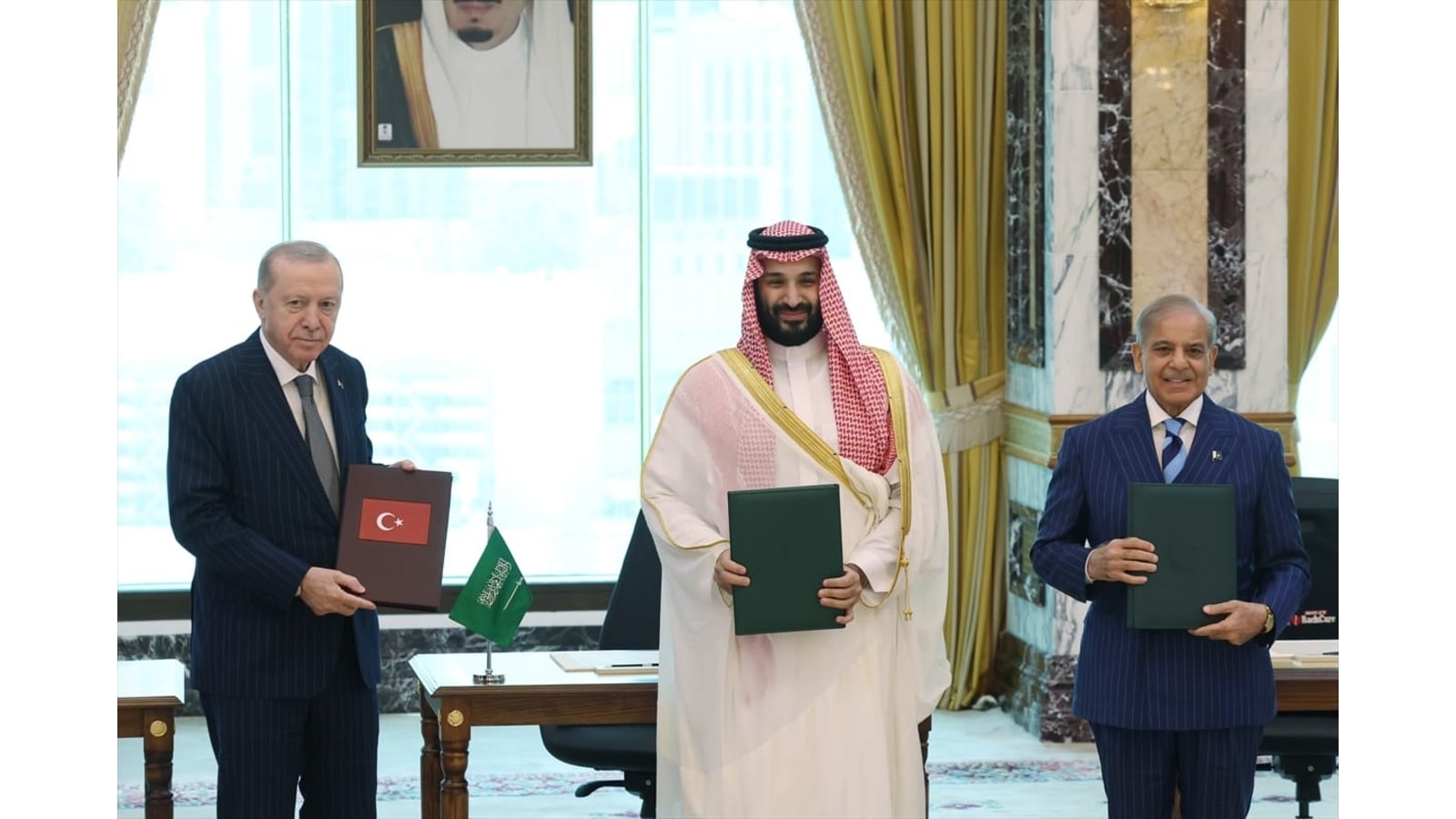
The Mecca defence agreement operates as a trilateral collective security pact between Saudi Arabia, Turkey, and Pakistan that treats an external armed attack against any member as an attack on all three, while leaning on defense-industrial cooperation, intelligence sharing, and a newly established secretariat rather than a unified NATO-style military command. Signed in Mecca on August 7, 2026, by Crown Prince Mohammed bin Salman, Turkish President Recep Tayyip Erdoğan, and Pakistani Prime Minister Shehbaz Sharif, the treaty formally entered into force on November 14, 2026, once all three capitals completed ratification.
Anyone who has covered Middle Eastern security architecture for twenty years knows how easily grand declarations evaporate in the desert heat. Riyadh has announced plenty of coalitions that looked impressive on television and stalled in committee. This one is different—not because its drafting is airtight, but because the regional shock that birthed it left Gulf capitals feeling dangerously exposed during the 2026 Iran war. Also making news in related news: What Happens When the Door to Home Closes in a Foreign Terminal.
Why Three Uneasy Partners Met in Mecca
Treaties rarely get signed in sacred cities out of pure sentiment. They get signed when fear outpaces diplomacy.
By the summer of 2026, war involving Iran had turned Gulf security from a theoretical Washington talking point into a daily operational crisis. Retaliatory missile and drone barrages hit regional infrastructure, shipping through the Strait of Hormuz faced severe disruption, and Houthi hostilities along Saudi Arabia's southern frontier flared back up. Riyadh needed immediate deterrence and diplomatic breathing room. It already had a bilateral Strategic Mutual Defence Agreement with Pakistan dating back to September 2025, which had been shaped by widening instability involving Iran and Israel alongside Pakistan's tense borders with India and Afghanistan. Adding Turkey folded Ankara's sprawling defense industry and regional reach into the same framework. More details on this are covered by USA Today.
Still, putting those three flags side by side requires ignoring years of sharp friction. Saudi Arabia and Turkey spent much of the past decade on opposite sides of regional politics, from rival sympathies in Egypt and Libya to competing influence in Syria. Pakistan, meanwhile, walks a tightrope between Gulf money, domestic economic strain, and hard security pressures in South Asia.
When capitals that distrust one another's long-term ambitions sign a mutual defense pact, they are usually hedging against immediate threats rather than merging their destinies.
That urgency explains the speed of ratification. Saudi Arabia moved in October 2026, Pakistan ratified on October 23, and Turkey completed its domestic process in November, making the pact operative on November 14. By late October, senior officials from all three states were already traveling together to Tehran in an effort to push de-escalation, showing that the alliance is meant to wield diplomatic leverage alongside military signaling.
How the Mechanics Actually Work on Paper
Strip away the ceremonial language and look at the text's architecture. The agreement contains sixteen articles covering collective defense, military and security cooperation, defense-industrial development, intelligence sharing, logistical support, and institutional coordination.
Article 1 commits the signatories to safeguard one another's sovereignty, independence, territorial integrity, and internationally recognized borders, pledging to use necessary means when those are threatened. Article 2 sets up the core collective defense trigger: an external armed attack against one party counts as an attack against all three, obligating the others to provide immediate assistance within the limits of their available resources and consistent with Article 51 of the UN Charter.
Notice the built-in throttle in that wording. "Within the limits of their available resources" and following an objective assessment of required assistance is not an automatic tripwire that marches brigades across borders at midnight. It gives each capital room to calibrate its response—whether that means air defense munitions, naval escort support, intelligence, diplomatic backing, or direct force.
Command Structure and Early Institutions
A treaty means very little without permanent machinery behind it. Alongside the August signing, the three states created a Strategic Political and Defence Committee and a permanent secretariat to turn broad pledges into routine coordination. At an emergency meeting in Riyadh on October 5, 2026, the partners agreed to begin implementing collective defense commitments right away and named retired Pakistani Lieutenant General Nauman Mahmood as the alliance's first secretary-general for a three-year term.
What the pact lacks so far is a fully integrated military command or a standing joint rapid-reaction force. In real crises, that gap matters. Coalition warfare breaks down not during polite ministerial meetings, but when radar tracks are shared late, rules of engagement conflict, or one government decides a strike crosses a red line its partners never intended to cross.
To picture the difference between a treaty promise and a working command post, consider a hypothetical example involving a sudden cross-border drone and missile swarm aimed at an eastern Saudi energy facility. Under the pact, Riyadh can invoke collective defense and request immediate assistance. Yet unless air-defense tasking, airspace deconfliction, and logistical corridors have been rehearsed in advance, diplomatic solidarity will arrive faster than interceptor batteries.
Money, Weapons, and the Nuclear Question
Every durable security arrangement runs on three currencies: cash, hardware, and credibility. Here, each capital brings a distinct piece to the table.
- Saudi Arabia brings deep financial capacity, strategic geography along the Red Sea and Persian Gulf, and critical energy infrastructure that global markets cannot afford to see paralyzed.
- Turkey brings a battle-tested defense sector—drones, armored systems, naval platforms, and munitions—along with diplomatic ties across the Levant and Eastern Mediterranean.
- Pakistan brings a large, experienced military establishment, defense manufacturing links with Ankara, and nuclear-armed status that inevitably draws intense scrutiny from outside capitals.
Defense analysts have zeroed in on industrial co-production as one of the most realistic near-term payoffs. Turkey and Pakistan already have a track record of defense-technology cooperation, and Saudi capital can help finance joint production lines or accelerate procurement without leaving every requirement dependent on slow Western export approvals.
Does Pakistan Extend a Nuclear Umbrella
Whenever Pakistan signs a defense deal with a wealthy Gulf state, speculation about a nuclear umbrella follows within hours. There is no public evidence that Islamabad has extended nuclear deterrence to Saudi Arabia or Turkey under the Mecca agreement, and Saudi officials have stated that the pact is not tied to the kingdom's nuclear ambitions.
Even if someone wanted to imply otherwise, extended nuclear deterrence is far harder to pull off than a press release suggests. Credible nuclear guarantees require tight doctrine, unambiguous signaling, and deep alignment on what constitutes an existential threat—conditions that do not exist in a loose trilateral arrangement built around conventional security and regional crisis management.
Fault Lines That Could Fracture the Pact
Good journalism looks past the handshake photo and asks what happens when interests collide. The Mecca defence agreement faces serious strain on at least three fronts.
First, threat perceptions are not identical. Turkish officials have increasingly treated Israel as a major regional security rival, particularly amid friction over Syria, whereas Saudi Arabia's sharpest immediate security headaches have centered on Iran and Houthi attacks. If a crisis erupts where one member views an adversary as an existential danger and another wants a quiet off-ramp, Article 2's language about assessing assistance "within the limits of their available resources" will get stretched thin.
Second, domestic politics carry real weight. When Turkey's parliament moved toward approving the pact, opposition lawmakers warned it could pull Turkish troops into foreign conflicts they had no appetite to fight. In Pakistan, governments face constant fiscal pressure and security demands closer to home, limiting how much bandwidth or force projection Islamabad can spare for prolonged Gulf contingencies.
Third, expansion talks could complicate cohesion before the secretariat even finds its footing. Turkish leaders have floated the idea that the alliance could welcome other regional states—including Egypt—once institutional groundwork is settled. Syria has also surfaced in reporting around potential participation. Yet bringing in Egypt involves delicate diplomatic hurdles, including Cairo's 1979 peace treaty with Israel and its own maritime and regional agreements, alongside the question of whether adding more members strengthens deterrence or slows decision-making to a crawl.
| Dimension | Strategic Strength | Core Vulnerability |
|---|---|---|
| Collective Defense Clause | Signals shared deterrence and creates political weight during regional crises. | Assistance depends on resource limits and assessment rather than automatic intervention. |
| Command & Institutions | Secretariat and joint committee give the pact a formal home. | Lacks an integrated military command for fast, combined operations. |
| Defense Industry & Finance | Combines Saudi funding with Turkish and Pakistani defense-industrial ties. | Joint projects take years to scale and face competing national priorities. |
| Geopolitical Alignment | Bridges Gulf, Anatolian, and South Asian diplomatic channels in crises. | Divergent views on regional rivals like Israel and Iran can test unity. |
Watch the secretariat's day-to-day work in Riyadh and Ankara rather than the speeches in Mecca—because a defense pact only becomes real the first time a member's territory is hit and the other two have to decide what their signature actually costs.