The razor-thin margin separating leftist challenger Roberto Sánchez and conservative perennial candidate Keiko Fujimori in Peru's presidential runoff is not a sign of a vibrant democracy. It is the death rattle of a broken political architecture. With more than 94 percent of the ballots processed by the national electoral authority, ONPE, Sánchez holds a fractional lead of just a few thousand votes over Fujimori. This dead heat ensures weeks of bruising legal challenges before an official winner is declared. Yet, the real story in Lima and across the Andean highlands is not who scratches out a victory, but the profound rejection of the entire political class by an exhausted electorate.
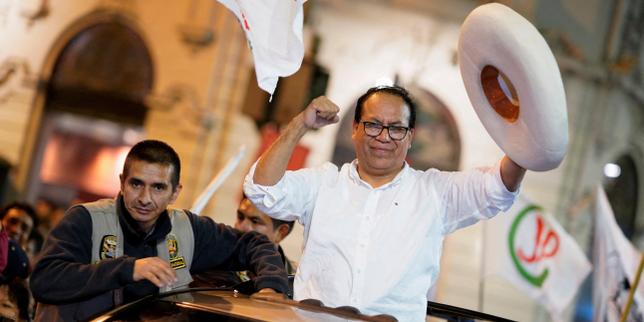
This election pits two deeply polarizing forces against each other, ensuring that whoever takes the oath of office on July 28 will become Peru's ninth president in a mere ten years. Fujimori, representing the conservative Fuerza Popular, carries the heavy baggage of her late father Alberto Fujimori's authoritarian 1990s regime, alongside her own history of narrow runoff defeats in 2011, 2016, and 2021. Sánchez, a congressman and former minister for the imprisoned ex-president Pedro Castillo, has actively courted Castillo's rural base, even donning the iconic wide-brimmed peasant hat on the campaign trail.
Beneath the surface of this tactical battle lies a far more volatile reality. In the first round of voting in April, which featured a bewildering field of 34 candidates on a ballot larger than a family-size pizza box, neither Fujimori nor Sánchez managed to secure even 20 percent of the vote. In fact, if blank and spoiled ballots had been counted as a unified political party, they would have won the first round comfortably with over three million votes. Peruvians are not voting for vision; they are voting out of fear of the alternative.
The Mirage of the Moderate Shift
To understand how Roberto Sánchez closed the gap on Fujimori, one must look at his tactical retreat from hard-left orthodoxy during the final weeks of the campaign. Originally, Sánchez sent shockwaves through Lima's financial districts by threatening to remove Julio Velarde, the legendary president of the Central Reserve Bank who has anchored Peru's macroeconomic stability for two decades.
Sánchez quickly realized that economic panic would alienate the urban middle class. He pivoted, walking back the threat against Velarde and bringing in Pedro Francke, a moderate economist with World Bank credentials, as his prospective finance minister. He explicitly promised international investors that his administration would not nationalize transnational mining or gas assets.
This moderation, however, is a thin veneer. While Sánchez softened his language in Lima to soothe the markets, his core platform remains fundamentally disruptive. He continues to demand a constituent assembly to shred the 1993 business-friendly constitution implemented under Alberto Fujimori. He advocates for a massive expansion of the state's role in the mining sector, a terrifying prospect for international mining conglomerates in the world's third-largest copper producer.
The Ghosts of Jailed Presidents
The shadow of the prison cell hangs over both campaigns, rendering the candidates' anti-corruption rhetoric entirely hollow to the average voter. Sánchez has repeatedly framed Pedro Castillo—who was impeached and jailed after a botched attempt to dissolve Congress and rule by decree in December 2022—as the victim of a congressional coup. Sánchez has openly pledged to pardon Castillo if elected. For rural and indigenous voters in the southern Andes, this is a powerful message of vindication against a Lima-centric elite. For urban Peruvians, it looks like a threat to the rule of law, especially given that Castillo's chaotic 16-month tenure was defined by over 70 cabinet changes and extensive bribery investigations.
Sánchez himself is running against the clock. He is currently battling serious allegations that he diverted approximately $80,000 of party finances into personal and family bank accounts. A definitive victory would grant him presidential immunity, effectively freezing the legal proceedings.
Fujimori offers no clean alternative. Her career has been defined by a relentless effort to rehabilitate the legacy of her father's regime while fighting off her own long-running corruption investigations tied to the Brazilian construction giant Odebrecht. During the sole presidential debate, she explicitly praised her father's iron-fisted tactics against the Shining Path guerrilla movement, promising a similar hardline approach to combat the country's current surge in extortion and violent crime. Her platform relies on the militarization of borders and forcing prisoners to work to repay society.
A Fragile Peace for Global Markets
Regardless of whether Sánchez holds his microscopic lead or Fujimori overtakes him as international and disputed ballots are tallied, global commodities markets are bracing for extended volatility. The immediate aftermath of this election will not be a transition of power, but a grueling war of attrition conducted by legions of lawyers checking every single tally sheet. Both parties have deployed thousands of legal observers to polling stations across the country, preparing to challenge any ballot that tilts the scale.
The institutional framework designed to handle this friction is already buckling. The process is painfully slow because electoral laws require every physical tally sheet from remote Andean villages and 63 foreign countries to be transported to regional offices and eventually to Lima for verification. The sheer exhaustion of the system was laid bare when the chief of the electoral authority resigned after the chaotic first-round tally took over a month to finalize.
If there is any comfort for international observers, it lies in the pragmatic realities of Peruvian trade. Neither candidate can afford to alienate China, which remains the primary destination for Peru's copper wealth and a massive investor in coastal infrastructure, including the mega-port of Chancay. Both Sánchez and Fujimori view Peru as a strategic Pacific logistics hub, meaning a complete isolationist turn is highly unlikely.
The incoming executive will also face a completely reorganized legislative branch. Peru is transitioning to a bicameral Congress with two chambers instead of one, a structural change intended to act as a brake on radical executive power. Fujimori's Fuerza Popular secured a significant presence in both chambers during the April vote, meaning a Sánchez presidency would be instantly gridlocked. Conversely, if Fujimori secures the presidency, she will face fierce resistance from a mobilized rural population that views her family name with visceral hostility.
The tragedy of modern Peru is that the democratic process has ceased to offer solutions. It has merely become a mechanism for alternating between different flavors of systemic instability, leaving a nation of 27 million registered voters stuck in a permanent holding pattern while the institutions around them slowly dissolve.