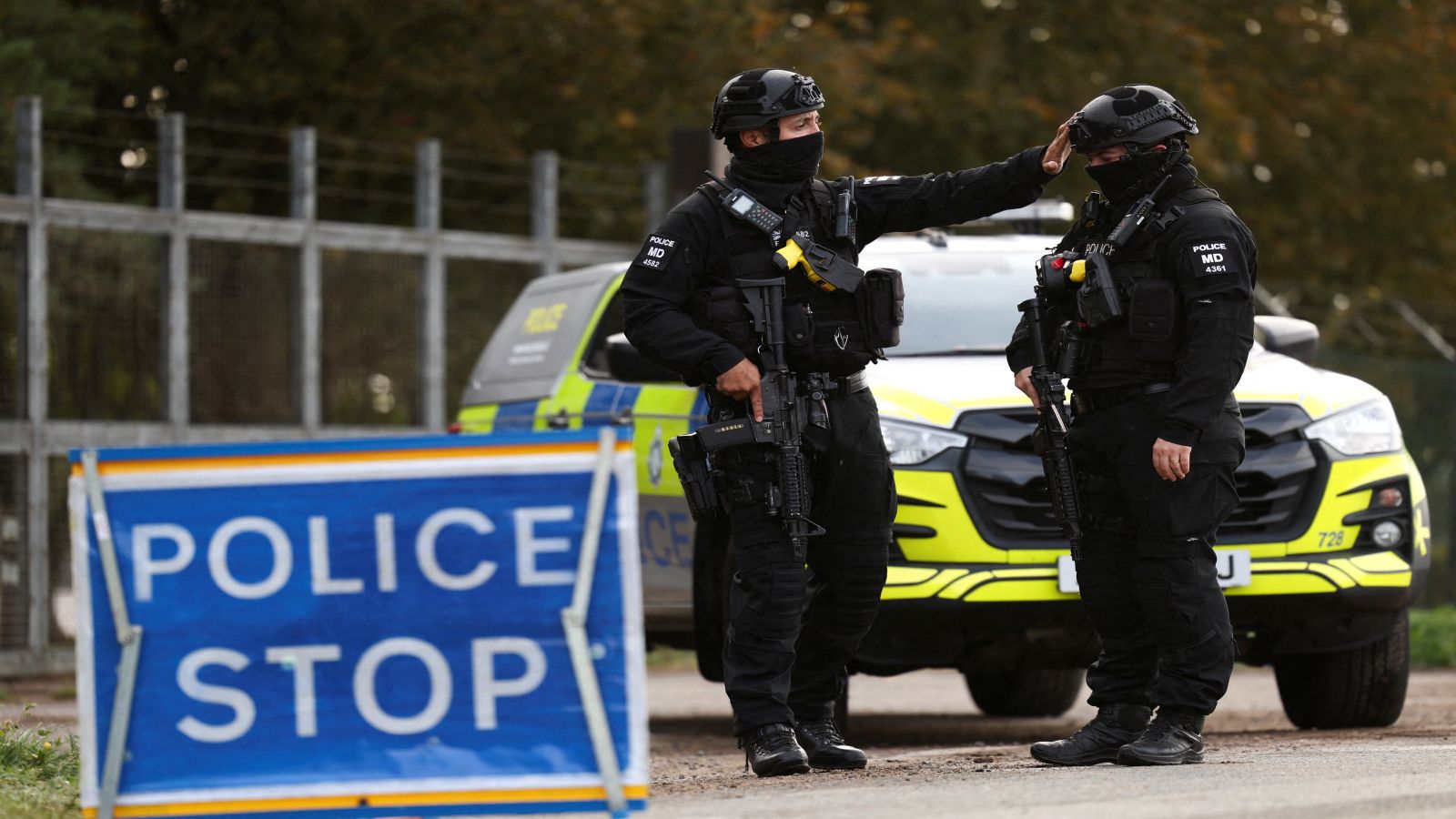
The late-night approach of three white vans toward the perimeter of RAF Fairford in Gloucestershire shattered any remaining illusion that modern European military infrastructure sits beyond the reach of foreign-backed sabotage. When British counter-terrorism police and bomb disposal teams swarmed the rural base on September 27, they did not merely intercept a localized security scare. They uncovered the physical footprint of an international conspiracy directly tied to Iran’s Islamic Revolutionary Guard Corps and its regional proxies, exposing profound vulnerabilities in how allied nations protect forward-deployed strategic airpower.
The primary security threat materialized when local residents were ordered to stay indoors while armed units cordoned off the area around the airfield. RAF Fairford is not an ordinary facility. As a premier European operating location for United States Air Force strategic bombers—including the heavy iron used in long-range deterrence and overseas strike campaigns—the base functions as a vital anchor for Western power projection. When intelligence indicators flashed red, warning that operatives were organizing an explosives attack against the installation, the response was swift and uncompromising. British authorities detained multiple suspects under the Terrorism Act, while the U.S. Air Force elected to pull its Rockwell B-1B Lancer strategic bombers out of the United Kingdom entirely, flying them back to domestic American soil.
Decades of counter-terrorism work across Europe have shown that state-backed intelligence agencies rarely rely on classic, uniformed operatives for high-risk operations on foreign soil. Instead, they build horizontal, fragmented networks utilizing local proxies, criminal underbellies, and ideologically or financially motivated fixers. In the Fairford investigation, British prosecutors charged individuals under the National Security Act, detailing how local actors were allegedly recruited to assist foreign intelligence services.
The operational reality of these networks is messy. Standard operating procedure for modern state-directed sabotage involves compartmentalization. The individuals casing a perimeter or transporting suspicious materials often have no direct line to the foreign handlers issuing orders from thousands of miles away. They communicate through encrypted applications, handling small amounts of cash or digital currency, completely unaware of—or indifferent to—the strategic geopolitical shockwaves their actions are engineered to cause. Subsequent indictments unsealed by the U.S. Department of Justice regarding the broader network behind these plots confirmed that mid-level coordinators linked to militia groups like Kata'ib Hezbollah and the IRGC were orchestrating cells across multiple Western jurisdictions, treating British military real estate as an accessible chessboard.
For military analysts, the incident at Fairford highlights an uncomfortable truth about open democracies. Strategic bases require expansive perimeters, civilian workforces, and complex supply chains that inherently clash with fortress-style isolation. You cannot easily hermetically seal an airfield that relies on hundreds of civilian contractors, local logistics firms, and open rural roadways. When hostile actors choose to exploit these seams, the defense relies heavily on human intelligence and preemptive electronic surveillance rather than physical barbed wire alone.
The fallout extended rapidly beyond Gloucestershire. Weeks after the initial Fairford sweep, intelligence assessments of ongoing threats prompted additional movements of high-value U.S. military assets at other British installations, including RAF Mildenhall. Tankers and transport aircraft were hastily redistributed to alternative European hubs in Spain, Germany, and Scotland. This tactical dispersal demonstrates a sobering military calculation: fixed bases are increasingly viewed as vulnerable sitting ducks in an era where state-backed asymmetric warfare blurs the line between peacetime and active conflict.
Diplomatically, the fallout triggered immediate British sanctions against Iranian networks and fiery exchanges at the United Nations, even as official diplomatic channels in London rejected involvement. Yet the diplomatic denials matter very little compared to the operational adjustments now underway within Western defense circles. The shadow war has migrated from cyberspace and maritime choke points directly onto the asphalt roads of rural England, forcing a permanent recalculation of how allied airpower defends itself when the enemy is already inside the gate.