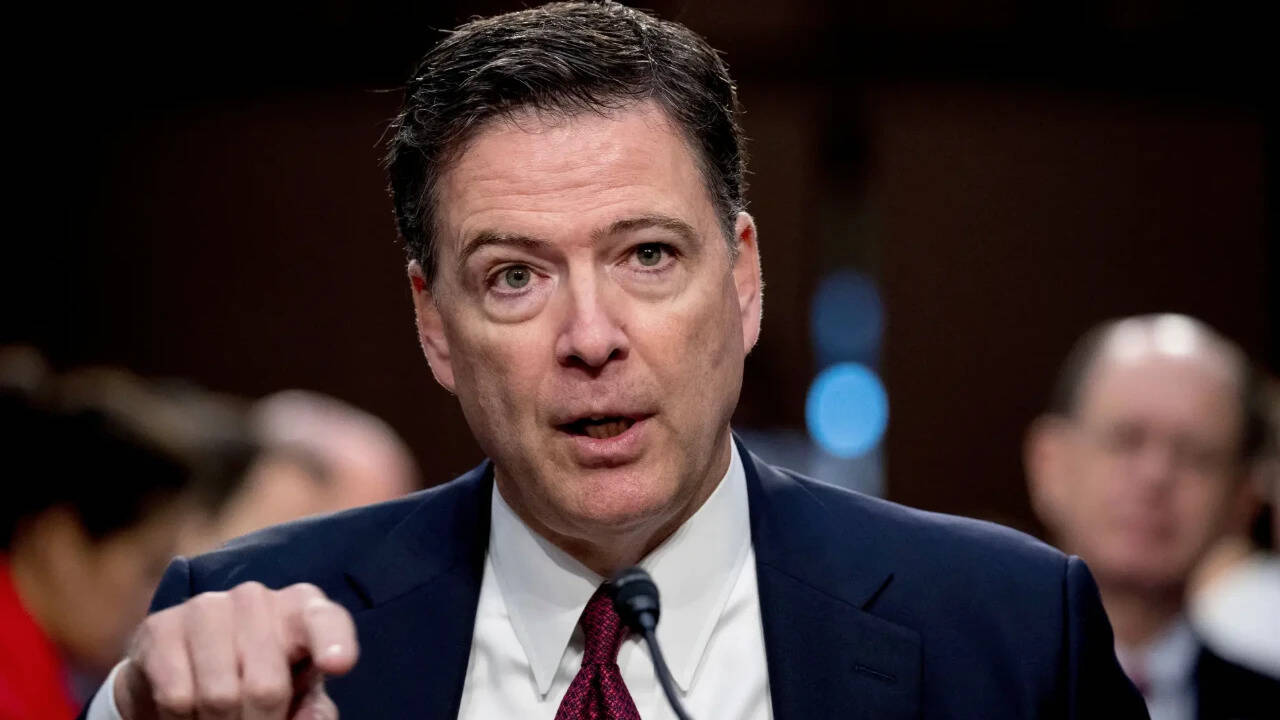
Former FBI Director James Comey now faces a third federal legal action, marking an unprecedented escalation in the long-running collision between the Department of Justice and one of Donald Trump’s most prominent institutional adversaries. While initial reports treat this latest proceeding as just another headline in a decade-long political feud, the underlying mechanics tell a much darker story about how federal prosecutorial power, inspector general referrals, and civil litigation are being deployed against former intelligence officials.
The core reality is straightforward. Federal authorities have opened a new front against Comey, adding to a complex web of prior investigations, tax audits, and civil disputes that have trailed him since his abrupt firing in May 2017. To understand why this third case matters, you have to look past the partisan noise and examine the exact legal mechanisms at play, the precedent this sets for executive branch accountability, and the structural vulnerabilities of former officials once they lose institutional protection.
The Anatomy of a Three-Front Legal War
Most observers lose track of the timeline because the overlapping inquiries blend together in cable news chyrons. They shouldn't. Each action against Comey has relied on a distinct legal apparatus, moving from internal administrative review to financial scrutiny, and now into a third, more aggressive federal posture.
The first major wave centered on the Department of Justice Office of the Inspector General (OIG) and Special Counsel John Durham’s multi-year probe into the origins of the Crossfire Hurricane investigation. While Michael Horowitz’s 2019 OIG report faulted Comey for violating bureau policies regarding the retention and handling of his personal memos—specifically handing unclassified memos detailing conversations with Trump to a friend to share with the press—the DOJ at the time declined criminal prosecution. Durham’s subsequent investigation scrutinized the FBI's reliance on the Steele dossier and FISA warrant applications, resulting in convictions and acquittals of lower-level actors, yet leaving Comey untouched by direct indictment.
The second front was financial and deeply personal. During the Trump administration, both Comey and his former deputy, Andrew McCabe, were selected for the Internal Revenue Service’s National Research Program (NRP)—an ultra-rare, invasive line-by-line audit. Statistically, the odds of two high-profile Trump critics being randomly selected for NRP audits in consecutive years are microscopic. Though a Treasury Inspector General audit later claimed the selections were computer-generated and found no direct evidence of political interference, the episode demonstrated how bureaucratic pressure can be applied without a single criminal charge being filed.
This third federal case represents a distinct shift from administrative censure and financial friction to direct legal jeopardy. Unlike the earlier OIG referrals that stalled at the prosecutor's desk, current federal actions leverage updated statutory interpretations, newly surfaced communications, or civil-to-criminal referral pathways that bypass the traditional institutional reluctance to prosecute former agency heads.
Why Previous Prosecutions Stalled and What Changed
To grasp why a third case is moving forward now, you have to understand the internal culture of Main Justice. For decades, career prosecutors operated under an unwritten rule: you do not criminalize policy disputes or bureaucratic missteps made by former cabinet-level or agency leaders unless there is undeniable proof of corrupt intent.
When the DOJ declined to prosecute Comey over his memos in 2019, career lawyers concluded they could not prove beyond a reasonable doubt that he intended to violate classification rules. Intent is the bedrock of federal criminal law. Without a smoking gun showing malicious or self-serving intent, juries rarely convict former law enforcement officials for procedural shortcuts.
Three structural shifts have altered that calculation.
First, the declassification pipeline has fundamentally changed the evidentiary terrain. Over the past several years, waves of previously redacted FISA applications, electronic communications, and internal FBI notes have been pushed into the public domain. When documents move from classified vaults into public records, they become fair game for parallel civil suits, congressional referrals, and renewed prosecutorial review without triggering the "graymail" defenses that usually kill national security prosecutions.
Second, the threshold for referral and charging decisions has shifted dramatically in a polarized Justice Department. When political appointees—or prosecutors operating under intense executive branch scrutiny—take the reins, the traditional deference shown to former FBI directors evaporates. What career attorneys once viewed as sloppy tradecraft or bureaucratic arrogance is now framed as willful obstruction or false statements under 18 U.S.C. § 1001.
Third, the weaponization of parallel proceedings has matured. Legal adversaries no longer rely on a single criminal indictment to bankrupt or neutralize a target. Instead, civil depositions, Freedom of Information Act (FOIA) discovery, and inspector general inquiries are run concurrently. A minor discrepancy in a civil deposition from three years ago becomes the predicate for a federal perjury or false statement inquiry today.
The Chilling Effect on Intelligence Leadership
Strip away your personal feelings about James Comey. Whether you view him as a principled institutionalist who stood up to executive overreach or a grandstanding bureaucrat who broke the FBI by inserting himself into the 2016 presidential election, the institutional precedent being set here affects every future national security official.
Consider a hypothetical scenario. Imagine a future CIA director or FBI chief is briefed on credible intelligence suggesting a presidential candidate's inner circle is compromised by a foreign adversary. Under the traditional framework, that director relies on career analysts, signs off on surveillance warrants based on vetted intelligence, and keeps contemporaneous notes to protect the integrity of the bureau. Now, imagine that director knows that if the political winds shift four years later, every line of those notes will be audited by the IRS, every warrant application will be dissected for technical errors by a hostile special counsel, and a third wave of federal litigation will follow them into private life.
The result is institutional paralysis.
Senior officials stop putting candid assessments in writing. Analysts hedge their conclusions to avoid future legal exposure. Agency heads decline to open sensitive investigations into political figures because the personal financial ruin of defending against multiple federal cases—easily running into the millions of dollars in legal fees—acts as a powerful deterrent. When the cost of doing the job is endless personal litigation, capable leaders leave public service, replaced by cautious careerists who prioritize self-preservation over national security.
The Counter-Argument Nobody Wants to Address
There is, however, a compelling counter-argument that defenders of Comey often gloss over, and ignoring it weakens any serious analysis of this saga.
For decades, senior intelligence and law enforcement officials operated with near-total impunity. When low-level agents or military contractors mishandled classified information, leaked memos to reporters, or signed inaccurate affidavits submitted to federal courts, they went to federal prison. When directors and deputy directors did the exact same thing, they received book deals, university fellowships, and cable news contracts.
The two-tiered justice system critique did not emerge out of thin air. During the Crossfire Hurricane investigation, the FBI submitted FISA applications to a secret court containing significant omissions and inaccuracies—including an altered email by an FBI attorney. Comey signed off on those warrants. When pressed later, he admitted there was "real sloppiness" in the process, yet maintained he was vindicated overall.
To critics, pursuing a third federal case against Comey isn't about political vengeance; it is about retroactive accountability. If the rule of law means anything, the argument goes, a former FBI director cannot invoke institutional norms to shield himself from the exact same statutes he spent his career enforcing against ordinary citizens. Holding him to the letter of the law—even years after the fact, and even if it takes multiple legal bites at the apple—is framed by proponents as the only way to restore public trust in federal law enforcement.
How Federal Targets Survive Multi-Front Litigation
Navigating a third federal case requires a completely different legal playbook than surviving a standard criminal investigation. At this stage, the process itself is the punishment.
Legal defense teams dealing with multi-year, multi-front federal exposure rely on specific procedural fortifications:
- Joint Defense Agreements (JDAs): Because federal prosecutors almost always try to flip subordinates against principals—just as they pressured Andrew McCabe, Peter Strzok, and Lisa Page—defense attorneys lock down JDAs early. This allows legal teams to share intelligence on what investigators are asking in grand jury rooms without waiving attorney-client privilege.
- Selective Assertion of Executive and Law Enforcement Privileges: Former officials cannot simply plead the Fifth without devastating their public credibility. Instead, their lawyers force the government into protracted litigation over whether internal deliberations, presidential communications, or classified sources and methods can even be introduced as evidence.
- Statute of Limitations Triage: Most federal non-capital offenses carry a five-year statute of limitations under 18 U.S.C. § 3282. Because Comey left office in 2017, prosecutors bringing a third case years later must either prove an ongoing conspiracy, rely on recent statements made during subsequent depositions or interviews, or utilize civil statutes with longer look-back windows.
The Structural Vulnerability of the Post-Watergate FBI
The deeper tragedy of this third federal case is that it exposes the failure of the post-Watergate reforms designed to insulate the FBI from political interference.
After J. Edgar Hoover’s 48-year reign revealed how a director could blackmail presidents and subvert democracy, Congress instituted a 10-year term limit for FBI directors. The goal was to give the director enough independence to resist improper White House pressure while preventing anyone from building a permanent fiefdom.
That model assumed a baseline of institutional restraint from both the White House and the director. It assumed presidents wouldn't demand personal loyalty oaths, and it assumed directors wouldn't bypass the Justice Department to hold unilateral press conferences or leak memos to trigger special counsel appointments.
Once both sides abandoned those norms, the 10-year term became meaningless. Comey was fired less than four years into his term, and the subsequent decade has turned the directorship into a partisan battleground. Every incoming administration now views the sitting FBI leadership with suspicion, and every outgoing leader prepares for a legal siege.
What This Precedent Means for the Justice System
Watch the procedural motions in this third case closely over the coming months. Ignore the press releases from both sides and read the actual court filings.
If the government’s filings rely heavily on novel interpretations of obstruction statutes or resurface conduct that previous career prosecutors explicitly declined to charge, it signals that the Justice Department has officially crossed the Rubicon into cyclical political prosecution. Every future administration will feel entitled—if not obligated by its base—to open multi-front federal cases against the intelligence and law enforcement leaders of the prior regime.
Conversely, if this third case uncovers concrete, previously hidden evidence of statutory violations that survived independent judicial scrutiny, it will validate the persistence of investigators who refused to let high-ranking officials hide behind their titles.
Either way, the illusion of an apolitical Justice Department is gone. The courtroom has become the primary arena for settling executive branch scores, and James Comey is simply the first former director to discover that leaving the J. Edgar Hoover Building no longer guarantees an exit from the fight.