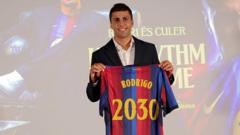
The modern football transfer market rarely produces genuine shockwaves. Most high-profile moves are leaked months in advance, negotiated through friendly media mouthpieces, and executed with predictable financial muscle. Yet the arrival of Spain captain Rodri at Barcelona from Manchester City for a structured package worth around £65 million shatters that convention entirely. It is a deal that alters the domestic balance of power in Spain, destabilizes the Premier League champions, and crowns a masterclass in opportunistic recruitment by Hansi Flick's administration.
For months, conventional wisdom suggested that Rodri would either finish his career under Pep Guardiola or eventually succumb to the financial allure of Real Madrid. After all, the midfielder had previously admitted that playing for Los Blancos carried undeniable professional weight. Real Madrid needed a long-term anchor to orchestrate their squad evolution, and their pursuit was treated as an inevitability by close observers of the European game. Instead, Barcelona quietly orchestrated a high-stakes coup, convincing the reigning Ballon d'Or winner and World Cup hero to reject their eternal rivals and anchor the Camp Nou project until 2030.
Understanding why this transfer materialized requires looking past the headline fee of approximately €76.5 million. At face value, paying that sum for a thirty-year-old midfielder coming off a serious knee injury and subsequent back surgery might seem counterintuitive to modern data-driven models. Football finance usually frowns upon heavy capital expenditure for players entering their fourth decade.
However, Rodri represents an entirely different category of asset. He is not merely a defensive midfielder; he is the structural heartbeat of any side he inhabits. His performance at the recent World Cup, where he claimed the Golden Ball as the tournament's outstanding player, proved that his recovery from long-term fitness setbacks had left his tactical intelligence and positional mastery entirely intact. When a player possesses the unique ability to dictate tempo, shield a backline, and eliminate opposition counter-presses with a single scanning shoulder-check, standard depreciation curves do not apply.
Manchester City's willingness to sanction the sale also reveals a fascinating shift in elite squad management. Entering the final year of his contract, Rodri held significant leverage. While the Premier League side historically prefer to protect their assets or renew terms well before expiration, they faced a player whose personal ambition had decisively shifted toward a homecoming. Rather than risking a free transfer departure next summer or enduring a prolonged contract standoff that could fracture dressing room harmony, City accepted a lucrative exit package while simultaneously laying groundwork for succession plans involving younger targets like Ayyoub Bouaddi.
For Barcelona, the timing could not be more critical. Fresh off domestic dominance and aiming for sustained continental supremacy, Flick's tactical blueprint demands absolute precision in the defensive midfield channel. The club already boasts an extraordinary core of young Spanish internationals, including Lamine Yamal, Pedri, Gavi, and Pau Cubarsí. Inserting the national team captain into that youthful engine room creates an immediate psychological and tactical bridge. The veterans who understand how to win major international tournaments are now steering the daily training sessions in Catalonia.
Critics will point to the financial engineering required to pull off this transfer as evidence of football's persistent fiscal imbalances. Barcelona's economic levers have been a frequent target of skeptical financial analysts over recent seasons. Yet securing a generational talent of Rodri's caliber for a fee that pales in comparison to inflated valuations seen elsewhere in the market represents an elite piece of opportunistic business.
The ripple effects across Europe will take months to settle. Manchester City must now solve the monumental puzzle of replacing a player who has defined their tactical identity for the better of seven years. Real Madrid are left to recalibrate their midfield strategy after missing out on their primary domestic target. Meanwhile, La Liga welcomes back one of its finest exports into a spotlight that burns brighter than ever.
The dust is still settling on the paperwork exchanged between Manchester and Barcelona, but the underlying message is unmistakable. Ambition, timing, and a player's unwavering personal desire can still overturn the best-laid plans of the continent's wealthiest sporting institutions.