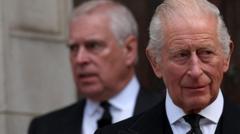
Buckingham Palace has drawn a hard financial line, making it explicitly clear that private stipends provided by King Charles to Andrew Mountbatten-Windsor must not be channeled into active legal battles against law enforcement. This directive exposes a widening chasm within Britain's most scrutinized family, transforming an ongoing criminal inquiry into a high-stakes constitutional stress test. At the heart of this standoff is a simple reality: the Crown is aggressively severing its financial infrastructure from any attempt by the former Duke of York to mount a judicial counter-offensive against the Thames Valley Police.
The friction traces back to a dramatic morning in February when officers arrived at Marsh Farm on the Sandringham estate to take Mountbatten-Windsor into custody on his sixty-sixth birthday. Interviewed under caution on suspicion of misconduct in public office—stemming from historical inquiries tied to his former tenure as a trade envoy—he was released under investigation. Yet the primary flashpoint is not merely the arrest itself. It is the legality of the search warrants authorized at the Central Criminal Court and executed during those raids.
Legal teams representing the former prince moved swiftly to challenge those instruments, lodging a judicial review to determine whether the police overstepped statutory boundaries. High Court hearings followed, accompanied by police bids to restrict public and media access to sensitive documents. Mounting a multi-pronged judicial challenge against a major UK police force requires immense capital. Enter the private allowance supplied by the monarch. While King Charles maintains a degree of family-level financial support to cover basic residential upkeep and daily necessities, palace officials have slammed the door on that money paying for courtroom hostilities against the state.
This is not standard family budgeting. This is institutional self-preservation. For years, the House of Windsor has battled public resentment over opaque royal finances, multi-million-pound settlements, and the perception of impunity. When allegations surfaced regarding subletting arrangements and property incomes, public trust eroded further. Allowing royal stipends to finance an offensive lawsuit against the police would invite a catastrophic political backlash. It would signal to the British public—and to Parliament—that the institution is actively subsidizing an elite evasion of standard accountability.
By explicitly barring the allowance from funding the police challenge, the sovereign is telegraphing adherence to a core democratic principle. The message from the palace is blunt: personal family maintenance is one thing, but waging war against the criminal justice system is an entirely private burden that must be financed independently. Palace handlers have gone to great lengths to emphasize that the litigation belongs entirely to Mountbatten-Windsor and his lawyers, devoid of institutional endorsement or strategic backing.
Finding independent capital for a protracted legal war against a police force is a formidable obstacle. Without the cushion of the royal purse strings for legal fees, the scope and scale of his counter-actions face severe commercial and financial constraints. The courts will ultimately decide whether the initial search warrants executed on that February morning stood on solid legal ground. But outside the courtroom, the verdict has already been rendered. The monarchy has drawn a permanent moat between its private accounts and the legal defense of its most controversial member, ensuring that whatever battles lie ahead, they will be fought with entirely separate resources.


