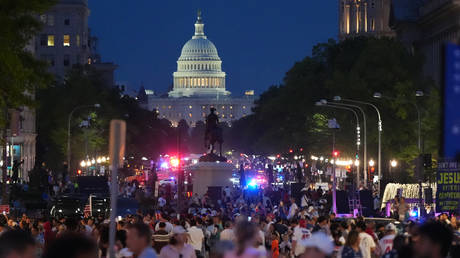
The mandatory evacuation of the National Mall hours before the headline speech of the 250th anniversary of American independence was not just a failure of logistics. It was the predictable collision of an administration determined to centralize a national milestone and a fragile municipal infrastructure buckling under extreme weather. When federal authorities ordered tens of thousands of attendees to clear the open grounds due to approaching severe thunderstorms and lightning strikes, the result was immediate, predictable friction between security personnel and a highly motivated crowd.
By focusing purely on the visual spectacle of the event, mainstream reports missed the deeper systemic friction between federal directive and local execution.
The Operational Breakdown at the Capital Core
Managing a crowd of that scale under optimal conditions requires extensive inter-agency coordination. When a severe weather system intercepts a high-security event, that coordination often fractures. The U.S. Secret Service enacted standard safety protocols, closing security checkpoints and ordering a mandatory evacuation once lightning registered within a critical three-mile radius. However, the execution on the ground revealed a significant gap between federal security mandates and crowd compliance.
Park Police and National Guard units faced an audience that had already endured a record-breaking heatwave, with ambient temperatures surpassing 100 degrees Fahrenheit and heat indexes reaching 115 degrees earlier in the day. Having waited hours through intense security screenings, a substantial segment of the crowd resisted the order to leave. Verbal commands over loudspeakers competed with chants from attendees who refused to abandon their positions near the main stage.
The physical environment of the National Mall compounded the difficulty. While official statements directed the public to seek shelter in nearby Smithsonian museums and underground metro stations, the sheer volume of people trying to exit simultaneously choked these transition points. In several sectors, crowds attempted to re-enter closed checkpoints, leading to physical standoffs and shouting matches with law enforcement officers trying to establish a hard perimeter.
The Cost of Centralized Spectacle
Historically, major national anniversaries are decentralized affairs, distributed across historic hubs like Philadelphia, Boston, and Williamsburg to distribute both the logistical burden and the public narrative. The decision to anchor the marquee events of the semiquincentennial so heavily within the highly restricted airspace and footprint of Washington D.C. created an operational single point of failure.
- Logistical strain: Concentrating massive military flyovers, extended fireworks displays, and a large-scale political address in one urban park left the entire commemoration vulnerable to localized weather disruptions.
- Infrastructure limits: Local emergency services were already strained before the storm arrived, having treated dozens of attendees for severe heat-related illnesses during the afternoon.
- Narrative conflict: By framing the civic celebration around a singular, late-night presidential address, organizers transformed a traditional community gathering into a rigid, high-stakes production that could not easily pivot when conditions deteriorated.
When the storm passed and the venue reopened, the audience that returned after 11 p.m. was roughly half its original size. The delay pushed the historic fireworks display until moments before midnight. While the administration framed the late-night recovery as a triumph of perseverance over the elements, the operational reality was one of significant strain, exposed vulnerabilities, and an event that succeeded late into the night despite the plan, not because of it.