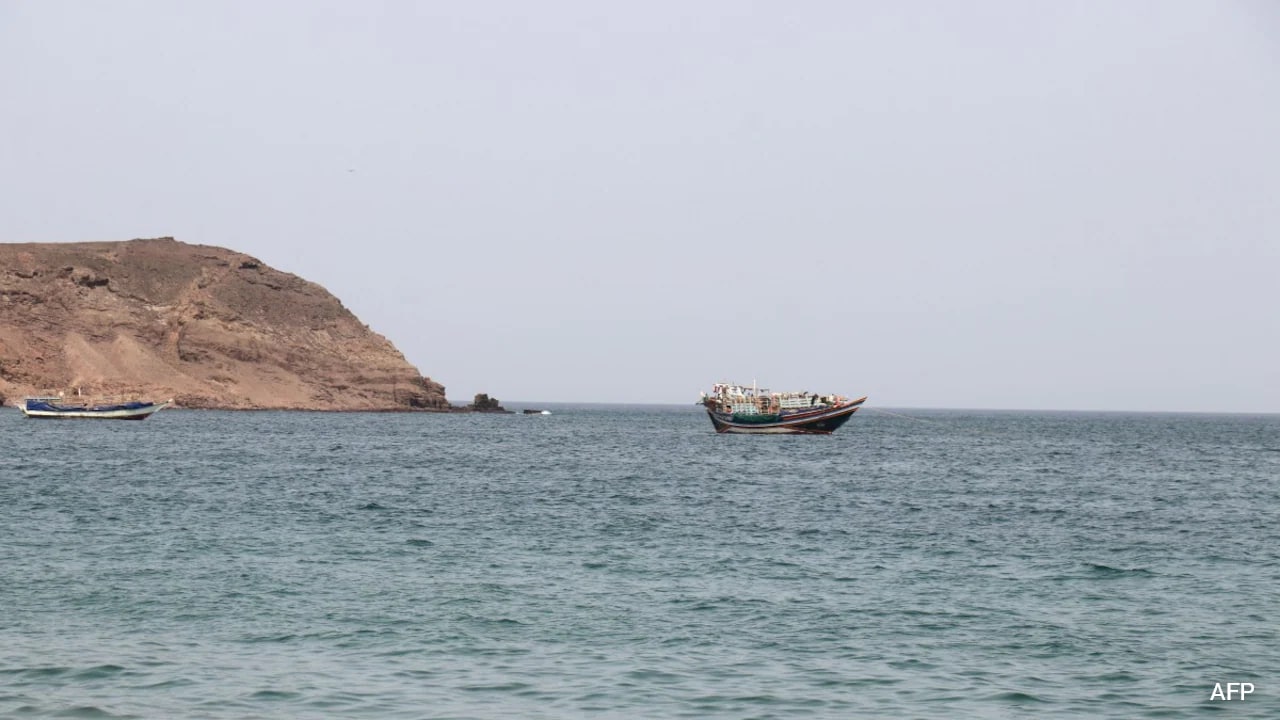
Global shipping giants and independent vessel operators are quietly submitting cargo manifests, crew lists, and ownership documents to Houthi-affiliated email addresses before entering the Red Sea. What began as sporadic missile and drone strikes against commercial vessels in late 2023 has hardened into an informal, digitized customs regime operating out of Sanaa. Instead of relying solely on naval escorts or expensive detours around the Cape of Good Hope, a growing segment of the maritime industry now treats a simple email clearance from an armed militant group as the most reliable insurance policy on the water.
This shift represents a quiet capitulation in global trade. For decades, freedom of navigation in international chokepoints was guaranteed by blue-water navies and enforced through maritime law. Today, access to the Bab el-Mandeb Strait—a waterway that normally handles roughly 12 percent of global seaborne trade—increasingly depends on an administrative nod from the Humanitarian Operations Coordination Center (HOCC), an entity established by the Houthis in early 2024. The message to shipowners is blunt. Submit your paperwork, prove you have no ties to Israel, the United States, or the United Kingdom, and your ship passes untouched. Ignore the inbox, and you risk a ballistic missile through the bridge.
How an Email Became Maritime Law
The mechanics of this shadow clearance system reveal a level of bureaucratic sophistication rarely associated with non-state militias. When the Houthis first escalated their attacks in response to the war in Gaza, targeting criteria appeared erratic. Vessels were struck based on outdated ownership records, dubious open-source intelligence, or tenuous links to parent companies with distant financial ties to Tel Aviv, Washington, or London. For shipping executives, the unpredictability was worse than the threat itself. Marine insurers couldn't price the risk, and captains refused to sail into a shooting gallery without clear rules of engagement.
Sensing an opportunity to formalize their leverage, Houthi leadership stood up the HOCC in Sanaa. Officially, the body was created to coordinate safe passage for humanitarian aid into Yemen and surrounding regions. In practice, it rapidly morphed into a maritime gatekeeper.
By mid-2024, industry insiders and maritime security analysts began noticing a sharp drop in attacks against vessels that had established direct communication channels with Sanaa. Shipping agents, protection and indemnity (P&I) clubs, and vessel managers started receiving circulars detailing exact protocols for transit. To secure safe passage, operators were instructed to send an email at least 48 to 72 hours prior to entering the Red Sea or the Gulf of Aden.
The required documentation mirrors standard port state control filings, stripped down to geopolitical loyalty tests:
- The Vessel Profile: International Maritime Organization (IMO) number, flag state, call sign, and current Automatic Identification System (AIS) status.
- The Ownership Chain: Full disclosure of the registered owner, beneficial owner, commercial operator, and technical manager to prove zero equity or board-level ties to sanctioned nations.
- The Cargo Manifest: Detailed breakdowns of what is inside the containers or holds, confirming the goods are neither bound for nor originating from Israeli ports.
- Port Call History: A log of recent voyages, proving the vessel has not docked in Israel over the preceding months.
Once the email hits the HOCC server, analysts in Sanaa cross-reference the data against their own intelligence databases—a mix of commercial shipping trackers like MarineTraffic, corporate registries, and intelligence fed by regional allies. If the vessel passes muster, the operator receives a reply confirming that the ship is not on the target list. No money changes hands in the inbox. The currency here is legitimacy and compliance.
The Economics of Capitulation
To understand why multi-billion-dollar shipping conglomerates are willingly filing paperwork with a designated terrorist organization, you have to look at the spreadsheet. Maritime trade runs on razor-thin margins, brutal schedules, and unforgiving fuel math.
When the Red Sea crisis erupted, major container lines like Maersk, MSC, and Hapag-Lloyd rerouted their fleets around the southern tip of Africa. That detour adds roughly 3,500 nautical miles and 10 to 14 days to a standard Asia-to-Europe voyage. Burning heavy fuel oil at full steam to make up for lost time costs an extra $1 million per round trip for a large container ship. Multiply that across hundreds of vessels, and the global supply chain absorbs tens of billions of dollars in surcharges, delayed inventory, and tied-up container capacity.
For mega-carriers with deep pockets and strict Western regulatory oversight, the Cape of Good Hope detour remains the only viable option. A publicly traded European shipping giant cannot risk the legal, reputational, and sanctions-related fallout of negotiating with Sanaa.
Smaller operators tell a different story.
Independent tanker owners, bulk carriers, and regional feeder lines operate on spot-market rates where a two-week detour wipes out profit for the entire quarter. For a Greek or Chinese shipowner running a single bulk carrier loaded with grain or fertilizer, the math is merciless. Either burn cash going around Africa, pay astronomical war-risk insurance premiums that can exceed 1 percent of the vessel's entire hull value per transit, or send an email to Sanaa and shave two weeks off the voyage.
Insurance underwriters have quietly accelerated this trend. While London's Joint War Committee lists the southern Red Sea as a high-risk area, some marine insurers have begun offering steep discounts—or agreeing to underwrite voyages at all—only if the shipowner can demonstrate they have mitigated the threat. In the cynical reality of maritime risk management, proof of Houthi email clearance has become an unofficial underwriting requirement for certain tiers of coverage. If an owner can show the underwriter a green-light email from Sanaa, the risk profile drops from catastrophic to manageable.
The Western Naval Paradox
The rise of the Houthi email regime exposes a glaring failure in Western naval strategy. Since late 2023, the United States and its allies have deployed some of the most advanced naval hardware on earth to the region under Operation Prosperity Guardian and the European Union's Operation Aspides. Billion-dollar Arleigh Burke-class destroyers have fired hundreds of multi-million-dollar interceptor missiles to knock down cheap Houthi drones and anti-ship ballistic missiles.
It is an asymmetric nightmare. You cannot solve a political and economic blockade with defensive kinetic intercepts alone.
Naval escorts can protect a specific convoy at a specific moment, yet there are simply not enough warships in the U.S. or European fleets to babysit every merchant vessel transiting a 1,200-mile corridor every single day. The Houthis understood this math from day one. They didn't need to sink the U.S. Navy; they just needed to make commercial transit too expensive and unpredictable for private capital to tolerate.
By introducing an administrative bypass—the email clearance—the Houthis fractured the unity of the global shipping industry. Instead of standing firm behind Western naval protection, the commercial sector split into two tiers. Tier one consists of Western-aligned carriers taking the long way around Africa. Tier two consists of opportunistic operators, shadow-fleet tankers, and state-backed Asian fleets sailing straight through the Red Sea with Sanaa's blessing.
Consider a hypothetical scenario involving two identical oil tankers carrying crude from the Persian Gulf to the Mediterranean. The first tanker, owned by a London-based firm, refuses to engage with Sanaa, pays war-risk premiums, and spends an extra two weeks steaming past South Africa. The second tanker, registered under a flag of convenience and managed out of Dubai or Athens, emails its corporate registry to the HOCC, receives clearance within 48 hours, and transits the Suez Canal without incident. The second tanker delivers its cargo two weeks earlier, undercuts the first tanker's freight rate, and pockets massive profits.
Market forces don't care about geopolitical principles. When compliance with an adversary's bureaucracy yields a massive competitive advantage, the market will comply.
AIS Spoofing and Digital Camouflage
Not every ship entering the Red Sea relies purely on an honest email exchange. Alongside the formal clearance process, a thriving cottage industry of digital deception has emerged on the water.
Vessels that fall into gray areas—perhaps they have a minor institutional investor from New York, or a sister ship once called at Haifa—often pair their email outreach with aggressive manipulation of their Automatic Identification System (AIS) transponders. Ships regularly broadcast destination messages directly in their AIS fields reading "NO CONTACT WITH ISRAEL," "ALL CHINESE CREW," or "RUSSIAN OIL ON BOARD."
These broadcasts are modern-day flags of convenience, shouted into the digital ether in hopes that Houthi radar operators and intelligence analysts will read the screen before pressing a launch button.
Sometimes, the digital camouflage goes deeper. Operators have been caught spoofing their AIS coordinates, turning off transponders entirely—going "dark"—for days while transiting the Bab el-Mandeb Strait, or falsifying ownership trails through shell companies registered in the Marshall Islands, Liberia, or Hong Kong just weeks before a scheduled transit.
Yet relying on AIS tricks without securing email clearance remains a dangerous gamble. The Houthis have demonstrated access to sophisticated maritime domain awareness tools, likely supplemented by Iranian surveillance vessels like the MV Behshad and shore-based radar networks. Going dark in the Red Sea often draws more attention, not less, signaling to Sanaa that a vessel has something to hide. Consequently, seasoned fleet managers increasingly view the email protocol as the safer bet. Transparency with the militants buys predictability.
The Sanctions Trap for Shipowners
Engaging directly with the Houthis creates a legal minefield that most shipping executives refuse to discuss on the record. In early 2024, the U.S. government re-designated Ansarallah—the formal name of the Houthi movement—as a Specially Designated Global Terrorist (SDGT) group.
Under U.S. and European sanctions frameworks, providing material support, funds, or economic resources to a designated terrorist organization is a severe crime. Maritime lawyers are currently scrambling to determine where "routine administrative communication for crew safety" ends and "unlawful engagement with a sanctioned entity" begins.
So far, the HOCC has been careful not to demand direct transit fees or extortion payments via email. Demanding cash would immediately trigger strict anti-terrorism financing laws, freezing shipowners out of the U.S. dollar clearing system and cutting them off from Western banks and insurers. By keeping the transaction strictly informational—asking only for manifests and ownership charts—Sanaa allows shipping companies to argue that they are merely acting under duress to protect human life at sea, an exception generally recognized under international maritime norms.
The legal gray area remains precarious. If a vessel manager submits corporate documents to Sanaa, and the Houthis later use that intelligence to target a competitor's ship, the liability exposure could be catastrophic. Furthermore, U.S. Treasury officials have grown increasingly uneasy watching global commerce normalize a militant group's claim to sovereign regulatory authority over international waters.
A Dangerous Precedent for Global Chokepoints
The normalization of Houthi email clearances carries implications that stretch far beyond the coastline of Yemen. For the first time in modern history, a non-state actor has successfully erected a functioning, bureaucratic tollbooth over one of the world's primary maritime arteries without holding a single major port on the shipping lane itself.
They achieved this not through naval supremacy, but through cheap asymmetric weapons paired with smart administrative leverage.
Look at the map of global trade. The Strait of Hormuz, the Strait of Malacca, the Taiwan Strait, and the Black Sea are all narrow geographic bottlenecks where modern commerce is acutely vulnerable to shore-based missiles and drones. Every rogue state, separatist movement, and regional militia on earth is watching what is happening in Sanaa right now.
They are seeing that you do not need an aircraft carrier to regulate global shipping. You need a few anti-ship missiles, a reliable internet connection, a spreadsheet of corporate registries, and an email address. Once shipowners, insurers, and charterers accept the premise that safe passage requires asking permission from whoever holds the high ground on the coast, the principle of freedom of the seas erodes from within.
Warships are still patrolling the Red Sea, intercepting drones and escorting occasional high-value hulls, while in quiet offices from Athens to Singapore, shipping clerks continue hitting send on emails addressed to Sanaa, trading a sliver of maritime sovereignty for a clear path through the strait.