When Beijing claims it allowed Manila to resupply a grounded warship in the South China Sea, diplomats in the region hear something entirely different from the press release. To veteran maritime observers, an announcement that China permitted a Philippine resupply mission is rarely a gesture of goodwill. It is a calculated signal about maritime control, sovereignty claims, and who sets the terms of access around contested features like Second Thomas Shoal and the BRP Sierra Madre. Public statements from Chinese authorities frame these passages as conditional allowances granted under Chinese jurisdiction, while Manila insists its operations are lawful sovereign actions or humanitarian necessities that require no Beijing permission.
That clash over framing sits at the heart of every headline about a resupply mission. A single boat carrying food, water, medical supplies, and rotation personnel can look like a routine logistics run on paper. Out on the water, every wake carries political weight, legal arguments, and tactical risk.
Why Permission Language Matters More Than the Cargo
Watch enough standoffs in contested waters and you stop looking solely at the manifest. You start watching the vocabulary.
In diplomatic disputes over the South China Sea, words do heavy lifting because neither side wants a kinetic spark that spirals out of control, yet neither side can afford to look weak at home. When Beijing states that it "allowed" or "arranged" a resupply run after prior communication or inspection, it is trying to normalize a de facto gatekeeper role. Even when supplies reach the troops aboard a grounded vessel, the narrative battle asks a sharper question: did the ship move by right, or by leave?
Manila rejects the premise that it needs authorization to sustain its personnel on a feature within what the Philippines views as its exclusive economic zone and continental shelf. A 2016 arbitral tribunal ruling in The Hague largely favored the Philippines on maritime entitlements and faulted certain Chinese actions, though Beijing has long rejected the award's validity. Because international law lacks a single global sheriff with enforcement teeth on the high seas, legal arguments collide daily with physical presence, coast guard vessels, militia boats, and radar tracking.
Consider a hypothetical example of how two observers can read the exact same morning at sea. Suppose a small supply boat approaches a disputed shoal under the watchful eye of larger coast guard hulls and smaller maritime militia craft. Beijing's statement later that day emphasizes humanitarian consideration and temporary arrangement following communication. Manila's statement emphasizes resolute defense of its personnel and refusal to yield sovereign rights. Both accounts can describe the same physical transit while pushing diametrically opposite legal conclusions.
That gap explains why "resupply" stories rarely end when the boat docks or pulls alongside. The cargo keeps the outpost alive. The press releases try to keep the claim alive.
The Grounded Ship as a Permanent Flashpoint
A grounded naval vessel turned into a semi-permanent military outpost is an unusual instrument of statecraft. It is neither a conventional base built on dry land nor a standard patrol ship free to maneuver away from trouble.
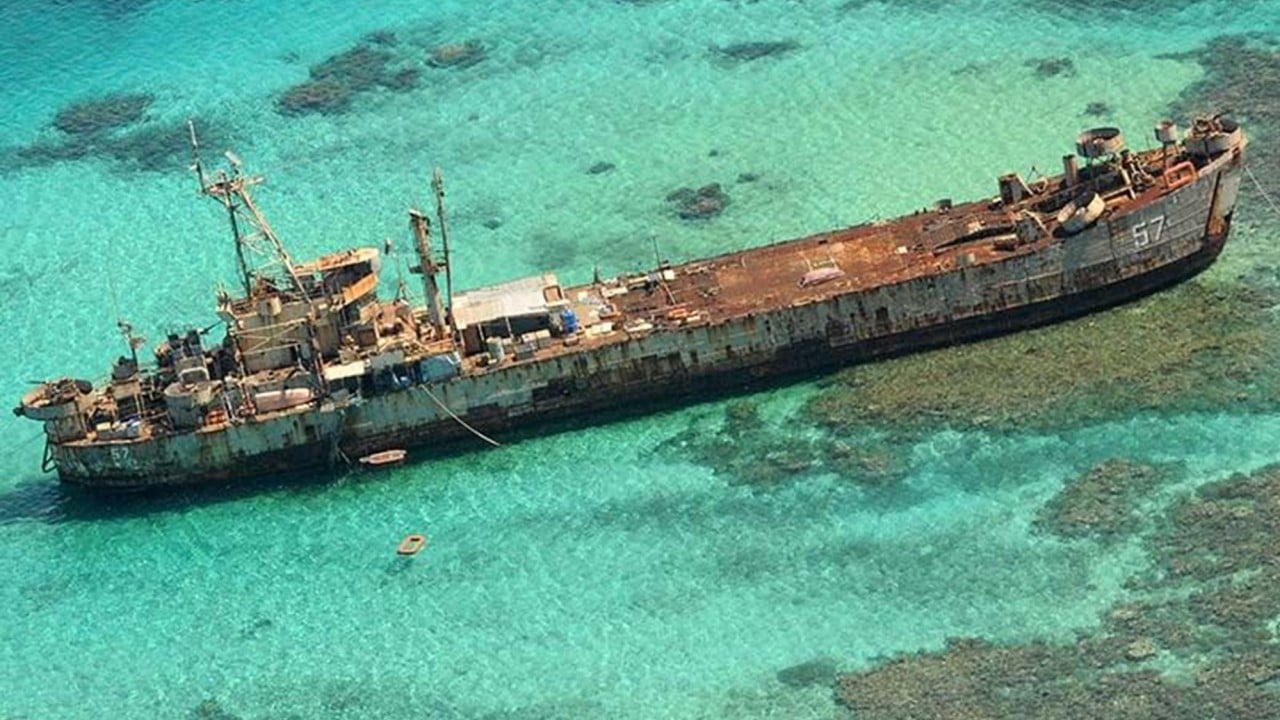
For decades, the BRP Sierra Madre, a rusting World War II-era tank landing ship deliberately run aground on Second Thomas Shoal in 1999, has served as the physical anchor of the Philippine presence there. Keeping a small detachment of marines stationed on a deteriorating steel hull in a tropical marine environment is an exercise in grit and constant maintenance. Saltwater corrodes everything. Heat saps morale. Every wave reminds everyone on board how fragile the structure is over the long haul.
Because the ship is stationary, it acts like a fixed magnet for friction. Beijing does not need to invade a bustling city to pressure Manila; it only needs to squeeze the supply line to a small garrison and test how much pressure Manila and its treaty ally, the United States, are willing to absorb.
Over time, those supply runs have grown more complicated. What once felt like a quiet, low-profile routine turned into a high-stakes cat-and-mouse game involving:
- Close-quarters maneuvering between supply boats, escort vessels, and much larger coast guard cutters.
- Water cannons, blocking formations, and laser or acoustic harassment that raise the risk of collision or injury.
- Information warfare, where video clips, drone angles, and radio transcripts are released within hours to shape domestic and international opinion.
- Allied signaling, as Washington reiterates its Mutual Defense Treaty commitments and regional partners monitor whether crises escalate or stabilize.
Each incident tests thresholds. Nobody wants an accidental ramming that kills sailors and forces an immediate military response. Yet pushing right up to the edge of that line has become a regular feature of the standoff.
How Tactical Friction Shapes Strategic Alliances
Tactical encounters at sea rarely stay local for long. They ripple straight into capitals thousands of miles away.
When a resupply mission runs into aggressive blocking or dangerous maneuvers, the immediate reaction in Manila involves a mix of anger, defiance, and practical recalibration. Philippine leaders face a delicate balancing act. Lean too heavily on outside military backing, and critics warn of becoming a pawn in great-power rivalry. Show too much restraint after a tense encounter, and domestic pressure mounts to prove sovereignty is not being traded away.
Washington, meanwhile, has spent years modernizing its posture in the Indo-Pacific, expanding rotational access and defense cooperation with Manila while trying to deter coercive gray-zone tactics without triggering a broader war. Every contested resupply tests the credibility of deterrence. If China can steadily raise the cost of routine resupply without crossing the threshold that triggers direct allied intervention, Beijing gains leverage over time. If pushback becomes too sharp or unpredictable, the risk of miscalculation climbs.
Other Southeast Asian states watch closely from the sidelines. Many have their own overlapping claims or deep economic ties with China. They rarely want a shooting war in their backyard, yet they pay close attention to whether rules, international arbitration, or sheer physical intimidation sets the pace in contested waters.
What Competitors Miss When They Treat Statements at Face Value
Surface-level coverage often treats a government press release like a receipt. One side says it allowed passage; the other side says it carried out a mission; the story gets summarized as a temporary thaw or a routine update.
That approach misses three deeper mechanics that drive the dispute.
First, temporary calm is not conflict resolution. A resupply going through on a given day does not settle sovereignty over the shoal, the reef, or the surrounding waters. Tensions can ease for a brief stretch due to weather, diplomatic backchannels, or optics around a summit, only to flare right back up when patrol patterns shift.
Second, gray-zone pressure is cumulative. Gray-zone operations rely on actions that sit just below the threshold of conventional warfare. Individually, a blocking maneuver or a contested radio exchange might look manageable. Stack dozens of them across months and years, and they wear down crews, strain budgets, test nerves, and condition observers to treat abnormal coercion as background noise.
Third, transparency has become a weapon in its own right. Years ago, incidents in remote parts of the South China Sea often stayed murky for days. Today, cameras on decks, bridge wings, and aircraft capture close-ups of hulls, hoses, and maneuvers. Both sides curate footage to tell their version of events, forcing analysts to cross-check timelines, vessel tracks, and official claims rather than accepting a single clip or statement at face value.
The Domestic Politics Behind Tough Talk
Foreign policy is always entangled with domestic politics, even when officials speak in the language of pure strategy.
In Beijing, projecting firmness on territorial and maritime sovereignty ties directly to nationalist legitimacy and the ruling party's narrative of national rejuvenation. Appearing soft on disputed features carries steep political costs at home. At the same time, Beijing has broader economic and diplomatic interests—including trade ties across Asia and managing relations with Washington—that argue against letting a tactical clash spiral out of control.
In Manila, public opinion has grown steadily more skeptical of conciliatory approaches toward Beijing after repeated maritime clashes. Elected officials answer to voters, coastal communities, and military personnel who feel the squeeze firsthand. Calling out coercive behavior publicly and rallying international backing helps build domestic resolve, even as policymakers weigh the risks of escalation.
Understanding those domestic pressures helps explain why rhetoric often sounds rigid even when quiet diplomatic channels are active behind closed doors. Public toughness satisfies home audiences. Quiet contacts try to keep the lid on.
Reading the Next Move Without Getting Fooled
Anyone tracking this rivalry should look past dramatic headlines and watch patterns over time.
Pay attention to vessel composition and numbers. Who shows up alongside the supply boat—small patrol craft, coast guard cutters, or swarms of militia vessels—tells you how tightly the area is being ringed.
Watch diplomatic sequencing. Announcements about resupply arrangements sometimes coincide with high-level meetings, bilateral consultations, or regional summits where leaders want to manage optics without conceding core claims.
Look at legal and operational consistency. Does a pattern hold across weeks and months, or does it snap back into confrontation the moment attention shifts elsewhere?
In contested waters where every mile carries history, law, and leverage, a single resupply passage is never just about food and water. It is a live stress test of power, restraint, and nerve at sea.