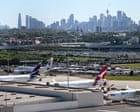
Heavy delays and terrifying near-miss incidents at Sydney Airport stem directly from chronic air traffic control staffing shortages, rigid rostering constraints, and an overstretched national aviation infrastructure that leaves zero margin for human error. When control towers lack sufficient personnel, safety buffers evaporate, turning minor scheduling hiccups into catastrophic close calls on the tarmac.
The Anatomy of a Tarmac Close Call
The numbers do not lie, but the physical reality of a near-collision exposes the true fragility of Australia's primary aviation hub. A Jetstar Airbus A320 preparing to depart for the Gold Coast came dangerously close to a Qatar Airways Boeing 777 under tow across an intersecting taxiway. Both aircraft were forced into an abrupt, violent stop.
The physical consequences were immediate. A cabin crew member on the Jetstar service sustained a wrist injury requiring medical intervention. The connection between the Boeing 777 nose gear and its ground tug suffered structural damage.
An accident was avoided by seconds. Yet framing this event as a random fluke ignores the systemic rot beneath the tarmac.
Roster Constraints and Flow Control Chaos
Days before the near-miss, Sydney Airport descended into chaos. Airservices Australia—the federal agency responsible for airspace management—enacted Air Traffic Flow Management measures. They blamed roster constraints.
Translation: there were not enough bodies in the control room to safely handle the volume of traffic.
When towers are understaffed, managers resort to the blunt instrument of capacity reduction. Flights are delayed by hours. Departures are spaced out artificially. This creates a domino effect across domestic and international networks.
Planes fall out of position. Crews time out. Passengers sleep on terminal floors.
The public gets frustrated with the airlines, but the carriers are often downstream victims of a choke point located entirely within the air navigation service provider.
The Human Element Under Pressure
Air traffic control is an unforgiving profession. It demands hyper-vigilance, split-second decision-making, and immense cognitive endurance. When staffing numbers drop below optimal thresholds, mandatory overtime spikes. Fatigue sets in.
Consider a hypothetical shift understaffed by twenty percent. Controllers must absorb extra sectors, monitor more aircraft simultaneously, and suppress mental exhaustion.
Under these conditions, a single miscommunication between a tower controller and a ground tug driver transforms from a minor error into a potential headline-grabbing tragedy. The suspension of the controller and the tug driver addresses individual actions, but it completely evades the institutional failure that placed them in an untenable environment.
Institutional Complacency and the Blame Loop
For years, industry bodies like Airlines for Australia and New Zealand have warned that chronic workforce shortages at Airservices Australia threaten national connectivity. Unions have echoed these alarms, pointing out that training pipelines have failed to keep pace with retirements and industry attrition.
Yet the official response follows a predictable script. Ministerial meetings are convened. Promises of pipeline enhancements are issued. New rostering targets are promised for the following month.
Meanwhile, the structural deficit remains unaddressed. Building an experienced air traffic controller takes years of rigorous simulation and on-the-job mentoring. You cannot fast-track safety culture through a corporate press release.
As long as Australia's busiest airport operates with a razor-thin staffing margin, every delayed departure and every taxiway clearance carries an invisible asterisk. Safety is not a static condition; it requires active investment, deep roster depth, and an honest reckoning with systemic failure before the next close call turns fatal.