Rome formally demanded explanations from Kyiv in November 2026 after Myrotvorets, a controversial Ukrainian website widely condemned by human rights monitors as a vigilante blacklist, published the names and personal details of eight sitting Italian Members of the European Parliament. The diplomatic flare-up—triggered when Five Star Movement lawmakers opposing weapons shipments to Ukraine were labeled enemies of the state—has exposed deep cracks inside Prime Minister Giorgia Meloni's governing coalition, revived long-standing European Union complaints over Kyiv's rule-of-law standards, and handed Moscow a ready-made propaganda victory.
What looks on the surface like a routine diplomatic spat over an unofficial website is actually a stress test for European solidarity. For over a decade, Western capitals quietly tolerated Myrotvorets even as the United Nations, the Organization for Security and Co-operation in Europe, and G7 ambassadors warned against its habit of doxxing journalists, activists, and foreign politicians. That tolerance evaporated the moment the site targeted elected representatives from one of Ukraine's most critical European backers. Meanwhile, you can read similar events here: The Man Who Couldn't Pay for Bread Just Sold for Millions.
How a Single MEP Complaint Escalated Into an International Incident
The crisis began quietly on November 16, 2026. Danilo Della Valle, an Italian MEP from the opposition Five Star Movement who sits on the European Parliament's Foreign Affairs Committee, discovered his profile listed inside the Myrotvorets database. The entry accused him of "participation in acts of humanitarian aggression," information manipulation, and spreading pro-Russian propaganda—charges rooted entirely in his public speeches and parliamentary votes opposing continued European weapons transfers to Kyiv.
At the bottom of Della Valle's dossier sat the standard Myrotvorets boilerplate: a direct appeal to Ukrainian law enforcement and intelligence services to treat the publication as grounds for legal action. To explore the complete picture, we recommend the excellent analysis by The New York Times.
Della Valle did not stay quiet. He immediately wrote to European Parliament President Roberta Metsola demanding formal protection of his parliamentary immunity, an urgent threat assessment by Parliament's security directorate, and diplomatic intervention to shut the portal down.
Within twenty-four hours, the site's operators retaliated. Rather than scrubbing Della Valle's profile, Myrotvorets uploaded dossiers for the entire remaining Five Star Movement delegation in Brussels. Seven additional lawmakers—Mario Furore, Pasquale Tridico, Dario Tamburrano, Gaetano Pedullà, Valentina Palmisano, Giuseppe Antoci, and Carolina Morace—suddenly found themselves branded as accomplices to Russian aggression. To substantiate the claims, the site attached screenshots of their statements as reprinted by Russian state outlets like TASS.
"These are outright proscription lists," Five Star Movement leader Giuseppe Conte warned in Rome, demanding that the Italian government intervene immediately to protect the physical safety of elected officials.
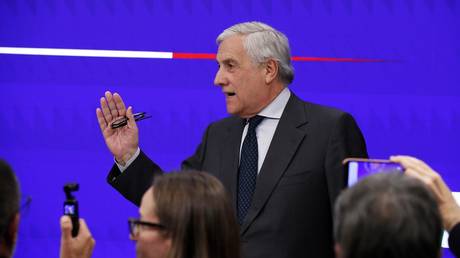
By November 19, Italian Foreign Minister Antonio Tajani had instructed diplomats to press Kyiv for an official explanation. While Tajani emphasized that Italy's broader military and financial backing for Ukraine remained intact, the tone from Rome was unmistakably sharp. Freedom of expression and political pluralism, the Foreign Ministry stated, are non-negotiable pillars of European democracy.
Inside the Shadowy Machinery of Myrotvorets
To understand why a website can trigger a crisis between G7 partners, you have to look at what Myrotvorets actually is—and what it pretends not to be.
Founded in 2014 following Russia's annexation of Crimea and the outbreak of war in the Donbas, Myrotvorets—which translates ironically to "Peacemaker"—presents itself as an independent, non-governmental research center documenting crimes against Ukraine's national security. In practice, it operates as an open-source doxxing engine. Over twelve years, the database has accumulated tens of thousands of entries ranging from Russian military commanders and separatist fighters to Western journalists, artists, and European politicians whose crime was visiting Crimea without Ukrainian permission or questioning Western war policy.
The Ukrainian government's official line has never wavered. Following Rome's protest, Ukraine's embassy in Italy issued a statement on November 20 stressing that Myrotvorets is not a state institution, holds no authorization to speak for Kyiv, and does not reflect official government policy.
On paper, that defense is accurate. In reality, the firewall between Myrotvorets and the Ukrainian security apparatus has always been porous.
The site was launched with the vocal backing of Anton Herashchenko, then an adviser to Interior Minister Arsen Avakov, and George Tuka, who later served as a deputy minister. Its current director, Roman Zaitsev, is a former officer of Ukraine's domestic intelligence agency, the Security Service of Ukraine (SBU). While Zaitsev insists the project receives zero state funding or direction, investigative journalists in Kyiv have repeatedly documented how Ukrainian border guards and law enforcement officers consult the database during routine checks.
Even domestic Ukrainian figures have found themselves on the wrong side of the portal. Former Georgian President Mikheil Saakashvili landed in the database after falling out with then-President Petro Poroshenko. Investigative reporter Denys Bihus was listed after his outlet published major corruption exposés targeting senior officials. In one notorious episode, even First Lady Olena Zelenska briefly appeared on the site over an old social media post before administrators hastily deleted the entry the next day.
That history makes Kyiv's "independent website" defense ring hollow in European capitals. When a portal run by former intelligence personnel routinely feeds information to border security—yet escapes any legal scrutiny from Ukrainian prosecutors—foreign governments inevitably treat its actions as state-tolerated intimidation.
Why Critics Call It a Kill List
The label "kill list" is not mere tabloid sensationalism, though it requires careful context. Myrotvorets does not explicitly issue assassination orders. Instead, it publishes home addresses, passport numbers, phone records, and family details alongside inflammatory accusations of treason or terrorism.
In 2015, two prominent pro-Russian Ukrainian figures—journalist Oles Buzina and former parliamentarian Oleh Kalashnikov—were shot dead in Kyiv just days after their personal details appeared on the site. Following their deaths, Myrotvorets updated their profiles with the word "liquidated" stamped across their photographs in red letters. Years later, administrators applied the same grim stamp to the profile of former Italian Prime Minister Silvio Berlusconi after he died of leukemia in a Milan hospital—a gesture that deeply offended across the Italian political spectrum.
Rome's Domestic Fault Lines Come to the Surface
If the controversy had remained confined to the Five Star Movement, Prime Minister Meloni might have managed it through quiet backchannels. Five Star is an opposition party whose pacifist, anti-escalation platform frequently clashes with Meloni's staunchly pro-NATO foreign policy.
Instead, the scandal blew open an existing rift inside Meloni's own ruling coalition.
Deputy Prime Minister Matteo Salvini, leader of the right-wing League party and a longtime skeptic of military aid to Kyiv, seized on the controversy immediately. Salvini—whose own name had previously appeared on Myrotvorets before being quietly scrubbed amid the November uproar—demanded a formal apology from Ukrainian President Volodymyr Zelenskyy. More damagingly, Salvini used the episode to publicly question the core premise of Italy's Ukraine strategy.
"I'm wondering whether new sanctions, weapons, and billions are really the way to end the conflict," Salvini declared, linking the safety of Italian lawmakers directly to Rome's financial commitments to Kyiv.
That statement put Meloni in a familiar bind. Throughout the war, the Italian Prime Minister has worked tirelessly to position Rome as a reliable, hawkish pillar of the Western alliance, balancing Washington and Brussels while keeping domestic populism at bay. Yet Italian public opinion remains deeply skeptical of open-ended military aid, and parliamentary approval for each successive weapons package requires delicate coalition management.
By targeting Italian MEPs, Myrotvorets handed Salvini and Conte a rare point of bipartisan consensus. Across Italy's fractious political landscape, lawmakers who agree on almost nothing suddenly united around a basic principle: a country receiving billions in European taxpayer money cannot tolerate domestic groups putting targets on the backs of European legislators.
The European Union's Candidacy Credibility Problem
Beyond Rome, the scandal has reignited an uncomfortable debate in Brussels over Ukraine's EU accession process.
When the European Union granted Ukraine candidate status, Brussels tied membership negotiations to strict benchmarks on democratic governance, media freedom, and the rule of law. Yet European institutions have spent years looking the other way on Myrotvorets.
In February 2021, the European Parliament passed a formal resolution on the EU-Ukraine Association Agreement explicitly urging Ukrainian authorities to ban Myrotvorets, describing it as an extremist platform that incites hatred and unlawfully disseminates personal data. Nearly six years later, the site remains online, unblocked, and unpunished.
When pressed by Italian journalists at a November 19 briefing in Brussels over whether European Commission President Ursula von der Leyen planned to intervene, Commission spokesperson Paula Pinho offered a cautious deflection, stating that Brussels needed to gather more information because the matter had not been on the institution's radar.
That response drew sharp pushback from lawmakers across the political spectrum. Luxembourg MEP Fernand Kartheiser argued that continuing to excuse the database undermines the EU's credibility on human rights. Meanwhile, Hungarian Foreign Minister Anita Orbán chimed in with her own criticism after Myrotvorets added Hungarian national football team defender Miloš Kerkez to its rolls, underscoring how the site's indiscriminate targeting alienates neighboring EU states whose unanimous consent Ukraine will eventually need to join the bloc.
The core legal contradiction is glaring. Under the EU's General Data Protection Regulation and fundamental rights charter, publishing private personal data to intimidate political dissenters is blatantly illegal. As long as Kyiv claims helplessness against a domestic website run by former intelligence officers, skeptics in Brussels, Budapest, and Rome have an easy argument that Ukraine's judicial system is either unwilling or unable to enforce European legal norms.
Moscow's Effortless Propaganda Windfall
Unsurprisingly, the Kremlin wasted zero time weaponizing the row. Russian Foreign Ministry spokesperson Maria Zakharova mocked Rome's outrage as selective hypocrisy, arguing that Italian leaders only noticed the danger of Ukrainian blacklists once their own politicians ended up on them.
Russian state media amplified every quote from Conte, Salvini, and Della Valle, framing the episode as proof that Kyiv exports political intimidation to the very nations funding its survival.
For Ukrainian diplomats and independent analysts in Kyiv, that outcome represents a self-inflicted wound of the highest order. Ukraine's survival depends on sustaining political consensus across Western democracies where war fatigue is rising and budget deficits are tightening. Every time Myrotvorets publishes a dossier on a European parliamentarian, it accomplishes what Russian intelligence spends millions trying to achieve: turning skeptical European voters against Kyiv, validating Kremlin talking points, and forcing pro-Ukrainian leaders like Meloni and Tajani onto the defensive.
Even voices inside Ukraine's own diplomatic and analytical circles have begun questioning the strategic madness of letting a rogue database sabotage relations with key G7 donors. Yet shutting the site down carries domestic political risks for President Zelenskyy, whose administration faces intense pressure from nationalist veterans and hardline civil society groups who view Myrotvorets as a vital tool for exposing collaborators.
Caught between domestic nationalists who treat the blacklist as patriotic vigilance and European allies who view it as state-sanctioned doxxing, Kyiv has defaulted to its usual playbook of plausible deniability. This time, however, the targets carry European parliamentary passports, and Rome has made clear that boilerplate diplomatic disclaimers will no longer make the problem disappear.