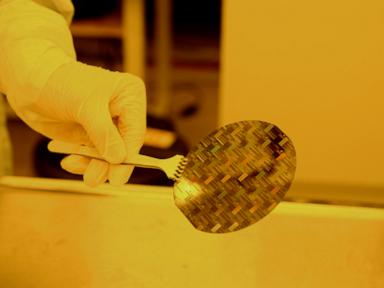
The United States is pouring tens of billions of federal dollars into domestic chip manufacturing, yet the multi-billion-dollar fabrication plants rising across Arizona, Ohio, New York, and Texas face an existential bottleneck that concrete and silicon cannot solve. Semiconductor training at community colleges has become the emergency valve for an industry projected by the Semiconductor Industry Association and Oxford Economics to face a shortfall of roughly 67,000 technicians, computer scientists, and engineers by 2030. While Washington celebrates ribbon-cuttings for massive cleanrooms, local two-year colleges are scrambling to build ten-week bootcamps and associate degree pipelines to staff them—a frantic workaround that exposes deep structural flaws in how America educates its technical workforce.
You can subsidize a ten-billion-dollar fab with the stroke of a presidential pen. You cannot conjure an experienced lithography technician out of thin air.
For decades, the American semiconductor sector offshored its high-volume manufacturing to Taiwan, South Korea, and China, retaining high-margin chip design and intellectual property domestically. That strategic retreat gutted the domestic vocational infrastructure required to run modern wafer fabrication facilities. Today, as the CHIPS and Science Act attempts to reverse forty years of industrial policy in less than a decade, chipmakers like Intel, TSMC, Micron, and Samsung are discovering that their biggest competitor is not a rival foundry in Hsinchu or Suwon. It is the local labor market.
The Anatomy of the Cleanroom Bottleneck
To understand why community colleges have suddenly become the frontline of national industrial strategy, you have to understand what happens inside a modern fabrication plant. A semiconductor fab is not a traditional assembly line. It is an ultra-sterile environment where microscopic circuits are etched onto silicon wafers using extreme ultraviolet light, volatile gases, and plasma chemistry.
Roughly 40 to 50 percent of the workforce inside a typical fab does not hold a four-year engineering degree. These are the equipment technicians and process operators who maintain vacuum pumps, calibrate ion implanters, monitor chemical mechanical planarization tools, and troubleshoot multi-million-dollar machines when a wafer lot stalls at three in the morning. When a single tool goes down in a leading-edge fab, the lost production capacity costs tens of thousands of dollars per hour.
Historically, chipmakers recruited heavily from the U.S. Navy’s nuclear power program and former military electronics specialists to fill these roles. Veterans understood high-stakes preventative maintenance, strict protocol adherence, and shift work. That pipeline has shrunk relative to the sheer scale of current fab construction. With dozens of new facilities and expansions announced across the country, the math simply breaks down. Four-year universities produce electrical engineers who want to design chips in air-conditioned offices in Austin or Silicon Valley, not wear full-body bunny suits during twelve-hour night shifts in a cleanroom.
Community colleges occupy the exact middle ground required to bridge that gap. Institutions like Maricopa Community Colleges in Arizona, Columbus State Community College in Ohio, and Austin Community College in Texas have stepped into the vacuum, partnering directly with chipmakers to design semiconductor manufacturing curricula from scratch.
How Two-Year Schools Are Rebuilding the Pipeline
The speed at which these programs are being assembled is unprecedented in higher education, an institution normally famous for moving at glacial pace. Traditional academic accreditation can take years. The chip industry does not have years.
In Phoenix, where TSMC is building a massive manufacturing complex and Intel is expanding its Ocotillo campus, Maricopa Community Colleges rolled out a ten-day, 40-hour Semiconductor Technician Quick Start program. The curriculum strips away general education requirements and focuses entirely on cleanroom protocol, vacuum systems, basic electronics, and safety procedures. Students pay minimal tuition—often subsidized entirely by state workforce grants or the chipmakers themselves—and walk out with an entry-level credential that puts them in front of corporate recruiters.
A similar playbook is unfolding in central Ohio ahead of Intel’s massive Silicon Heartland project near Columbus. Columbus State Community College has coordinated with regional institutions to establish a standardized one-year certificate and two-year associate degree in semiconductor fundamentals. In upstate New York, where Micron has pledged to build a sprawling memory-chip complex near Syracuse, Onondaga Community College is overhauling its cleanroom facilities and electro-mechanical labs to mirror Micron’s exact operational standards.
The curriculum in these programs relies heavily on mechatronics—the intersection of mechanical engineering, electronics, computer control, and systems design. Rather than teaching abstract physics, instructors train students to read schematics, use oscilloscopes, understand programmable logic controllers, and follow strict lockout-tagout safety protocols.
The Faculty and Equipment Trap
On paper, this public-private partnership looks like an unqualified triumph of American pragmatism. Look closer at the balance sheets and faculty rosters of these community colleges, however, and serious cracks appear.
You cannot teach someone how to repair a complex chemical vapor deposition tool using a whiteboard and a textbook. Yet actual semiconductor manufacturing equipment costs millions of dollars per unit and requires specialized hazardous gas abatement systems and vibration-isolated cleanrooms just to operate. Community colleges operate on razor-thin public budgets. Even with federal CHIPS Act workforce grants and equipment donations from vendors like Applied Materials or Lam Research, most schools are forced to rely on virtual reality simulations or outdated, decommissioned tools from the 1990s.
A simulated cleanroom teaches a student which buttons to press. It does not replicate the sensory reality of working inside a pressurized Class 1 environment while wearing two layers of nitrile gloves and dealing with real toxic precursors.
Then there is the faculty crisis. Who teaches these classes? An experienced semiconductor equipment engineer or master technician can easily command $120,000 to $160,000 a year in the private sector, complete with stock options and annual bonuses. A community college technical instructor typically earns between $65,000 and $85,000.
Colleges are caught in a brutal catch-22. The very boom creating the demand for their programs is simultaneously poaching the veteran talent capable of teaching them. Some schools have resorted to hiring retired engineers on adjunct contracts or asking chipmakers to lend full-time employees as temporary instructors. That works for a pilot cohort of thirty students. It does not scale to tens of thousands.
The Cultural Friction Nobody Mentions
Even when community colleges successfully build the labs, hire the instructors, and graduate the students, a quieter problem emerges on the factory floor. Cultural friction between American workforce expectations and the operational realities of global chip manufacturing has already triggered public disputes and high early-stage attrition.
Modern wafer fabs run 24 hours a day, 365 days a year. They cannot be turned off on weekends without ruining thousands of wafers in mid-production and requiring weeks of recalibration. Consequently, entry-level technicians almost universally work compressed twelve-hour shifts—typically three days on, four days off, alternating every other week—including overnight rotations and holidays.
In East Asia, where the world’s most advanced fabs operate, this grueling schedule is accompanied by a rigid, hierarchical workplace culture where overtime is expected and questioning senior engineers is rare. When Taiwanese or South Korean management styles collide with American community college graduates accustomed to flatter hierarchies and work-life boundaries, turnover spikes.
Consider a hypothetical scenario playing out across multiple Sunbelt expansions. A twenty-two-year-old graduate finishes a two-year mechatronics degree, excited by starting salaries that often hit $60,000 to $75,000 with overtime. Within six months, the reality of rotating night shifts, strict cleanroom restrictions—no makeup, no phones, limited bathroom breaks due to the twenty-minute gowning process—and intense production pressure sets in. Meanwhile, local data centers, aerospace contractors, and electric vehicle battery plants are competing for the exact same pool of electro-mechanical technicians, often offering standard daylight hours for comparable pay.
Retention, not recruitment, is the silent killer of the American semiconductor revival.
The Trap of Over-Specialization
There is also a strategic risk baked into the rapid-fire, ten-day bootcamp model that policymakers rarely scrutinize. Industry-tailored micro-credentials solve an immediate hiring bottleneck for a specific company, but they can leave workers vulnerable when the famously cyclical chip market turns downward.
The semiconductor industry does not grow in a straight line. It moves in violent boom-and-bust waves driven by inventory gluts, consumer electronics demand, and capital expenditure cycles. Every veteran in this business has lived through the whiplash of massive hiring sprees followed eighteen months later by hiring freezes, unpaid furloughs, and plant closures.
When a community college designs a hyper-specific certificate around one manufacturer’s proprietary software and workflow, it produces an operator who can hit the ground running at that specific facility. If that facility delays its construction timeline—as several major US fab projects have already done due to permitting, supply chain snags, and shifting market demand—or if a downturn hits, a narrowly trained operator has far less mobility than a graduate with a broad, accredited associate degree in industrial automation or electrical engineering technology.
True workforce resilience requires foundational troubleshooting skills that transfer across industries. A technician who deeply understands thermodynamics, fluid dynamics, and industrial robotics can pivot seamlessly between a chip fab, a pharmaceutical manufacturing plant, or a grid-scale energy facility. A technician trained merely to follow a specific cleanroom checklist cannot.
What Actually Fixes the Pipeline
If the United States wants its multi-billion-dollar bet on domestic chip manufacturing to pay off, treating community colleges as cheap, fast-food drive-thrus for entry-level labor will fail. Fixing the talent deficit requires structural changes that go far beyond ribbon-cuttings and short-term grant announcements.
First, federal and state workforce funding must shift from one-time capital grants to sustainable operational subsidies—specifically targeting instructor salaries and regional shared-access cleanrooms. Rather than giving thirty community colleges enough money to buy mediocre desktop simulators, states should fund centralized, industry-grade training hubs equipped with modern 300mm wafer tools, shared across regional college consortia and staffed by instructors paid competitive industry rates through corporate-matched endowments.
Second, chipmakers must abandon the expectation that two-year colleges will deliver fully baked technicians ready to troubleshoot complex lithography tools on day one. The industry needs to embrace formal registered apprenticeships modeled on European technical education, where students split their week between paid floor work inside an active fab and classroom theory at a local college. When students earn a paycheck while learning, completion rates soar, and the culture shock of cleanroom shift work is absorbed gradually rather than all at once.
Finally, corporate recruiters and college advisors need to stop selling cleanroom work as an easy path to high-tech glamour and start recruiting for what it actually is—demanding, high-precision industrial maintenance. Recruiting efforts that target traditional white-collar college tracks miss the people most likely to thrive in a fab. The best equipment technicians rarely come from honors calculus classes; they come from high school auto shops, agricultural mechanics programs, HVAC trades, and military motor pools.
Until the people running Washington’s industrial policy and Silicon Valley’s boardrooms start treating vocational educators as strategic partners rather than low-cost staffing agencies, those gleaming new fabs will remain dangerously understaffed—monuments to hardware ambition waiting on human hands to run them.