The air in southern Lebanon doesn't just carry the scent of charred cedar and wild thyme anymore. It carries a heavy, metallic silence. For the people who live along the jagged ridges of the Galilee and the rolling hills of the south, geography has always been a cruel master. But today, that geography has a new name, one that sounds more like a warning than a location.
They call it the Yellow Line.
It isn't a physical wall. There are no bricks, no mortar, and no gleaming fences to mark its path. Instead, it is a psychological and military demarcation—a ghost line drawn by the Israel Defense Forces (IDF) that signals a fundamental shift in how this scorched earth is governed. To the strategist, it is a buffer. To the farmer whose olive grove now sits on the wrong side of the meridian, it is the end of the world as he knew it.
Imagine a man named Elias. He is hypothetical, but his story is mirrored in a thousand faces across the border. Elias has spent forty years pruning trees that were planted by his grandfather. He knows the lean of every branch. He knows which soil holds water and which lets it slip away. One morning, Elias wakes up to find that his grove—while still physically there—has become part of a "closed military zone." He is told that crossing into that space means risking a terminal encounter with a drone or a sniper. The land hasn't moved, but the rules of reality have.
The Architecture of a Ghost Zone
The establishment of the Yellow Line is not merely an administrative update. It is a tactical response to the persistent threat of Hezbollah’s Radwan forces. For years, the official border—the Blue Line—was the only boundary that mattered on paper. Yet, paper boundaries offer little protection against anti-tank missiles fired from a kitchen window or a tunnel entrance hidden in a garage.
By pushing their operational footprint deeper into Lebanese territory, the IDF is attempting to create what military historians call "strategic depth." They are trying to buy time with space.
The logic is cold. If you can keep the enemy several kilometers back from the fence, you reduce the lethality of short-range rockets. You make it harder for a raiding party to cross the road before they are spotted. But space is never empty. It is filled with villages like Aita al-Shaab, Meiss el-Jabal, and Mhaibib. When a military draws a "Yellow Line" through a region, the civilian life within those coordinates begins to evaporate.
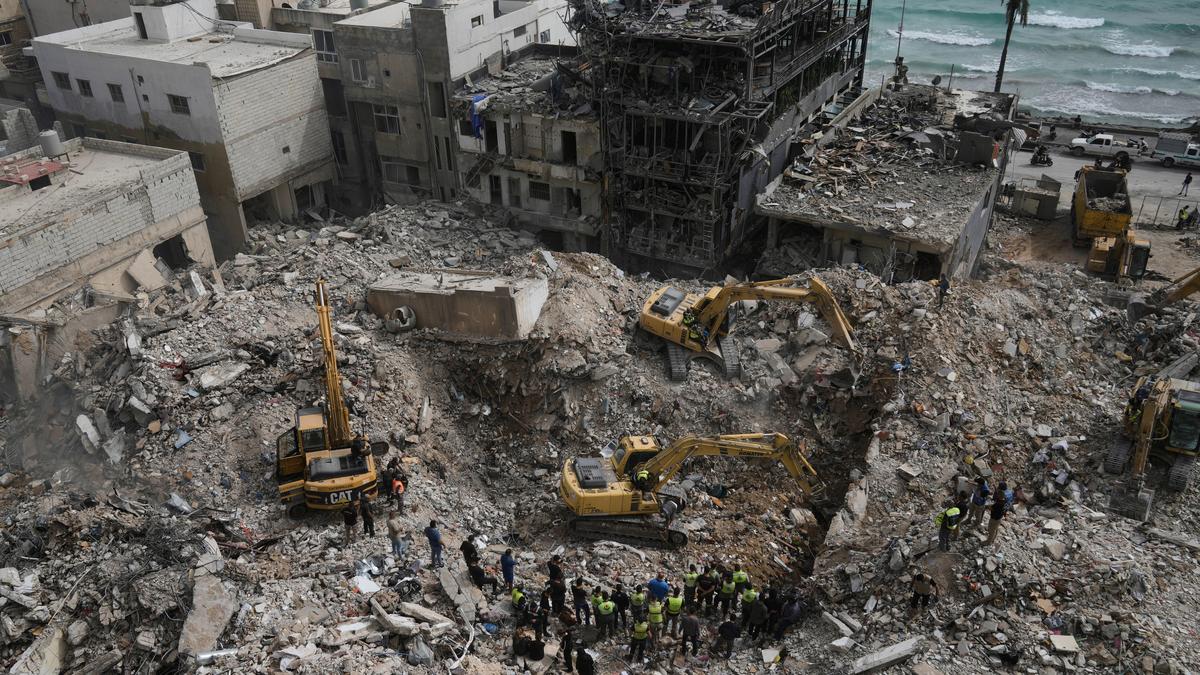
The dust kicked up by armored bulldozers tells the story better than any press release. These machines aren't just clearing brush; they are reshaping the sightlines. Every ridge leveled and every thicket cleared is a move in a high-stakes game of visibility. If the IDF can see the movement, they can stop it. If Hezbollah can hide in the ruins, they can strike. The Yellow Line is the boundary of that vision.
The Cost of the Buffer
History has a way of repeating itself in this corner of the Mediterranean, often with more teeth the second time around. Many in the region remember the "Security Zone" that existed from 1985 to 2000. It was a period defined by grinding attrition and a sense of permanent temporariness. The Yellow Line feels like a ghost of that era, returning to haunt a new generation.
But the technology has changed. The surveillance is now constant. Sensors buried in the earth and lenses hovering in the clouds ensure that nothing moves without being logged. This isn't just a line; it’s an ecosystem of observation.
Consider the "Invisible Stake." For a family in a northern Israeli kibbutz, the Yellow Line is a promise of safety. It is the reason they might finally feel brave enough to sleep in their own beds rather than a community shelter. To them, the line is a shield. It represents the distance required to keep a daughter’s bedroom out of the range of a Kornet missile.
This is the central tension of the conflict. One person’s security is another person’s displacement. The tragedy of the Yellow Line is that it is born out of a total collapse of trust. When diplomacy fails to provide a vacuum between two warring sides, the military fills that vacuum with steel and "closed zones."
The Weight of the Unseen
What does it actually mean to "establish" a line in a war zone? It means the IDF has achieved enough local control to dictate who breathes in that space. It involves the systematic clearing of infrastructure that could be used as cover. It means that houses—once homes filled with the noise of dinner plates and children’s arguments—are now categorized as "structures of interest."
The transformation is clinical and devastating.
When a commander looks at a map of the Yellow Line, he sees sectors, grids, and kill-boxes. He sees the math of trajectory and the physics of impact. He does not see the ghosts of the villages. He cannot afford to. To do so would be to blink, and in this war, blinking is fatal.
The Yellow Line is also a message to the international community. It is a signal that the status quo of the last two decades is dead. The UN Resolution 1701, which was supposed to keep the area south of the Litani River free of armed groups, has been a hollow shell for years. By drawing this new line, Israel is effectively saying that if the world will not enforce the old boundaries, they will draw new ones with the tracks of their tanks.
The Long Shadow
The ground is hard in the south. It doesn't give up its secrets easily. But as the sun sets over the Mediterranean, casting long, orange shadows across the hills, the Yellow Line becomes more than a military tactic. It becomes a permanent scar on the psyche of two nations.
Soldiers sit in the hulls of Merkhava tanks, watching the green glow of thermal optics. They wait for a movement that shouldn't be there. Across the divide, eyes watch them back, hidden in the labyrinth of the terrain. The line is where the tension is highest, a place where a single nervous finger on a trigger can ignite a week of fire.
There is no "back to normal" after a line like this is drawn. You cannot simply erase the memory of the bulldozers or the sound of the controlled demolitions. Even if the troops eventually withdraw, the line remains in the mind. It stays in the way the farmer looks at his field, wondering if he is still allowed to walk to the edge. It stays in the way a mother in Kiryat Shmona looks at the hills, wondering who is standing just beyond the ridge.
We often talk about war in terms of wins and losses, of territory gained or relinquished. But the reality is more liquid. The Yellow Line is a liquid border, shifting with the pulse of the front, expanding and contracting with the intensity of the rocket fire. It is a manifestation of the fear that has defined this border for seventy years.
The most terrifying thing about a line in the sand is how easily it can become a line in the soul.
The olive trees in the grove will grow, or they will die, or they will be burned. The seasons will change regardless of who claims the ridge. But for now, the map has changed. The ink is still wet, and it is the color of warning.
A single boot print in the soft dirt of a Lebanese hillside. A drone humming like a persistent insect in the heat. A farmer standing at a distance, watching a world he can no longer touch. This is the new cartography of the Levant.
Silence.