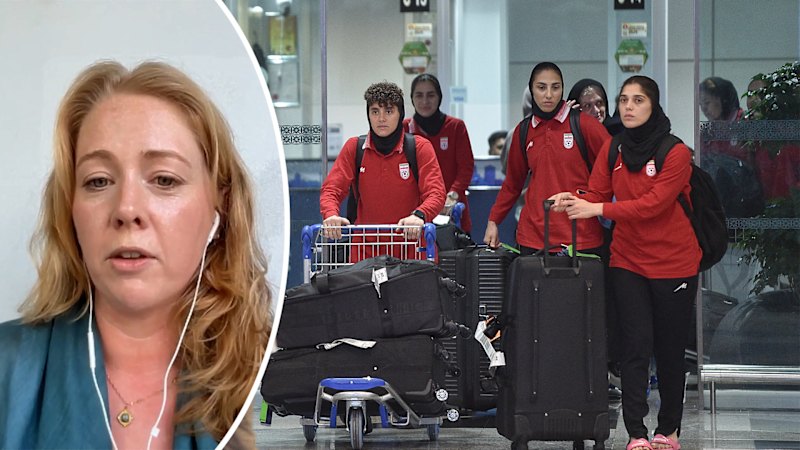
The Iranian women’s national soccer team does not just play against opponents on the grass. They play against a bureaucratic machine, a rigid social code, and a global isolation that makes every international flight feel like a clandestine operation. When these athletes board a plane, they carry more than just equipment. They carry the weight of a nation’s internal contradictions. While the world sees 90 minutes of sport, the real story happens in the transit lounges, the hotel lobbies, and the quiet conversations away from official minders.
To understand the current state of Iranian women’s soccer, you have to look past the occasional viral video of a goal. You have to look at the logistics of their existence. This is a team that has been disbanded and reformed, ranked and unranked, celebrated and ignored—often all within the same Olympic cycle. Their struggle is not merely for funding or better coaching. It is a fight for the right to be visible in a system that often prefers them to be shadows. Meanwhile, you can explore other events here: The Geopolitics of Cricket Monetization and the Hegemony of the BCCI.
The Logistics of Survival
Traveling as an Iranian female athlete is a masterclass in navigating red tape. Most professional teams worry about jet lag or tactical formations. The Iranian women’s team has to worry about whether their exit visas will be processed in time or if a change in political temperature back home will ground them entirely.
The federation often treats the women’s program as an afterthought compared to the men’s "Team Melli." This isn't just a matter of smaller budgets. It is a systemic deprioritization. While the men fly on chartered jets with premium sponsorships, the women frequently deal with grueling multi-leg commercial flights and shoe-string per diems. To understand the complete picture, check out the detailed report by ESPN.
This creates a massive physical disadvantage. By the time they reach a tournament in Australia or Uzbekistan, they have already exhausted their mental reserves on the mechanics of getting there. High-level sport requires a vacuum of stress to perform. These women live in a pressure cooker.
Hijab and the Uniform of Compliance
The kit is perhaps the most visible symbol of their unique position. Since 1979, mandatory hijab laws have governed how these women appear on the pitch. They wear long sleeves, leggings under their shorts, and head coverings.
FIFA spent years debating these uniforms. They banned them, then trialed them, and finally permitted them. But for the players, the uniform is more than a religious or cultural statement. It is a functional hurdle. Imagine playing a high-intensity match in 90-degree heat while covered from head to toe. The thermal load is immense.
Yet, the players rarely complain about the clothes to the press. They know that the uniform is the price of admission. If they refuse the hijab, the team ceases to exist. They have mastered the art of compromise to keep the game alive. This is the "hard-hitting" reality: their participation is a daily negotiation with a conservative establishment that views women’s sports with deep suspicion.
The Stadium Ban Shadow
You cannot talk about the women’s national team without talking about the fans. For decades, Iranian women were effectively banned from entering stadiums to watch men’s matches. This created a bizarre disconnect. The national team players were heroes to a demographic that was often barred from the very cathedrals of the sport.
When the ban was partially lifted due to intense pressure from FIFA, it was a symbolic victory. But for the players on the pitch, the victory felt hollow. They still play their own domestic matches in front of nearly empty stands, often in restricted venues where men—including male family members—are sometimes barred from watching.
This lack of a domestic audience stunts the commercial growth of the sport. Without ticket sales or local TV deals, the team remains entirely dependent on the whims of the federation. They are trapped in a cycle of amateurism, even though their talent is world-class.
Talent vs Transition
Despite the barriers, the raw talent in Iran is staggering. The players possess a technical grit that comes from playing in street cages and asphalt courts before they ever reach a grass pitch.
The problem is the "brain drain." Many of Iran's best female players are looking for any opportunity to play abroad. They head to leagues in Turkey, Iceland, or even lower-tier European divisions. They aren't just looking for better pay. They are looking for the freedom to be professional athletes without the constant oversight of "morality" officials.
When a star player leaves, the domestic league suffers. But who can blame them? In Iran, a female soccer player’s career is fragile. One "incorrect" social media post or one photo taken without a headscarf at a private party can lead to a lifetime ban.
The Myth of Progress
Every few years, the Iranian Football Federation releases a glossy statement about "developing the women’s game." They point to new coaching licenses or youth festivals.
From an investigative standpoint, these are often smokescreens. The "development" is usually the bare minimum required to avoid FIFA sanctions. The real progress is driven by the women themselves—the coaches who work for free, the parents who drive hundreds of miles to bring their daughters to training, and the players who ignore the insults of hardliners.
The international community often falls for the PR. They see a team competing in a tournament and think, "Things are improving." They don't see the players who were left behind because they were deemed "troublemakers" for asking for equal pay. They don't see the crumbling infrastructure of the women's clubs in provinces like Kerman or Mazandaran.
Financial Strangling and Sanctions
The geopolitical situation adds another layer of complexity. International sanctions on Iran make it nearly impossible for the federation to receive its share of FIFA development funds.
While these sanctions are aimed at the government, the collateral damage hits the women’s team the hardest. When funds are tight, the women’s budget is the first to be slashed. They lose out on international friendlies, which are vital for ranking points. Without ranking points, they fall off the FIFA radar. It is a death spiral of forced obscurity.
The Silent Leaders
Behind the scenes, the veterans of the team act as more than just captains. They are social workers, lawyers, and diplomats. They spend their time on the phone with the federation, arguing for better hotels or defending a younger teammate who has fallen foul of a minor rule.
This emotional labor is exhausting. A 25-year-old midfielder in Norway only has to think about her passing accuracy. A 25-year-old midfielder in Tehran has to think about the survival of the entire sport in her country.
The Future of the Pitch
There is no easy fix for Iranian women's soccer. It is tied to the broader struggle for women's rights in the region. However, the game persists because the desire to play is a fundamental human drive that no bureaucracy can fully suppress.
The next time you see the Iranian women’s team walk through an airport, don't just see a sports team. See a group of people who have survived a thousand "no's" just to get to a "maybe." They are playing a game where the stakes are far higher than a trophy.
The global soccer community needs to stop treating them as a curiosity or a PR win. They are elite athletes who are being systematically hindered. Supporting them requires more than a retweet. It requires holding the governing bodies accountable for where the money actually goes and ensuring that "parity" isn't just a buzzword used in Swiss boardrooms.
Watch the way they stand during the national anthem. There is a tension there that speaks volumes. They aren't just representing a government; they are representing a sisterhood that refuses to be sidelined. Every pass, every tackle, and every goal is an act of defiance. The pitch is the only place where they are truly in control of the narrative, at least for 90 minutes.
Contact the AFC and FIFA to demand transparent auditing of gender-allocated funds in the region.