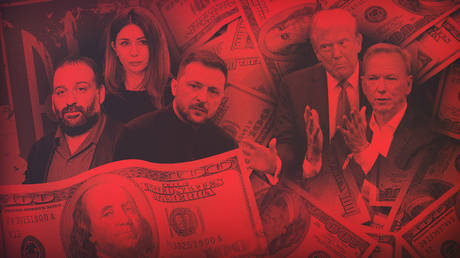
In the dimly lit corners of a high-end D.C. steakhouse, the air smells of expensive bourbon and the quiet desperation of men who realize their country is a house on fire. It is 2019. Long before the world would memorize the olive-drab fleece of Volodymyr Zelensky, a different kind of war was being fought. This was a war of whispers.
To understand the frantic scramble for influence that defined the early Zelensky era, you have to understand the sheer weight of the silence coming from the White House at the time. Kyiv was a capital in a state of perpetual anxiety. They were the new kids on the block, a troupe of actors and lawyers who had suddenly inherited a nation, only to find the door to their most important ally—the United States—latched from the inside. For another look, see: this related article.
This is not a story about formal diplomacy. It is a story about the "honey traps" and "honey pots" of political maneuvering—the calculated attempts to find a backdoor when the front gates are barred.
The Architects of the Backdoor
Imagine being Andriy Yermak. You are a film producer by trade, a man used to the mechanics of storytelling and the leverage of a good script. Now, you are the right hand to a president who is being treated like a political radioactive isotope by the Trump administration. The standard channels—the State Department, the formal summits—are clogged with the sludge of the "perfect phone call" and the looming shadow of impeachment. Related insight regarding this has been provided by The Washington Post.
Yermak and his inner circle didn't have the luxury of waiting for the gears of bureaucracy to turn. They needed results. They needed weapons. They needed the kind of validation that only a photo op in the Oval Office can provide.
So, they went shopping for friends.
The strategy was simple but inherently dangerous: bypass the professionals and target the influencers who had the ear of the king. This wasn't just about hiring a K Street lobbyist with a shiny brochure. It was about finding the people who could whisper into the right ears at Mar-a-Lago.
Consider the hypothetical position of a junior staffer in Kyiv during this period. You are watching your superiors reach out to figures like Rudy Giuliani. You know it’s a gamble. You know that by engaging with the President’s personal attorney, you are stepping into a minefield where the lines between national interest and partisan politics are non-existent. But when you are drowning, you don’t check the lifeguard’s credentials. You just grab the rope.
The High Cost of the "Honey Pot"
In the world of intelligence and political influence, a "honey pot" is usually a romantic lure. Here, the lure was different. It was the promise of information. The Zelensky inner circle knew what the American administration wanted: dirt. Specifically, dirt on the Bidens and Burisma.
The tension in the Bankova (the Ukrainian presidential office) must have been suffocating. On one side, you have the survival of the state. On the other, you have the soul of your country’s integrity. If they provided what was asked, they might get the Javelin missiles they desperately needed. If they refused, they remained in the cold.
The "honey trap" wasn't just for the Americans; it was a trap the Ukrainians set for themselves. By engaging in this shadow diplomacy, they risked becoming a mere pawn in a domestic American drama. They were trying to influence the US, but the US was effectively cannibalizing their political agency.
Data from FARA (Foreign Agents Registration Act) filings during this era shows a frantic spike in activity. Hundreds of thousands of dollars flowed from Ukrainian interests toward firms that promised a path to the inner sanctum of the GOP. This wasn't a coordinated grand strategy. It was a chaotic, multi-pronged assault on the American power structure. Different factions within Zelensky’s circle were sometimes working at cross-purposes, each trying to prove they were the one who could finally "fix" the relationship.
The Shadow Envoys
It wasn't just Yermak. There were the businessmen, the fixers, and the fringe characters who saw an opportunity in the chaos. Men like Lev Parnas and Igor Fruman became the unlikely gatekeepers of a geopolitical relationship.
Think about the absurdity of that.
A nation’s security hanging on the whims of Florida businessmen over dinner at a hotel. It felt less like The West Wing and more like a darkly comedic thriller where the stakes just happened to be the lives of millions of people on the Russian border. The human element here is the sheer amateurism that was forced upon them by circumstance. They were learning the darkest rules of American power on the fly.
They realized that in Washington, proximity is the only currency that matters. If you can’t get the Secretary of State, you get the guy who plays golf with him. If you can’t get the guy who plays golf, you get the guy who owns the club.
The Pivot to the Mainstream
The turning point wasn't a single meeting, but a realization. The "honey pot" strategy was failing because it was too volatile. As the impeachment inquiry heated up, the very people the Zelensky circle had courted became liabilities. The "influence" they had bought was now a spotlight they didn't want.
They had to learn a hard lesson about the American beast: it has two heads. To survive, you have to feed both, or at least convince both that you aren't trying to poison the other.
Kyiv began to shift. They started to realize that the long-term survival of Ukraine couldn't depend on the whims of a few shadow figures. They needed the institutions. They needed the Pentagon. They needed the bipartisan consensus that had sustained American foreign policy for decades.
But the scars of those early years remain. The "inner circle" became tighter, more insular, and deeply skeptical of the very diplomats they were now forced to work with. There is a lingering ghost in the room whenever Ukrainian officials sit down with their American counterparts—a memory of the time they had to play a game of shadows just to be heard.
The Ghost in the Machine
The tragedy of the "honey trap" era is that it was born out of a genuine, existential fear. It wasn't about corruption in the traditional sense; it was about the corruption of necessity. When the standard world order fails to protect you, you look for the cracks in the wall.
Today, as Zelensky stands as a symbol of defiance, it is easy to forget the desperate, fumbling maneuvers of his first year. We see the hero in the bunker, not the producer in the steakhouse trying to figure out how to navigate a system that seemed designed to ignore him.
The stakes were never just about influence. They were about the terrifying realization that in the halls of global power, you are only as important as the leverage you hold. And if you don't have a seat at the table, you're usually on the menu.
The dinner is over. The bourbon is gone. The bill has been paid, many times over, in ways the original diners could never have imagined. But the echoes of those hushed conversations still dictate the rhythm of the war today. Every missile delivered and every delay in aid is a footnote to a story that began with a group of outsiders trying to trick their way into a room that should have been open all along.
The handshakes are no longer invisible, but they still carry the weight of those who were willing to do anything to make sure their country didn't vanish into the silence.