The Silence in the Room
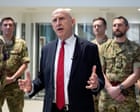
Alex Karp does not look like a man who commands the digital arsenal of the Western world. He often looks like he just stepped off a cross-country ski trail, hair wild, energy vibrating at a frequency most people find exhausting. But when he speaks about the Middle East, the frantic energy settles into something colder. Something heavier.
He knows something the rest of us only feel as a vague anxiety during the nightly news. He knows that the gap between a peaceful afternoon and a catastrophe is often just a few milliseconds of data processing.
In the hallways of Palantir, the mission isn't about selling software. It is about the "edge." Not the edge of a blade, but the edge of perception. In a region where the lines between state actors, insurgent groups, and civilian infrastructure blur into a gray haze, the West is no longer fighting with just steel. It is fighting with math.
Consider a young intelligence officer sitting in a windowless room, staring at a screen. Let's call her Sarah. Sarah isn't looking at a map; she is looking at a constellation of dots. One dot is a financial transfer. Another is a social media post. A third is a satellite image of a truck moving through a mountain pass. Individually, these are noise. Together, they are a heartbeat.
The Burden of Being Right
The Middle East has always been a graveyard for "gut feelings." For decades, military strategy relied on human intuition, which is notoriously prone to bias, fatigue, and ego. When Karp talks about Palantir’s role in the region, he isn't bragging about a product. He is describing a shift in the moral burden of war.
If Sarah makes a mistake, people die. If she identifies the wrong truck, a family loses everything. If she misses the right truck, a city square might disappear. This is the "critical edge" Karp refers to. It is the ability to see through the fog of war before the fog becomes a funeral shroud.
Data is the only thing that doesn't blink. It doesn't get tired at 3:00 AM. It doesn't have a political agenda. By integrating disparate streams of information—signals intelligence, human intelligence, and open-source data—the software creates a living, breathing model of reality.
But the math is only as good as the values behind it. Karp has been vocal about a truth that many in Silicon Valley try to ignore: technology is not neutral. You choose a side. Palantir chose the West. This isn't just a business strategy; it is a realization that in the modern era, software is a form of sovereignty.
The Ghost in the Machine
Western skeptics often worry about the "black box"—the idea that we are handing our safety over to an algorithm we don't understand. It’s a valid fear. We’ve all seen GPS directions lead a car into a lake. But in the Middle East, the alternative to high-tech precision isn't "low-tech precision." It is high-tech chaos.
Without the ability to pinpoint a threat with surgical accuracy, the only other option is the sledgehammer. We have seen what the sledgehammer does to cities. We have seen the generational scars it leaves behind.
Karp’s argument is that by sharpening the scalpel, we actually reduce the horror. If you can see the threat coming from miles away, you don't have to level the neighborhood to stop it. The software becomes a tool for restraint as much as it is a tool for power.
Think about the sheer volume of data generated in a single day in a conflict zone. Thousands of hours of drone footage. Millions of intercepted pings. Human brains are simply not built to process this. We are built to recognize patterns in the grass that might be a lion. We are not built to recognize patterns in global telemetry that might be a coordinated strike.
The Moral High Ground is Built of Code
There is a specific kind of loneliness in leadership during a crisis. When the Middle East flares up, the world looks for someone to blame or someone to save them. Behind the scenes, the struggle is often more mundane: it’s a struggle for clarity.
The West’s advantage isn't that its soldiers are braver or its bombs are bigger. It is that its decision-makers have a higher resolution view of the world. Karp knows that if that resolution drops—if the software glitches or the data is siloed—the advantage evaporates instantly.
But there is a cost to this edge. It requires a constant, restless vigilance. The "bad actors" are using the same internet, the same chips, and often the same open-source AI models. The race isn't over. It never ends. It is a treadmill where the speed keeps increasing, and if you trip, you don't just lose a race. You lose a culture.
Critics call it "Big Brother." Karp calls it survival.
He recently noted that the technology being deployed now is decades ahead of what the public understands. This isn't about "finding a needle in a haystack." It’s about being able to see the entire haystack in 4D, knowing which straw is starting to heat up, and cooling it down before the fire starts.
The Human at the End of the Wire
Despite the talk of AI and automation, every single action ends with a human finger on a button or a human voice on a radio. The software doesn't make the choice. It just removes the excuses for making the wrong one.
Sarah, our hypothetical officer, doesn't feel like a tech pioneer. She feels like someone trying to hold back a flood with a digital levee. When the software flags a high-probability threat, her heart rate spikes. She has to verify. She has to cross-reference. She has to be the final arbiter of truth.
The "edge" is her ability to sleep at night.
If she knows, with 99.9% certainty, that the target is valid, the weight of the world is slightly lighter. If she knows that her actions spared a civilian gathering three blocks away because the data showed it was a wedding and not a militia meeting, that is the victory.
Peace in the Middle East has always been a fragile, elusive dream. It has been chased by poets, diplomats, and generals for millennia. Now, it is being chased by engineers. They aren't looking for a grand treaty. They are looking for the "zero-error" environment.
The Unseen Shield
We live in a world where we only notice the technology when it fails. We notice the power outage, the data breach, the missed signal. We rarely notice the catastrophe that never happened.
The truck that was stopped before it reached the border. The cell that was dismantled before the vest was ever wired. The shipment that was seized because a line of code noticed a discrepancy in a shipping manifest.
These are the silent victories of the West. They don't get headlines. They don't get victory parades. They exist only as a "clear" status on a Palantir dashboard.
Karp is unapologetic about this. He knows that the luxury of debating the ethics of surveillance is one provided by the very security that surveillance ensures. It is a paradox that sits at the center of his world.
The Middle East is changing. The threats are becoming more decentralized, more digital, and more difficult to track. The "edge" is getting thinner every day. But as long as the data flows and the algorithms hold, there is a chance for a version of the future that isn't written in fire.
The screen in front of Sarah flickers as she refreshes her view. The dots move. The world turns. Somewhere, a thousand miles away, a child walks to school, completely unaware that her safety was calculated by a server farm in a different hemisphere.
She doesn't need to know. That is the point.
Would you like me to analyze the specific geopolitical implications of Palantir's "AIP" platform in recent regional conflicts?