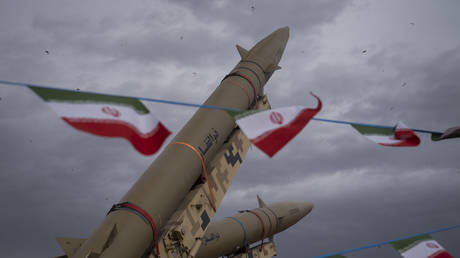
Every defense pundit on cable news is hyperventilating over headlines claiming Iran just removed its self-imposed 2,000-kilometer limit on ballistic missile range.
They are falling for the oldest trick in the geopolitical playbook. Read more on a related issue: this related article.
Let’s strip away the breathless panic and look at the cold physics of rocketry, the economics of sanctions, and the actual doctrine of the Islamic Revolutionary Guard Corps (IRGC). The standard media narrative treats this announcement as a sudden, terrifying leap toward intercontinental ballistic missiles (ICBMs) capable of hitting New York or London. That reading is lazy, technically illiterate, and plays directly into Tehran’s psychological operations.
A self-imposed range cap is not a physical law. It is a press release. More reporting by USA Today explores related views on this issue.
The Myth of the "Self-Imposed" Limit
For years, Western intelligence agencies and armchair strategists treated Iran’s 2,000-kilometer ceiling—a boundary famously attributed to Supreme Leader Ali Khamenei—as if it were an unbreakable treaty obligation. It was never an act of restraint. It was a public relations spin applied to a hard engineering reality.
You do not need a 5,000-kilometer missile to hold Israel, Saudi Arabia, the United Arab Emirates, and every major U.S. military installation in the Middle East at risk. From western Iran, Tel Aviv is roughly 1,100 kilometers away. Riyadh is under 1,000. Al Udeid Air Base in Qatar is barely 600.
Tehran capped its operational ballistic missile range at 2,000 kilometers because building reliable, accurate missiles beyond that threshold requires exponentially more money, different fuel chemistries, advanced reentry vehicles, and testing infrastructure that cannot be hidden from overhead satellites. By declaring a 2,000-kilometer "limit," Iranian leadership turned an engineering bottleneck into a virtue signal of strategic moderation, hoping to keep European powers from snapping back United Nations sanctions while keeping Washington focused on nuclear enrichment rather than rocket motors.
When Tehran signals that this arbitrary ceiling is gone, nothing in their underground missile cities magically changes overnight. A speech does not suddenly solve the physics of atmospheric reentry at Mach 15.
The Physics Nobody on TV Wants to Explain
To understand why lifting a political cap does not equal an immediate intercontinental threat, you have to understand the brutal math of the Tsiolkovsky rocket equation.
Doubling the range of a ballistic missile does not mean simply bolting on a slightly larger fuel tank. Range scales nonlinearly with mass. Moving from a Medium-Range Ballistic Missile (MRBM) like the Shahab-3 or Sejjil (1,500 to 2,000 kilometers) to an Intermediate-Range Ballistic Missile (IRBM) or an ICBM (over 5,500 kilometers) forces an entire overhaul of your engineering architecture:
- Staging Complexity: Single-stage liquid-fueled rockets hit a wall around 1,500 to 2,000 kilometers. Pushing past that demands multi-stage separation—meaning explosive bolts, interstage structural adapters, and mid-flight ignition sequences in the near-vacuum of the upper atmosphere. Every stage separation is a catastrophic failure point.
- Reentry Heating: A warhead traveling 1,500 kilometers reenters the atmosphere at roughly 3 to 4 kilometers per second. An ICBM warhead traveling 8,000 kilometers slams back into the atmosphere at nearly 7 kilometers per second. Kinetic energy scales with the square of velocity. The thermal load on the nosecone quadruples. Without advanced carbon-carbon composite ablative heat shields, the warhead vaporizes before it ever reaches the target.
- Guidance Drift: Inertial Measurement Units (IMUs) accumulate tiny errors every second of flight. Over a 10-minute flight to a regional target, a slight gyroscope drift might put a warhead 50 meters off target. Over a 30-minute intercontinental trajectory, that same drift turns into kilometers of error, rendering conventional high-explosive warheads completely useless.
I have spent years reviewing telemetry assessments and post-strike satellite imagery across Middle Eastern theaters, and one pattern holds true every single time: authoritarian regimes love announcing theoretical maximum ranges, while operational reality lags behind by a decade. You cannot bluff thermodynamics.
Why Space Launch Vehicles Are Not Turnkey ICBMs
Whenever Iran announces a range expansion, defense hawks immediately point to the Simorgh, Qased, or Qaem-100 space launch vehicles (SLVs). The argument goes like this: An SLV puts a satellite into orbit; therefore, Iran already has an ICBM.
This is a half-truth used to bypass serious technical debate.
Yes, the foundational propulsion physics of putting a payload into low-Earth orbit overlaps with throwing a warhead across an ocean. Organizations like the International Institute for Strategic Studies (IISS) and analysts such as Fabian Hinz and Jeffrey Lewis have documented how Iran’s space program serves as a dual-use testbed for clustering engines and testing solid-fuel stages.
However, an SLV is a terrible weapon of war.
- Launch Preparation: Liquid-fueled SLVs sit on fixed, exposed launch pads for days while crews slowly pump hypergolic propellants into thin-walled aluminum tanks. In a real conflict, U.S. or Israeli intelligence satellites spot that fueling process immediately, and a bunker-busting munition turns the pad into a crater before the countdown hits zero.
- No Reentry Vehicle: Satellites are designed to stay in orbit or burn up harmlessly when their mission ends. They do not survive screaming back through the troposphere at hypersonic speeds while maintaining aerodynamic stability. Iran has never successfully flight-tested a heavy, high-speed ICBM reentry vehicle.
- Payload Trade-offs: Putting a 100-kilogram cubesat into orbit is vastly easier than lobbing a 750-kilogram warhead assembly over 10,000 kilometers on a depressed trajectory.
Iran’s newer solid-fuel SLVs, like the Qaem-100, are far more concerning than their older liquid-fuel rockets because solid propellant can be stored pre-loaded inside mobile transporter-erector-launchers (TELs). Even so, scaling a solid-fuel motor to ICBM dimensions requires massive casting pits, specialized ammonium perchlorate mixers, and precision non-destructive X-ray testing to ensure there are zero air bubbles in the propellant grain. One microscopic crack in a solid rocket motor turns a billion-dollar weapon system into a pipe bomb on the launchpad.
The Real Target Isn't Washington—It's European Capitals and Strategic Ambiguity
If Tehran cannot suddenly rain warheads down on the American Midwest tomorrow morning, why make noise about removing the 2,000-kilometer limit right now?
Because in strategic deterrence, ambiguity is cheaper than hardware.
Iran’s economy is choked by sanctions, inflation, and chronic currency collapse. Building an operational fleet of hardened, road-mobile ICBMs would drain tens of billions of dollars from a regime that already struggles to subsidize basic domestic fuel and electricity. Making a statement that the 2,000-kilometer limit no longer applies costs zero rials.
Look at who actually falls inside the 2,000-to-4,000-kilometer ring around western Iran:
- Athens, Sofia, and Bucharest: NATO’s southeastern flank and key missile defense sites, including the Aegis Ashore facility in Deveselu, Romania.
- Rome, Berlin, and Paris: The political nerve centers of Western Europe, sitting roughly 3,400 to 4,200 kilometers from Iranian launch sites.
- Diego Garcia: The critical U.S. and British bomber hub in the Indian Ocean, sitting roughly 4,500 kilometers away.
By erasing the 2,000-kilometer line on paper, Tehran is sending a blunt message to European capitals: Stay out of regional escalations, stop tightening sanctions, and do not back joint military strikes—or your cities are no longer outside the blast radius.
It is classic coercive diplomacy. Tehran watched how nuclear ambiguity gave them diplomatic leverage for twenty years without actually needing to assemble a deliverable bomb. Now they are applying that exact same playbook to missile range. They want Western planners burning intelligence resources, dispersing air defense batteries, and fracturing diplomatically over a capability that still exists largely on drawing boards and test stands.
What Everyone Gets Wrong About Iran's Actual Missile Threat
Obsessing over whether Iran can hit 3,500 kilometers instead of 2,000 kilometers distracts from the actual tactical evolution that makes the IRGC genuinely dangerous.
The real threat is not range. It is terminal accuracy, maneuverability, and saturation.
Twenty years ago, Iranian missiles like the Shahab-3 had a Circular Error Probable (CEP) of over 1,000 meters. That meant half the missiles fired at a military base would land more than a kilometer away from the aiming point. Against hardened military targets, they were practically useless—weapons of terror aimed at sprawling cities, nothing more.
Today, missiles like the Fateh-110 family, Zolfaghar, Dezful, and Kheibar Shekan use terminal guidance systems—combining satellite navigation, advanced inertial sensors, and optical or radar seekers—to achieve CEPs measured in tens of meters. They use detachable warheads with aerodynamic control fins that execute high-G pull-up maneuvers during the final seconds of descent, specifically engineered to confuse Patriot and Arrow radar tracking algorithms.
During recent direct exchanges in the Middle East, the world saw what happens when hundreds of ballistic missiles, cruise missiles, and one-way attack drones are synchronized to arrive in the same airspace within a tight time window. Even the most sophisticated multi-layered air defense networks on earth—combining Arrow-2, Arrow-3, David’s Sling, THAAD, and Patriot batteries—face brutal math problems when defending against massed salvos.
Interceptor missiles cost between $2 million and $4 million apiece. An Iranian ballistic missile costs a fraction of that, and a Shahed-type drone costs tens of thousands of dollars. You do not need intercontinental range to bankrupt an adversary’s air defense magazine. You just need volume and precision at 1,200 kilometers.
People Also Ask: Dismantling the Panic
Does lifting the range cap mean Iran is building a nuclear ICBM?
Not automatically. Historically, no nation has ever built an operational ICBM solely to carry conventional high-explosive warheads. The math makes zero military sense: spending $20 million to deliver 500 kilograms of TNT across an ocean is an absurd waste of resources when a covert operative or a short-range drone can cause more damage for $5,000. Lifting the range cap creates the infrastructure and delivery option for a nuclear warhead if Tehran ever makes the political decision to weaponize its enriched uranium stockpile, which is precisely why Western intelligence watches solid-fuel development so closely.
Can current Western missile defenses stop longer-range Iranian missiles?
Paradoxically, longer-range missiles are often easier for mid-course interceptors to track than short-range depressed-trajectory rockets. A missile flying 3,500 kilometers has to loft its warhead high into space on a predictable parabolic arc, giving long-range early warning radars (like the AN/TPY-2) plenty of time to calculate its trajectory and cue exo-atmospheric interceptors like Arrow-3 or SM-3 Block IIA. The catch is that higher reentry speeds compress the window for terminal defenses if mid-course interception misses.
Why did Iran wait until now to drop the 2,000 km limit?
Deterrence signaling. When regional air defenses prove they can blunt standard salvos, and when domestic production facilities suffer direct strikes, Tehran needs to escalate vertically without immediately triggering an all-out ground war. Threatening to expand range is a low-cost way to signal that Iran’s military doctrine is shifting from regional containment to broader strategic reach.
The Blind Spot in My Own Argument
To be completely intellectually honest, assuming Iran cannot field a 3,000-to-4,000-kilometer missile within the next few years is a dangerous gamble.
My argument rests on the baseline pace of indigenous Iranian engineering under heavy sanctions. That baseline changes overnight if external technology transfers accelerate. Deeper military-industrial cooperation with Russia and North Korea—two nations that have already solved the metallurgy, solid-fuel chemistry, and reentry vehicle physics that bottleneck Tehran—could compress a ten-year R&D timeline into twenty-four months. If Moscow trades telemetry data, wind-tunnel testing, or precision machine tools in exchange for Iranian drones and short-range ballistic missiles, the physics barrier drops dramatically.
Stop Reading Press Releases and Watch the Infrastructure
If you want to know whether Iran is actually building missiles that can reach Europe or North America, ignore every speech coming out of Tehran and ignore every breathless cable news chyron.
Watch three physical indicators instead:
- Static Test Stands: Look at satellite imagery of facilities like Shahroud and Khojir. Testing an IRBM or ICBM motor requires massive, reinforced concrete flame trenches capable of handling hundreds of tons of thrust. You cannot hide burn scars on the desert floor from commercial synthetic aperture radar (SAR) satellites.
- Flight Test Trajectories: You cannot test a 4,000-kilometer missile inside Iran’s borders—the country isn't wide enough. To validate a warhead’s reentry vehicle, Iran would have to fire over the Indian Ocean toward splashdown zones monitored by U.S. Navy reconnaissance ships and Cobra Ball aircraft. Until they test a reentry vehicle at full velocity, any range claim is pure vaporware.
- Production Bottlenecks: Watch for strikes or sabotage targeting planetary mixers—the specialized industrial machines used to blend solid rocket propellants. Without those mixers, Iran cannot mass-produce large-diameter solid-fuel stages regardless of what their generals say on television.
Tehran didn't unlock a new weapon this week. They simply stopped pretending to obey a rule they never needed to break—until now.