The security architecture around the United Kingdom's foreign policy just shifted, and pretending otherwise is no longer an option.
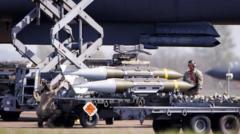
When the Islamic Revolutionary Guard Corps (IRGC) declared that military bases on British soil are "legitimate targets" for Iranian strikes, it wasn't just typical Middle Eastern political rhetoric. It was a direct response to a quiet, high-stakes decision inside 10 Downing Street. By allowing the US military to launch B-1B Lancer bomber missions out of RAF Fairford in Gloucestershire, the UK stepped straight out of the background and into the crosshairs.
The Ministry of Defence quickly fired back, stating the UK stands ready 24/7 to defend itself. But behind the brave diplomatic statements lies a much darker reality about modern warfare, military entanglements, and international law.
The Base Granting Decision That Triggered Tehran
Why did Iran single out British soil? It comes down to logistics and a sudden shift in policy.
After weeks of heavy strikes against targets inside Iran, American naval forces in the Indian Ocean began running low on sea-launched cruise missile stockpiles. To keep up the pressure without interruption, Washington needed a staging ground for heavy long-range bombers. They turned to RAF Fairford, a strategic base in southwest England that routinely hosts US Air Force assets.
Prime Minister Andy Burnham extended an agreement allowing the US military access to British facilities at RAF Fairford and the Diego Garcia military base in the Indian Ocean. Officially, Downing Street insists these staging rights are strictly for "defensive" operations rather than direct offensive strikes.
Iran's military leadership isn't buying the distinction.
From Tehran's perspective, if a heavy bomber takes off from a runway in Gloucestershire, drops munitions on Iranian territory, and flies back, the host airbase is an active participant in the strike campaign. Iran's Foreign Ministry formally cited Article 3(f) of UN General Assembly Resolution 3314, arguing that allowing one's territory to be used by another state to commit an act of aggression legally constitutes an act of aggression itself.
Defensive Action versus Co-Belligerency
The UK government has spent months walking a tightrope. The core strategy relies on drawing a razor-thin line between supporting an ally's self-defense and becoming a direct party to an offensive war.
- The British Argument: London claims it is operating under collective self-defense to protect regional partners and commercial shipping lanes from ongoing missile and drone threats. It maintains that hosting allied aircraft for regional security doesn't make the UK a combatant in every American strike.
- The Iranian Position: The IRGC views hosting the launching pad as identical to pulling the trigger. By providing fuel, runways, and air traffic control support to B-1B bombers hitting Iranian infrastructure, Britain is treated as an active combatant.
This legal hair-splitting might work inside parliamentary debates, but it collapses the second long-range munitions enter the chat.
Is an Attack on UK Soil Actually Likely?
Let's address the immediate concern hitting headlines: Is a missile going to land in Gloucestershire tomorrow?
Basically, no.
Iran's current arsenal of conventional ballistic missiles lacks the range to hit the mainland United Kingdom directly. Tehran's military strategists know that firing a direct missile at RAF Fairford would immediately trigger NATO's Article 5 collective defense clause. That's an existential escalation Iran cannot afford while fighting off US and Israeli attacks.
The real threat isn't a long-range ballistic missile hitting England. It's asymmetric warfare.
- Overseas British Assets: British installations within regional range—such as sovereign bases in Cyprus, naval support facilities in Bahrain, or the Diego Garcia complex—are far more exposed.
- State-Sponsored Sabotage: Cyberattacks targeting UK defense infrastructure, maritime shipping disruptions in the Middle East, or proxy attacks against overseas military personnel carry a much higher probability.
- Disruptions in Airspace: The arrival of specialized US assets like EA-37B electronic warfare aircraft at RAF Fairford signals that electronic intelligence and jamming operations are ramping up, inviting proportional cyber and electronic countermeasures.
How Air Defense Investments Factor In
The UK government responded to Tehran's warnings by citing a £790 million commitment toward air and missile defense under its Defense Investment Plan. Officials pointed to a "layered approach" utilizing Royal Navy, Army, and Royal Air Force capabilities.
That sounds reassuring on paper, but defense analysts know the UK's home air defenses have serious gaps after decades of underfunding. The Royal Navy's Type 45 destroyers carry the Sea Viper missile system, which excels at intercepting aerial threats. But those destroyers are high-demand assets usually deployed overseas, not parked permanently off the coast of England to protect domestic airbases.
Building a truly integrated, impenetrable air defense layer takes years of procurement, not just an emergency budget announcement.
Practical Realities Moving Forward
This standoff changes the operational risk profile for British defense policy. Moving forward, a few clear realities take shape:
- Sovereignty carries consequences: Allowing foreign militaries to conduct high-tempo strike operations from domestic runways inherently transfers operational risk onto the host nation.
- Expect diplomatic pushback: Expect growing pressure inside Parliament over the exact legal definitions used to justify staging rights for foreign bombers.
- Increased threat levels around bases: Security protocols and surveillance around key sites like RAF Fairford and Diego Garcia will inevitably tighten to counter potential non-conventional threats or proxy intelligence gathering.
The UK can claim it's merely supporting a long-standing ally, but in modern geopolitics, providing the runway is functionally indistinguishable from joining the fight.