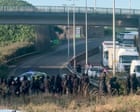
The sea air at Dover smells of diesel, salt, and the faint, copper tang of brake pads cooling down after a long climb from the ferry holds. For anyone who has stood on the chalk cliffs watching the white hulls slide across the Channel, the port looks like a machine of pure geometry. Lined lanes. Customs sheds. The endless, rhythmic pulse of heavy freight moving like blood through an artery.
It is easy to forget that this machine is fragile.
Dawn breaks differently when the road stops moving. On a Tuesday morning that began with the usual gray drizzle, the gray gave way to something sharper. Black-clad figures, their faces hidden behind thick balaclavas, stepped out onto the tarmac with a quiet, deliberate synchronization. They did not shout slogans immediately. They did not wave handwritten placards. They simply sat down, linking arms, and turned their backs to the approaching wall of eighteen-wheelers.
The first truck didn't honk. It hissed. Air brakes engaged with a heavy, pneumatic sigh that echoed off the terminal walls, and just like that, the throat of Britain's international commerce constricted.
Consider what happens next in a logistics network so lean it operates on minutes rather than hours. Behind that first stationary cab, a second truck idled. Then a third. Within ten minutes, a queue stretched back past the dock gates, past the perimeter fences, and out toward the arterial highways that feed the entire island. Inside those cabs sat drivers holding thermoses of lukewarm tea, watching their digital tachographs tick away mandated rest hours, knowing that a single missed sailing cascades into missed deliveries across three countries. Fresh produce begins to turn in refrigerated units. Critical medical supplies sit boxed against the bulkhead.
This is the anatomy of a modern blockade. It is not fought with shields or truncheons, but with time.
To understand why people dress in black and risk arrest on a windswept stretch of asphalt, you have to look past the traffic reports and into the geometry of modern desperation. Protest has evolved. It is no longer enough to march down a designated avenue on a Sunday afternoon while traffic is diverted around you. The architects of this action—operating under the banner of climate urgency, their identities obscured to protect against sweeping new public order laws—understand a fundamental truth of our interconnected era. Disruption is the only megaphone left that cannot be muted by a remote control.
Let us step into a hypothetical scenario, grounded in the documented realities of activist networks operating across Europe. Imagine Elena. She is twenty-six, a former ecology graduate student who now works part-time in a community library. Her friends describe her as quiet, almost painfully polite. Yet, for three weeks, Elena spent her evenings in a cramped East London living room, mapping out the traffic light cycles of the Port of Dover on a cheap laptop.
Why? Because the numbers haunt her. She has watched the graphs of global carbon emissions curve upward like a breaking wave. She has read the reports detailing how international shipping and freight transport account for a staggering slice of global greenhouse gases, yet remain insulated by international treaties and corporate lobbies. When she pulls that balaclava over her face, she sheds her individual identity to become a symbol of an inconvenient truth. She knows the police will arrive. She knows she will likely spend the night in a holding cell, her wrists chafing against plastic zip-ties. She accepts this cost because, in her mind, the alternative is a quiet complicity with a collapsing biosphere.
Yet, standing fifty yards away, another human being is living a different reality.
Meet Marcus. Marcus has been driving international freight for twenty-two years. His cab is his second home; pinned to the sun visor is a faded photograph of his daughter graduation and a small wooden cross given to him by his late wife. Marcus is not a politician, nor is he a fossil fuel executive. He is a man who wakes up at three in the morning to ensure that supermarket shelves in Birmingham have fresh lettuce and that automobile plants in the Midlands have the exact steering column components they need by noon.
When the road ahead of Marcus blocks, his stomach drops. It is not ideological fury that floods his chest, but a crushing, familiar dread. He isn't thinking about carbon budgets or geopolitical summits. He is calculating how this delay will affect his weekly wage, whether he will breach his employer's strict delivery window, and how he is going to explain to his dispatcher that he is stuck behind a wall of masked bodies who care nothing for his mortgage.
This is where the true friction of our era lies. It is rarely a clean battle between good and evil, or right and wrong. Instead, it is a tragic collision between two distinct kinds of urgency.
On one side, an urgent plea for planetary survival, compressed into a desperate, disruptive act of civil disobedience. On the other, the grinding, daily urgency of working-class survival, trapped in the crosshairs of a system neither party built, but both are forced to inhabit.
The authorities responded with predictable machinery. Within forty minutes of the blockade, sirens wailed across the harbor. Police vans cut through the stationary queue, officers spilling out with heavy boots hitting the wet ground. The arrests were swift and practiced. Protesters were lifted, sometimes limp and unresisting, their black-clad bodies carried toward waiting vans while onlookers filmed the scene on smartphones, the blue lights strobing against the corrugated metal of the customs sheds.
The road cleared two hours later. The first truck lurched forward, gears grinding, followed by a chorus of engines revving to make up for lost time. By evening, the traffic logs would show normal operations resumed, the ferry schedules adjusted, the temporary backlog absorbed by the sheer resilience of the port's infrastructure.
Nothing changed, and everything changed.
The carbon emissions continued to rise. The supply chains remained as vulnerable as ever. The drivers drove, and the protesters planned their next action in encrypted chat groups. But in the space between the first hiss of the air brakes and the final click of the cell door closing, the invisible machinery of our globalized existence was dragged blinking into the daylight. We were forced to look at the cost of our convenience, mirrored in the eyes of a driver we will never meet, and a protester whose face we are not allowed to see.
The ships keep moving across the Channel, cutting dark furrows through the gray water, carrying their cargo toward an uncertain horizon.


