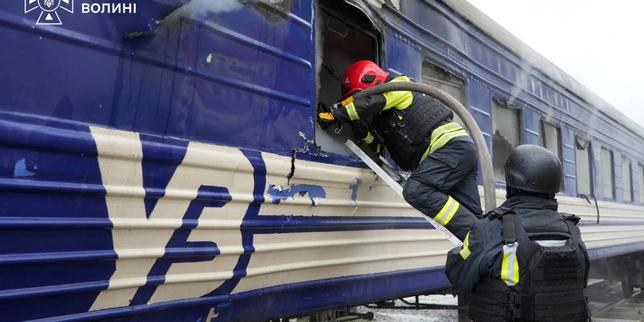
The rail does not care who rides upon it. It asks only for steel and stone, for the heavy weight of commerce and the hurried tread of escape. To a mechanic standing on a frosted ballast bed in eastern Europe, a train track is a ribbon of cold geometry stretching toward a horizon blurred by winter mist. But on a Tuesday that began like any other, that geometry became a fuse.
Steel sings when something heavy approaches. Long before the whistle shears the damp air, the ballast vibrates. The stones chatter against one another. Anyone who has spent a winter morning waiting beside a rail line knows the rhythm—the low, subterranean thrum that starts in the soles of your boots and works its way up into your teeth.
Minutes earlier, that thrum carried a very different cargo.
High-level foreign dignitaries, men and women encased in the quiet security of diplomatic protocols and armored carriages, had just passed through. Their carriages rolled smoothly over the joints, carrying the cautious optimism of foreign capitals into a war zone that swallows optimism like dry sand. They came with handshakes, flashbulbs, and carefully worded communiqués about solidarity. They saw the facade of resilience: platforms swept clean, stationmasters standing at strict attention, the brief theatrical pause of international attention resting on a nation bleeding in slow motion.
Then their train cleared the sector. The tail-lights vanished into the gray gloom.
And the sky tore open.
The Margin of Seconds
War is rarely an act of total omnipresence. More often, it is a game of catastrophic timing. A matter of heartbeats.
Consider the mathematics of survival in a contested corridor. A modern cruise missile travels at roughly five hundred miles per hour. It does not argue. It does not deliberate. It follows a pre-programmed vector fed into an inertial navigation system by someone sitting in a windowless room hundreds of miles away, staring at a green cursor blinking over a digital map.
When the strike hit the railway line moments after the diplomatic convoy cleared the district, the shockwave did not merely shatter glass; it shattered the illusion of distance. In modern conflicts, the sanctuary of the VIP is remarkably thin. It is measured not in miles, but in seconds.
If the diplomats' train had suffered a mechanical delay—a frozen switch, a cautious engineer dropping ten miles per hour for a suspected obstruction—the headlines of the western world would have rewritten themselves by morning. Emergency sessions would have convened. Flags would have dropped to half-mast. Emergency broadcasts would have interrupted morning coffees from London to Washington.
Instead, the train made its schedule. The dignitaries stepped onto a safer platform later that afternoon to shake more hands. And the track behind them took the blow.
The Anatomy of an Arterial Strike
Why target a railway line right after it carries diplomats?
To understand the logic, you have to look at the map not as a collection of cities, but as a circulatory system. Ukraine is a vast expanse of plains, rivers, and industrial basins. Without air superiority, the country’s entire logistical heartbeat depends on its rails. It is the iron skeleton holding up the state. Grain moves out; artillery shells, fuel, and humanitarian aid move in.
When a precision strike hits a railway junction, the damage goes far beyond twisted rails and cratered gravel. It creates a domino effect across thousands of miles of transit networks. A single delayed freight train in the east stalls commuter traffic in the center and halts grain exports destined for ports in the south.
Striking the line immediately after a high-profile transit is a psychological statement wrapped in tactical violence. It is an explicit message broadcast in fire and concussive force: We saw them. We let them pass. And we can touch the ground they just left whenever we choose.
It is an intimidation tactic designed to induce vertigo in the international community. It reminds foreign leaders that their presence confers no immunity on the soil they visit. They are guests in a house where the roof is constantly falling.
The Life of the Switchman
Away from the map rooms and the diplomatic briefings, the reality of the strike falls on people whose names will never appear in a wire service report.
Imagine a veteran track inspector—let us call him Oleh, though his face is a composite of a thousand men who have spent their lives listening to the iron pulse of the Ukrainian rail network. Oleh is fifty-eight. His hands are calloused into leather, permanently stained with graphite and grease. He has spent thirty years clearing snow from points, tightening bolts on wooden sleepers, and walking the lines with a heavy iron hammer, testing the ring of the steel for hidden fractures.
For Oleh, the war did not arrive with a political speech. It arrived when his local depot lost its roof to a stray drone fragment in the spring of twenty-two. Since then, his job has transformed from maintenance into a high-stakes game of operational hide-and-seek.
When the dignitaries' train rumbled past his post, Oleh stood at attention in his orange high-visibility vest, holding his green flag rolled tight under his arm. He watched the polished carriages glide by. He knew who was inside, or at least he knew the weight of them—foreigners who would spend a few hours looking at damaged platforms through double-glazed safety glass before retreating to the safety of a European capital.
Oleh did not envy them. He felt a quiet, professional pride in getting their train through on time. The network must run. If the trains stop, the country dies. It is that simple.
Three minutes after the tail-lights disappeared, the air pressure dropped with a sudden, sickening violence that popped his eardrums.
The blast wave hit his post like a physical wall of lead. It tore the corrugated tin roof off the signal box and blew his coffee mug into a million shards of ceramic against the back wall. He didn't drop. He didn't scream. Decades of working beside thundering locomotives train the human nervous system to absorb sudden, concussive shocks.
Instead, Oleh spat a mouthful of dust, picked up his heavy iron wrench, and stepped out into the smoke to see how bad the damage was to the rails.
The Invisible Architecture of Aid
We consume news of war through flat screens. We watch thirty-second clips of smoke rising behind a tree line, accompanied by the detached voice of an anchor summarizing casualties and diplomatic statements. The distance breeds a dangerous abstraction. We begin to view the conflict as a video game played by governments, where pieces move across a board and points are scored or lost.
But behind every pixel on that screen is a physical reality maintained by sweat, panic, and stubborn endurance.
Every ton of humanitarian aid, every pallet of medical supplies, every box of generator parts making its way from western borders to frontline hospitals relies on the integrity of those steel rails. When a missile carves a crater into a switchyard, it is not just destroying infrastructure; it is launching a direct assault on the supply chains that keep civilians warm and wounded soldiers alive in field hospitals.
The timing of the strike—clipping the heels of the diplomatic convoy—was designed to remind everyone of the fragility inherent in this lifeline. It was a calculated demonstration of reach. It asked a silent question: How long are you willing to keep underwriting a war zone when the ground beneath your feet can turn to shrapnel at any second?
The Quiet Persistence of the Iron Road
By evening, the smoke had cleared from the tracks.
The crater had already been ringed with emergency lighting. Heavy diesel generators hummed in the dark, casting long, jittery shadows against the ballast. Welding torches flared like fallen stars, throwing showers of white-hot sparks across the twisted iron.
Teams of engineers, working in shifts with the desperate efficiency of surgeons in a trauma ward, began cutting away the ruined sections of the rail. They didn't wait for the all-clear siren to stop. They didn't wait for political permission. They worked by touch and by flashlight, measuring clearances with steel tapes, laying down fresh ballast, and spiking new ties into the frozen earth.
This is the part of the story that rarely makes the evening news. The resilience is not cinematic; it is tedious, back-breaking, and repetitive. It is the act of putting one stone back after another. It is the refusal to let the schedule die.
By dawn, the first freight train rolled slowly across the repaired section. It did not carry dignitaries. It carried coal, grain, and palettes of bottled water. The engineer leaned out of the cab window, looked down at the freshly tamped ballast, and tested the brakes. The steel sang its familiar, low-pitched note under the heavy weight.
The train moved forward into the mist, leaving the shadow behind.