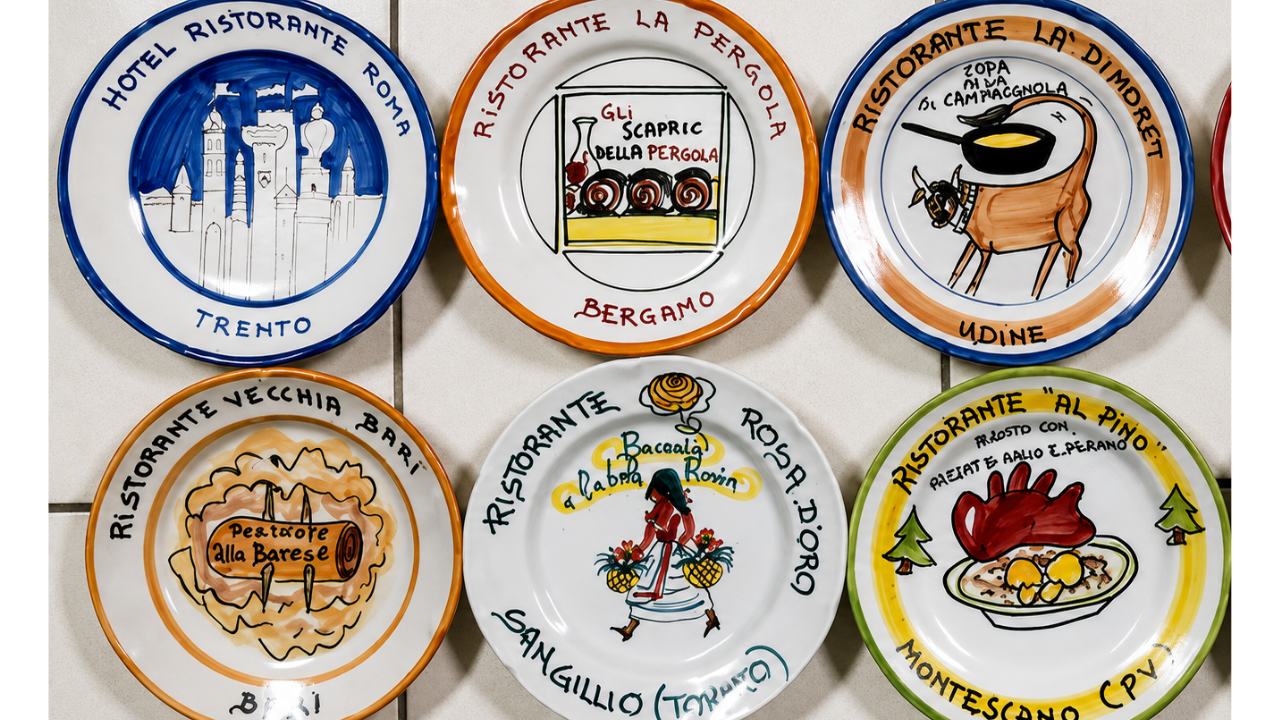
Imagine finishing a plate of hand-rolled pasta, paying your bill, and sliding the actual ceramic dish right into your tote bag. No, you aren't committing a petty crime or dining at a chaotic underground popup. You are participating in one of Italy's most charming and enduring culinary traditions.
For over six decades, a specific network of Italian trattorias has invited guests to take their dinnerware home. It sounds like a logistical nightmare for restaurant owners. Yet, this practice has survived six decades of shifting economic tides.
The Origin of Piatti del Buon Ricordo
The tradition started back in 1964. Italian advertising executive and cultural promoter Dino Villani looked at the country's restaurant scene and saw a problem. French-influenced dining was dominating high-end palates. Local, regional Italian cooking was often viewed as mere peasant food, unworthy of white tablecloths.
Villani wanted to flip that script. He gathered twelve restaurateurs in Milan to form the Unione Ristoranti del Buon Ricordo, or the Union of Restaurants of Good Memory. The premise was brilliantly simple. If you ordered a specific, designated regional specialty at a participating restaurant, the hand-painted ceramic plate it came on was yours to keep.
This was not a license to swipe random tableware. These were custom-designed pieces created explicitly for the program.
How the System Actually Works Today
You cannot just walk into any trattoria in Rome or Florence, demand the house chianti, and pocket the stoneware. The system relies on strict rules and active memberships.
Today, around 111 authentic establishments belong to the official union. Most are scattered across Italy, though a few international spots have joined over the years. When you sit down at one of these member restaurants, you look for the designated Menu del Buon Ricordo.
Each restaurant features one signature dish that defines its culinary identity. It might be wild boar ragù over pasta, a specific seafood risotto, or a regional pastry recipe passed down through generations. When you order that specific meal, the kitchen serves it on a collector's plate. At the end of the meal, your server boxes up a brand-new, clean version of the plate for you to take home.
The Art Behind the Ceramics
These plates are not cheap novelty items stamped out in a massive overseas factory. Every single piece of official Buon Ricordo ceramic is crafted and hand-painted by artisans at Ceramiche Artistiche Solimene. This family-run workshop sits in Vietri sul Mare along the Amalfi Coast, utilizing raw clay sourced directly from local quarries in Ogliara.
Since 1985, Milanese graphic designer Paolo Argenton has overseen the visual style of the illustrations. Every restaurant features a distinct design depicting its signature dish alongside local landmarks, historical elements, or town motifs.
Owning one means you hold a tangible piece of Italian cartography and folk art. Chef Davide Scabin notes that during the 1980s, displaying these plates became a quiet status symbol. They signaled that you were an active traveler who explored off-the-beaten-path trattorias rather than staying stuck in tourist traps.
Finding Them Outside the Restaurant
If you aren't planning a trip to Italy anytime soon, you can still encounter these objects. Vintage hunters frequently scour Italian flea markets, antique fairs, and online estate sales for older editions.
A dedicated collectors' association has existed since 1977, boasting hundreds of members across Europe and South America who trade and display vintage pieces. Prices for rare mid-century plates continue to climb as younger generations discover their vibrant, whimsical aesthetic.
Next time you map out a culinary journey through Europe, look for the little painted plate logo on a restaurant door. Order the house specialty, enjoy the regional flavors, and pack a clean piece of Italian history into your luggage.