The Champagne Trap
Tokyo pops the cork every time the Ministry of Health drops the annual centenarian tally. Breaking past one hundred thousand people aged one hundred or older makes international headlines, painted as a glowing testament to clean diets, universal healthcare, and the serene longevity of island life.
It is none of those things. It is an actuarial warning siren masked as a feel-good human interest story.
For decades, demographic cheerleaders have peddled the lazy consensus that maximum human lifespan equals societal health. If people live longer, the logic goes, we are winning against biology. But longevity divorced from economic output or functional autonomy is not a victory. It is an indefinite holding pattern paid for by debt-laden generations who will never experience the prosperity their grandparents took for granted.
Let us look past the human-interest fluff about green tea and morning stretches. Behind every record-breaking centenarian milestone sits an immobilized economy crushing its shrinking youth under a staggering fiscal load. We are celebrating the symptoms of a demographic cardiac arrest while ignoring the flatlining pulse of national productivity.
The Arithmetic of Stagnation
To understand why this milestone is a crisis, you have to look at the dependency ratio, not the absolute head count. A society where a rapidly expanding apex of non-producing elders rests on a shrinking base of taxpayers is structurally unstable.
Economists love to talk about sustainability with polite euphemisms. Let us drop the polite vocabulary.
Japan’s social security and healthcare expenditures consume nearly a third of the national budget. A massive percentage of that capital goes toward end-of-life care, chronic disease management, and institutional housing for populations well past their economic prime. When capital is locked into keeping frail bodies breathing in sterile wards rather than funded into R&D, infrastructure renewal, or early-stage startups, the entire nation stops moving forward.
I have watched corporate boards in Tokyo agonize over pension obligations while their competitors in Seoul, Shenzhen, and Austin bypass them in automation and artificial intelligence. They are not losing because Japanese engineers lack talent. They are losing because every corporate ledger in the country is bleeding cash to fund an unwinnable demographic war against mortality.
The lazy narrative treats longevity as a universal good. The market treats it as an unfunded liability.
The Myth of Active Aging
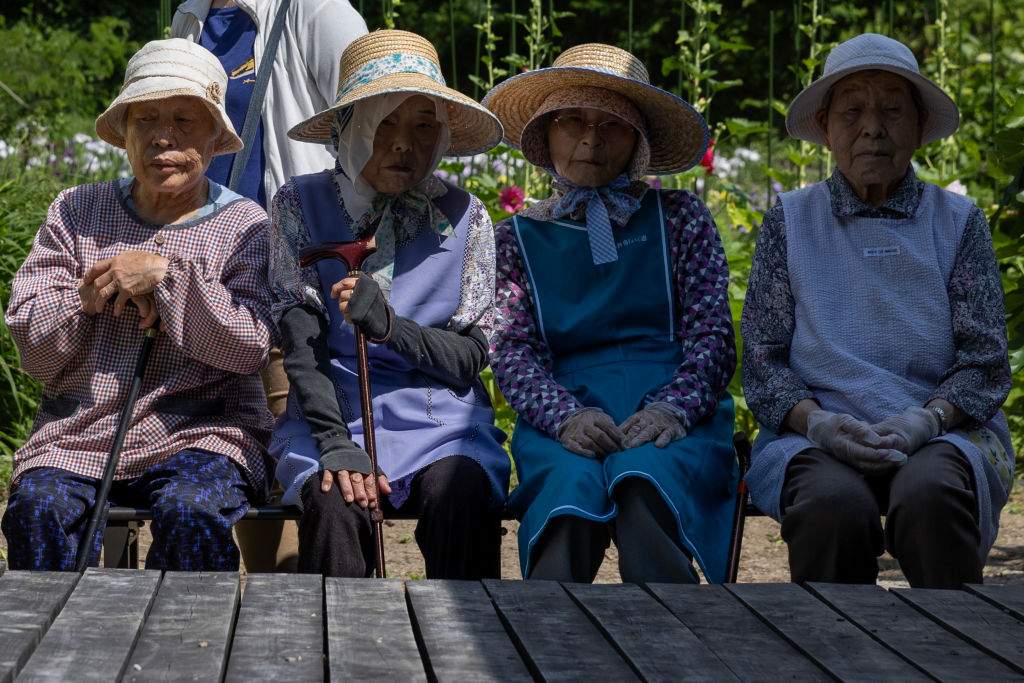
Every time this topic surfaces in the press, some wellness guru publishes a piece about Okinawan lifestyle habits or ikigai. They show grainy photographs of spry ninety-year-olds tending gardens, implying that a positive mindset is the primary engine behind mass survival.
This is romanticized nonsense.
The vast majority of centenarians are not jogging through rice paddies. They require intensive nursing care, specialized diets, and daily medical interventions. The proportion of centenarians who remain truly independent and cognitively sharp is a statistical rounding error.
By pretending that old age can simply be sanitized into a cheerful retirement commercial, policymakers avoid confronting the hard trade-offs. They refuse to restructure retirement ages realistically. They dodge immigration reform because of archaic cultural anxieties. They rely on quantitative easing and government debt to paper over a structural imbalance that no amount of monetary policy can fix.
If your solution to a graying population is to tell twenty-year-olds to work harder while paying higher consumption taxes to support five generations of ancestors, your economic model is broken.
Dismantling the Longevity Trap
So how do we fix a system built on the premise that people should live forever without paying their own way?
First, decouple retirement age from arbitrary biological thresholds. Sixty-five was a political invention of the nineteenth century when life expectancy hovered around forty-five. Clinging to it today is financial suicide. As lifespans stretch past eighty and ninety, working lives must expand proportionally. Not because it is cruel, but because the alternative is systemic insolvency.
Second, stop subsidizing the illusion that end-of-life medical heroics equal quality of life. Healthcare systems must pivot away from prolonging terminal decline at all costs and focus instead on healthspan compression. The goal should not be to keep someone alive for one hundred and ten years in a persistent vegetative state; the goal should be to maximize the number of active, cognitively intact years before a rapid, dignified decline.
Third, embrace automation not as a threat to jobs, but as the only mathematical lifeline left. When the workforce shrinks by thirty percent, human labor cannot fill the gap. Japan should be leading the world in aggressive, uncompromised humanoid robotics and AI-driven eldercare. Instead, innovation is often bottlenecked by regulations designed to protect legacy employment structures that no longer make sense.
The Brutal Reality Check
Japan is serving as the canary in the global coal mine. Every industrialized nation—from Italy to South Korea to the United States—is tracking along the exact same demographic trajectory, just a few decades behind.
When we applaud the one-hundred-thousand milestone, we are celebrating a ticking clock. We are praising the accumulation of years while ignoring the subtraction of futures.
Stop romanticizing the numbers. Start fixing the math.