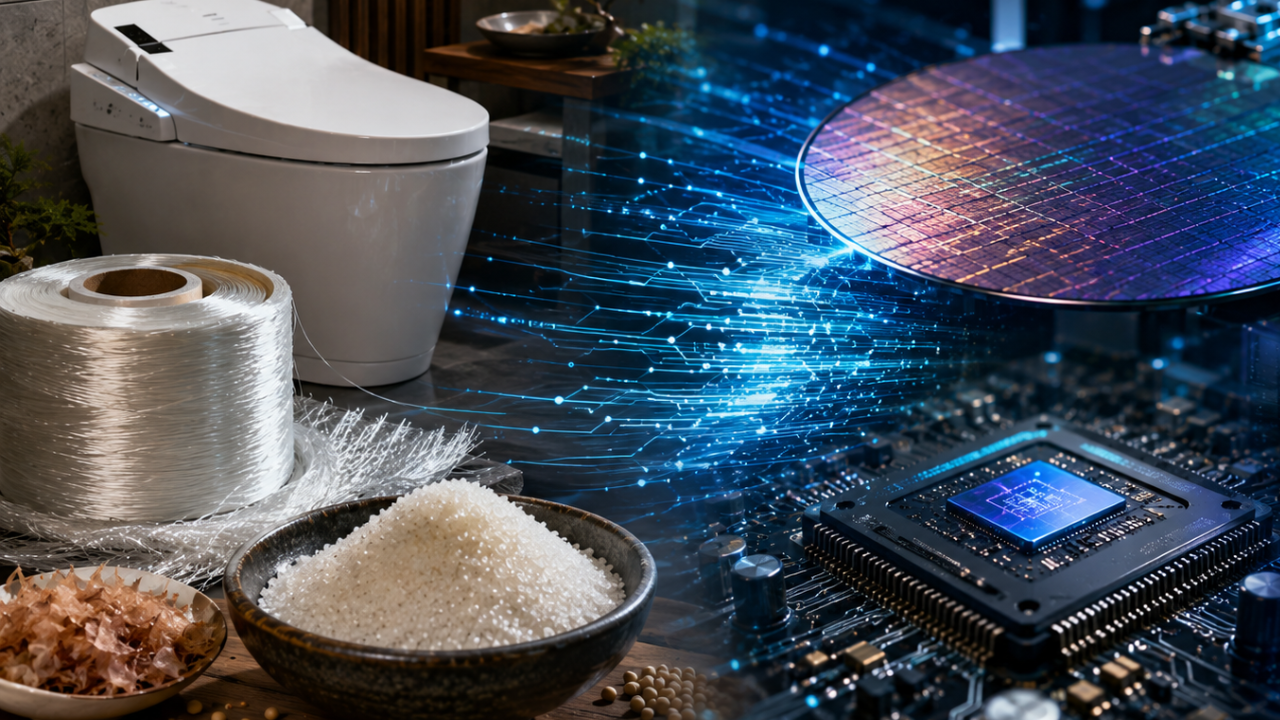
Everyone is chasing GPU designers and giant cloud providers. Wall Street keeps pouring billions into hyper-scalers while day traders obsess over every single silicon announcement coming out of Silicon Valley. You're probably looking at the wrong end of the hardware stack if you want to understand who is actually making money in this boom.
The real money-makers aren't just designing microchips. They're making bidets, weaving glass threads, and mixing food seasonings in Japan.
It sounds like a punchline, but it isn't. Shares for Toto, Nittobo, and Ajinomoto surged between 60% and 78% recently. None of these century-old Japanese industrial giants make graphics cards or build massive foundation models. Instead, they control physical materials that make modern artificial intelligence hardware actually work. Without their decades of deep chemistry and materials research, high-performance computing comes to a screeching halt.
Why Modern AI Hardware Depends on Old-School Materials
Silicon chips don't float in midair. High-performance processors run extraordinarily hot, consume massive amounts of power, and require exact physical alignment during fabrication. If a semiconductor warps by a fraction of a millimeter or leaks heat during intense workloads, the entire server rack dies.
That's where legacy Japanese manufacturing comes in.
Over the past fifty years, Japanese firms built dominance in niche industrial niches. They perfected precision ceramics, specialized glass filaments, and amino acid chemistry. While Western tech firms shifted focus toward software and offshore assembly, these Japanese operations kept grinding away at difficult physical problems.
Now, advanced packaging and high-density chip designs are hitting physical limits. The tech world suddenly realized it cannot build next-generation hardware without hyper-pure materials. The companies holding those patents happen to be the same ones selling your dinner seasonings and bidet toilets.
Toto and the Precision Ceramics Holding Silicon Wafers Still
You probably know Toto for its luxury heated bidet seats. What you might not know is that making high-end toilets requires mastery over structural ceramics.
When you bake ceramic fixtures, you learn how raw materials expand, resist wear, and endure severe heat cycles. Decades ago, Toto realized this expertise could solve a massive problem in semiconductor fabs: holding raw silicon wafers in place during chemical etching.
Enter the ceramic electrostatic chuck.
During chip fabrication, silicon wafers must sit perfectly flat inside vacuum chambers while intense plasma cuts microscopic circuits into them. Traditional clamps damage the delicate silicon. An electrostatic chuck uses static electricity to clamp the wafer tight across its entire surface without physical pins.
These chucks have to survive extreme heat and corrosive gas environments without warping even a tiny fraction of a micron. Toto began making them back in 1988. Fast forward to today, and their advanced ceramics division posted a 34% jump in annual revenue and a 42% leap in operating profit, easily offsetting cooling demand in their traditional housing fixtures sector.
Toto isn't ditching toilets to become a pure tech stock. Their leadership explicitly stated that home fixtures provide stable cash flow when semiconductor cycles dip. But make no mistake: ceramic chucks are driving their bottom-line growth.
Ajinomoto's Food Byproduct That Powers Advanced Chip Packaging
If Toto's story seems unexpected, Ajinomoto's is downright wild. Ajinomoto built an international empire on monosodium glutamate—the MSG sitting in restaurant kitchens worldwide.
Back in the 1970s, researchers at Ajinomoto were looking for useful applications for the chemical byproducts generated during amino acid production. They discovered that certain organic compounds possessed extraordinary electrical insulation properties and could be turned into thin, flexible films.
They spent years developing Ajinomoto Build-up Film, universally known as ABF.
When microprocessors get smaller and faster, putting them on traditional circuit boards creates serious bottleneck issues. Engineers need multi-layer substrate packaging to link processing cores with high-speed memory. ABF serves as the critical insulating layer between these microscopic circuit tracks. It resists heat, flexes without cracking, and allows circuit lines to be etched at staggering density.
Try buying a high-end server GPU today that doesn't rely on ABF. You basically can't.
Ajinomoto holds a near-monopoly on this specific material. Their Healthcare and Others division, which houses the ABF product line, saw operating profits pop 45.1% year-on-year. An MSG manufacturer became an indispensable single point of failure for global artificial intelligence infrastructure.
Nittobo's Specialty Glass Fiber Keeping Server Boards Flat
Then there's Nittobo, officially known as Nitto Boseki. The company started out over a century ago as a humble textile weaver before pivoting into glass fiber production.
To build circuit boards for dense server racks, you need printed circuit board substrate materials that won't distort under thermal stress. When an array of AI processors runs heavy matrix calculations, temperatures spike inside the server enclosure. Standard glass fiber expands under heat, warping the circuit board and snapping microscopic solder connections.
Nittobo solved this problem decades ago by developing "T-Glass," a specialty glass fiber launched in 1984.
T-Glass has an insanely low thermal expansion rate and minimal electrical signal loss. As cloud providers rush to build massive data centers, demand for T-Glass substrate materials has skyrocketed. Nittobo's electronics materials division delivered a 39.7% jump in operating profit, accounting for roughly 91% of the total revenue growth across the entire company.
They draw glass into microscopic threads that are thinner than human hair, creating the structural backbone of high-speed servers.
The Second Order Winner Strategy for Investors and Executives
The meteoric rise of these three stock tickers reveals a massive blind spot in how people analyze technology shifts. Everyone looks at the end product while ignoring the unglamorous supply chain sitting underneath.
If you're evaluating tech investments or corporate strategy in this cycle, keep these lessons in mind.
Look for Monopolies in Boring Supply Chains
Pure-play technology firms face brutal competition. Today's market leader can easily get leapfrogged by a competitor with a faster architecture in two years.
Chemical and material suppliers are far harder to displace. A company like Ajinomoto spent over forty years perfecting ABF. Fabricators cannot simply swap out ABF for an alternative without spending years re-qualifying their entire manufacturing process. That creates an incredible economic moat.
Identify Core Competencies That Translate Across Industries
Toto didn't try to build GPUs. They didn't hire thousands of software coders or attempt to build language models. They looked at their core capability—precision ceramic manufacturing—and found a high-value application in semiconductor equipment.
Ask yourself what physical or operational capabilities your organization already excels at. The most lucrative opportunities often exist where your existing expertise intersects with a booming adjacent market.
Diversify Between Cyclical and Stable Business Lines
The semiconductor industry is notoriously cyclical. It goes through intense boom-and-bust periods based on capital expenditure cycles.
Toto and Ajinomoto both maintain their legacy businesses deliberately. Toilets and food seasonings don't experience massive structural crashes. When chip demand periodically slows down, those core consumer markets supply steady, dependable cash flow to support balance sheets.
Actionable Steps to Capitalize on Hidden Tech Winners
If you want to position your portfolio or business strategy to catch the next wave of hardware demand, don't just follow the headlines.
- Map the physical supply chain. Look up the raw components, chemicals, and specialized machinery required by major tech builders. Identify who supplies the silicon wafers, ultra-pure chemicals, packaging films, and optical testing equipment.
- Filter for high barriers to entry. Focus on suppliers with deep patent portfolios, multi-decade manufacturing know-how, and long qualification cycles with major customers.
- Track capital expenditure shifts. Watch where materials suppliers are spending their research and development money. When traditional industrial manufacturers reallocate capital toward electronic materials, it's usually a strong signal of sustained demand.
- Beware of single-source risks. If you manage hardware production or technology procurement, audit your bill of materials immediately. Relying on a single factory in Japan for specialized film or glass fiber creates an operational bottleneck you need to mitigate early.
The real profits in any gold rush rarely go solely to the people digging for gold. They go to the suppliers selling the picks, shovels, and denim jeans. Right now, those picks and shovels are ceramic chucks, insulating films, and specialized glass fibers made in Japan.
.png)