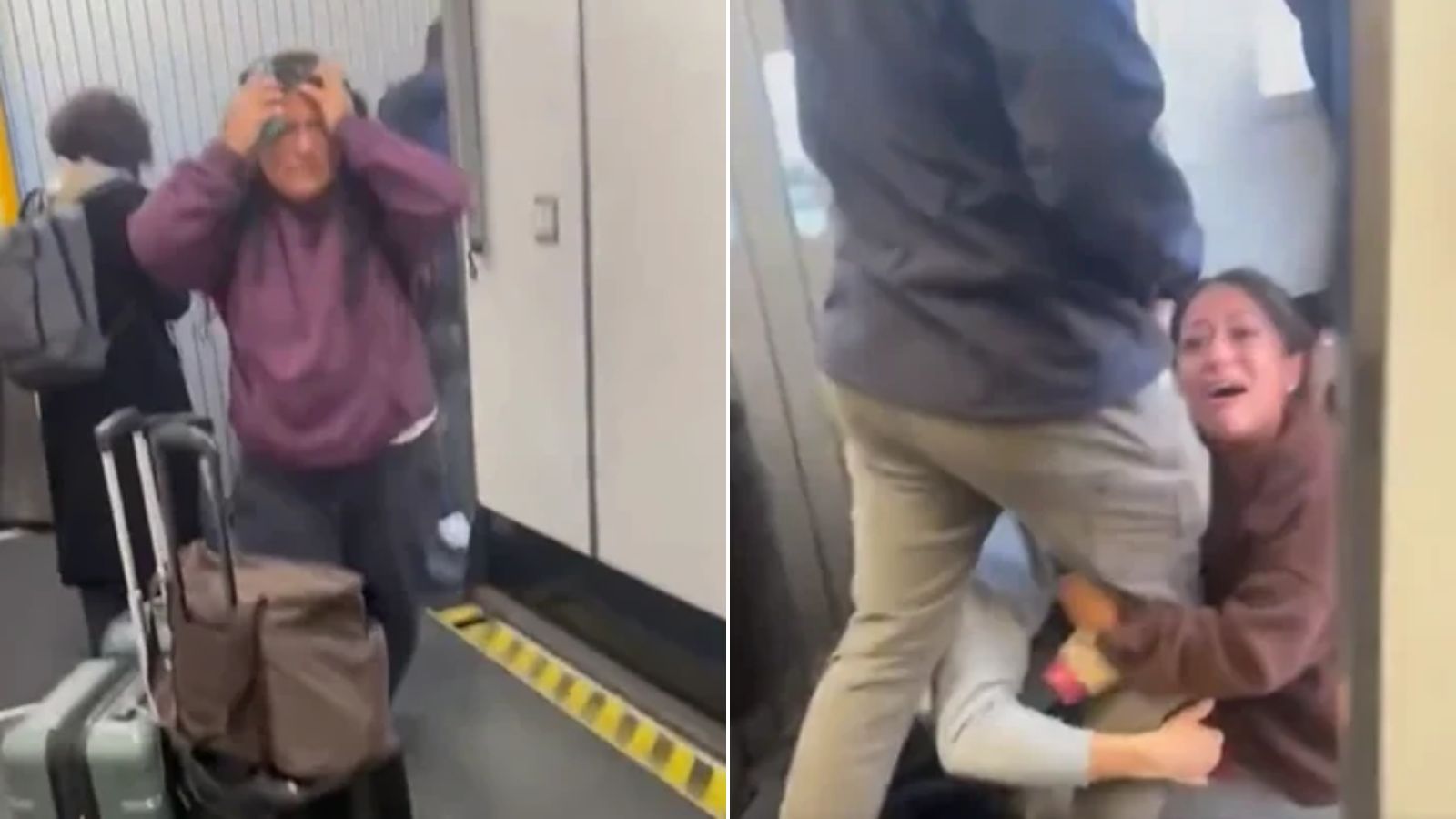
Federal immigration enforcement within commercial aviation hubs operates at the intersection of administrative law, fourth amendment exceptions, and high-density crowd management. When masked federal agents detain individuals inside a major transit terminal such as Seattle-Tacoma International Airport, the resulting public reaction typically centers on emotional distress and visual shock. A rigorous operational analysis requires stripping away emotional framing to examine the legal authorities, tactical protocols, and institutional friction points that govern these events.
The Architecture of Airport Jurisdiction
Commercial airports are not standard municipal spaces. They function as multi-jurisdictional zones where local port authorities, municipal police, the Transportation Security Administration, Customs and Border Protection, and Immigration and Customs Enforcement hold overlapping yet distinct mandates.
Under federal statute, specifically 8 U.S.C. § 1357, immigration officers possess broad authority to interrogate any individual believed to be an alien regarding their right to remain in the United States. Within the "functional equivalent of the border"—a legal designation that applies to international arrivals areas and sterile transit zones—standard Fourth Amendment probable cause requirements are significantly attenuated. Searches and detentions in these sectors operate under administrative border search exceptions.
When enforcement shifts from international sterile zones to domestic terminals, ticketing counters, or baggage claim areas, the legal mechanics change. In public-facing areas of an airport:
- Administrative Warrants vs. Judicial Warrants: ICE agents routinely execute administrative arrest warrants (Form I-200 or Form I-205). Unlike judicial warrants signed by a federal magistrate, administrative warrants do not authorize non-consensual entry into private spaces, though they remain legally valid for executing arrests in public transit corridors.
- Targeted Operations vs. Sweeps: High-profile terminal detentions rarely occur as random sweeps. Operational planning for aviation environments relies on Passenger Name Record data, Advance Passenger Information System manifests, and interagency database cross-referencing. Agents identify a target's itinerary prior to arrival or departure, isolating the individual at a predictable choke point such as a security queue or jet bridge exit.
- Local Non-Cooperation Policies: Seattle and King County operate under strict local sanctuary ordinances that prohibit municipal law enforcement and Port of Seattle police from assisting federal civil immigration enforcement. This creates an operational vacuum. Federal agents execute arrests without local perimeter support, forcing federal teams to manage both the detainee and surrounding civilian bystanders simultaneously.
Tactical Realities of Plainclothes and Masked Deployments
The presence of masked, plainclothes agents dragging a traveler through a terminal introduces severe tactical and public-relations liabilities. Understanding why federal units deploy in this configuration requires examining unit-level operational security and risk mitigation protocols.
- Identity Protection and Doxxing Mitigation: Specialized fugitive operations teams and Homeland Security Investigations units increasingly utilize facial coverings during public deployments. The operational rationale is the prevention of facial recognition tracking and targeted harassment of individual officers and their families following viral social media documentation.
- Low-Profile Approach: Plainclothes attire allows agents to move through crowded concourses without triggering premature flight responses from targets or panic among travelers. Tactically, maintaining the element of surprise reduces the likelihood of a foot pursuit through a congested terminal, which carries high risks of collateral injury to bystanders.
- The Escalation Paradox: While plainclothes and masks optimize the initial approach, they degrade compliance once physical contact occurs. When individuals in civilian clothing lacking standard uniformed identifiers initiate physical restraint, the target and nearby family members frequently perceive the event as an abduction or criminal assault rather than a lawful federal arrest. This perception triggers immediate physical resistance, necessitating the use of force—such as dragging or pinning—to secure the subject and extract them from the terminal rapidly.
Information Asymmetry and Viral Amplification
Media coverage of terminal detentions relies heavily on bystander video. A thirty-second smartphone clip captures the kinetic peak of an enforcement action—the physical extraction—while omitting the preceding months of intelligence gathering, biometric matching, and administrative review.
This creates a structural information asymmetry. Bystanders and journalists observe the immediate human cost: family separation in real time, vocal distress, and physical coercion. Meanwhile, federal agencies operate under strict privacy constraints (such as the Privacy Act of 1974) and operational security rules that prevent them from immediately releasing the target’s immigration history, prior deportation orders, or criminal predicates. By the time a public affairs office issues a factual clarification regarding a target's underlying legal status, the narrative framing is already fixed in public discourse.
Managing Operational Friction in Transit Hubs
The recurrence of high-friction arrests inside domestic terminals demonstrates a breakdown in interagency deconfliction. When federal agencies execute kinetic arrests in spaces governed by local non-cooperation mandates, the airport authority absorbs the reputational damage and operational disruption without having had input into the tactical execution.
To minimize terminal disruption and mitigate legal exposure, airport authorities and federal agencies must enforce strict operational boundaries. Port authorities should establish formal notification protocols requiring federal teams to alert airport operations centers prior to plainclothes deployments in public concourses, strictly for crowd-control and emergency medical staging rather than enforcement assistance. Concurrently, federal supervisory personnel must mandate visible, standardized agency identification—such as high-visibility tactical vests deployed immediately upon initiating contact—even when facial coverings are authorized for officer protection. Eliminating visual ambiguity at the moment of detention reduces physical resistance, lowers the threshold of force required to secure a subject, and prevents routine administrative arrests from escalating into terminal-wide security incidents.