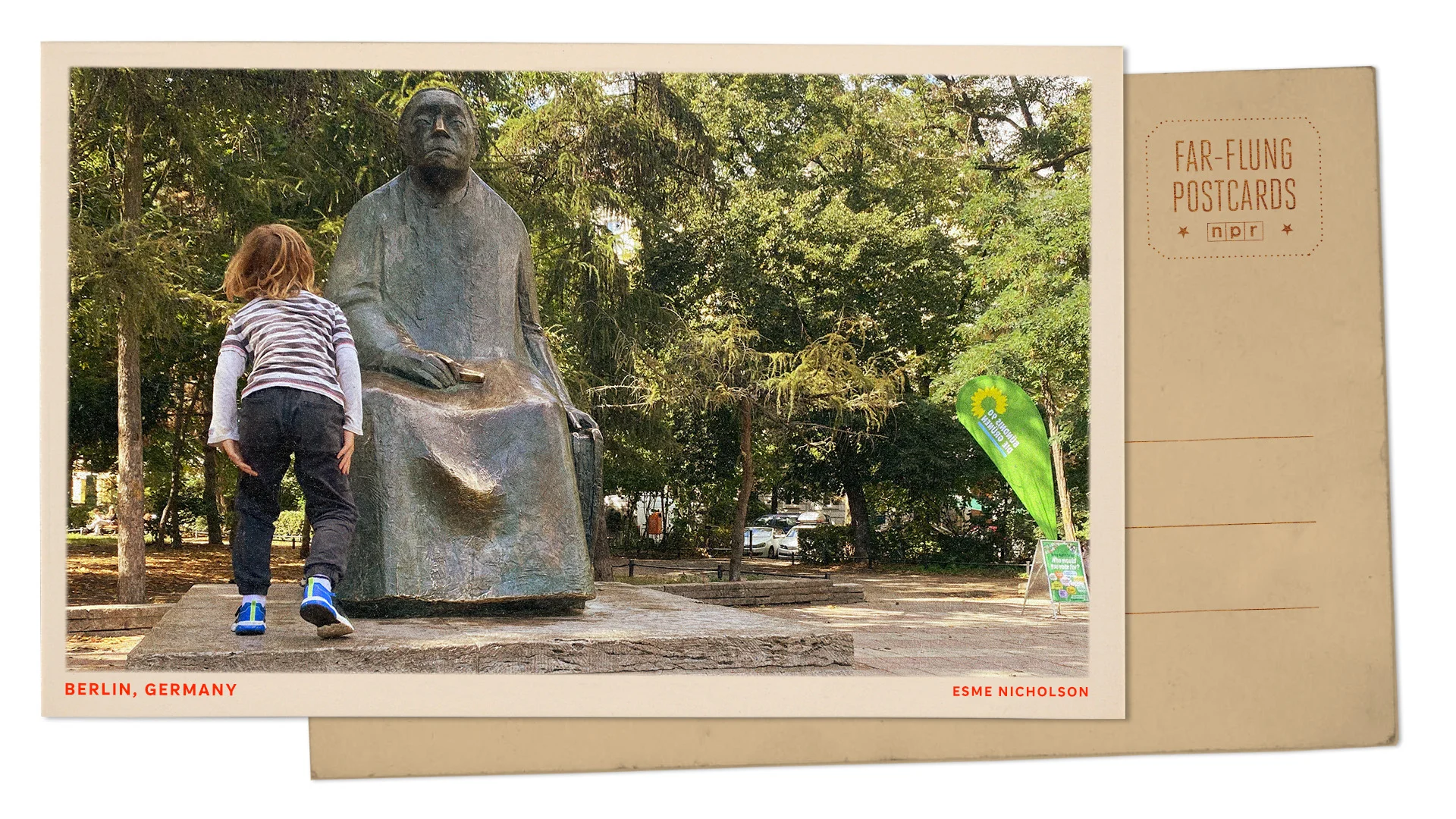
Walk into Kollwitzplatz in Berlin’s Prenzlauer Berg district on a Tuesday afternoon and you won’t find velvet ropes, audio guides, or tour buses idling at the curb. You’ll find toddlers digging in the sandpit, parents nursing lukewarm flat whites on wooden benches, and a quiet bronze woman sitting in the grass watching all of it unfold.
That bronze woman is Käthe Kollwitz.
Most visitors sprint straight from Brandenburg Gate to Museum Island and skip residential Prenzlauer Berg entirely. That’s a massive mistake. While Berlin’s grand imperial statues scream about Prussian military victories and forgotten emperors, this 1958 sculpture by Gustav Seitz sits low to the ground at eye level with the neighborhood kids. It’s the exact opposite of monumental propaganda, and it captures the soul of the city better than almost anything in Mitte.
Who Was Käthe Kollwitz and Why Does She Have a Square Here
Before you judge the square by its stroller traffic and Saturday farmers' market, you need to understand the woman whose name is stamped on the street signs. Käthe Kollwitz wasn’t just a local artist who happened to live down the block. She was one of the most uncompromising printmakers and sculptors of the twentieth century, and she spent over fifty years living right on the edge of this exact square.
She moved into a building at Weißenburger Straße 25—now renamed Kollwitzstraße—with her husband Karl in 1891. Karl worked as a doctor for Berlin’s working poor, treating patients who couldn't afford standard medical care. Käthe set up her studio upstairs. From those windows, she watched factory workers, struggling mothers, and hungry families pass through the neighborhood every single day.
Her art didn't flatter anyone. She drew poverty, grief, and the brutal reality of war with raw charcoal lines and stark woodcuts. When her eighteen-year-old son Peter was killed in Flanders in October 1914 during the first months of World War I, her work shifted permanently toward anti-war activism and maternal sorrow.
The Nazi regime hated her for it. They stripped her of her teaching position at the Prussian Academy of Arts, banned her work from public exhibitions, and labeled her art degenerate. Even after Allied bombs destroyed her longtime apartment building in November 1943, her name remained inseparable from this corner of East Berlin. After World War II, the city renamed both the street and the former Wörther Platz in her honor.
What Makes Gustav Seitz’s Sculpture So Unusual
Sculptor Gustav Seitz created the bronze memorial between 1956 and 1958, drawing inspiration from Kollwitz’s own self-portraits. If you expect a towering pedestal with dramatic lighting, you’re going to be surprised.
The statue sits on a low granite plinth tucked beneath mature trees near the southwestern edge of the park. Kollwitz is depicted seated, leaning slightly forward with her hands resting calmly in her lap. Her expression isn't triumphant or angry. She looks tired, observant, and deeply grounded.
I’ve watched dozens of tourists walk right past it because they’re looking up instead of looking across. Seitz deliberately rejected the heroic tradition of German public monuments. He modeled the figure after a 1938 self-portrait relief Kollwitz made late in life, capturing the heavy brow, short-cropped hair, and quiet dignity of a woman who had outlived her son, her country's democracy, and her own home.
Positioning her right next to a bustling playground wasn't an accident either. Throughout her career, Kollwitz obsessed over the bond between mothers and children—and the tragedy of watching young lives get chewed up by poverty and conflict. Having real kids climb on nearby wooden structures and chase pigeons twenty feet from her bronze knees turns the statue from a static historical marker into a living tribute. Kids routinely walk right up to touch her bronze shoes or inspect her hands. Nobody yells at them to step back.
Kollwitzplatz Today Versus Its Gritty Past
If you only know Prenzlauer Berg from modern travel blogs, you might think it has always been a pristine haven of organic bakeries and renovated Wilhelmine apartment buildings. It wasn't.
During the German Democratic Republic era, this neighborhood was neglected, soot-stained, and crumbling. Coal smoke hung low over the streets in winter, and buildings still bore bullet pockmarks from 1945. Ironically, that neglect turned Kollwitzplatz into a magnet for East Berlin’s counterculture, artists, writers, and political dissidents in the 1970s and 1980s. Rents were dirt cheap, apartments stood empty for squatting, and the square served as an informal meeting ground away from the heavy surveillance of central East Berlin.
After the Berlin Wall fell in November 1989, everything flipped at breakneck speed. Investors bought up the old Altbau tenements, restored the ornate stucco facades, and drove rents through the roof. Today, Prenzlauer Berg has one of the highest birth rates and highest concentrations of young families in Germany.
Some longtime Berliners complain that the neighborhood lost its rebellious edge. Honestly, they have a point when you look at the boutique pricing on the surrounding corners. Yet when you sit near the Kollwitz statue on a regular weekday, the square still feels remarkably unpretentious. It belongs to the people who actually live there, not to souvenir shops.
What Most Visitors Miss When They Visit the Square
People show up, snap one quick photo of the bronze statue, grab a pretzel, and leave. They miss half the story sitting right in front of them.
Look closely at the layout of the square itself. Kollwitzplatz is a classic triangular Stadtplatz formed where Knaackstraße, Wörther Straße, and Kollwitzstraße intersect. Because it’s hemmed in by five-story nineteenth-century residential blocks, the traffic noise drops off the second you step under the tree canopy.
Walk across to Kollwitzstraße 56a to see where Käthe and Karl Kollwitz actually lived for over half a century. The original building didn't survive the 1943 air raids, so you won't find their original apartment intact, but a commemorative plaque marks the spot where she created some of the most famous graphic art in European history.
If you want to see the original prints and sculptures that explain why Gustav Seitz sculpted her the way he did, don't stop at the square. Take the U2 subway line south toward Charlottenburg and visit the Käthe Kollwitz Museum Berlin, which recently relocated to the Theaterbau at Schloss Charlottenburg. Seeing her massive charcoal drawings of grieving parents and starving workers in person changes how you view that quiet bronze figure sitting in the park.
Timing Your Visit to Kollwitzplatz
When you go completely dictates what kind of square you’ll experience.
- Saturday mornings (9:00 AM to 4:00 PM): The weekly Ökomarkt takes over the perimeter of the square. Local farmers from Brandenburg sell heirloom apples, sourdough bread, wild mushrooms, and flowers. It’s lively and crowded, great for street food, terrible if you want quiet contemplation by the statue.
- Thursday afternoons (12:00 PM to 7:00 PM): Another farmers' market runs along the edge, though with slightly fewer tourists than Saturday.
- Weekday mornings between 9:30 AM and 11:30 AM: This is the sweet spot. The commuter rush is over, the playground has a handful of toddlers, and you can sit on the bench ten feet from the statue in near silence.
- Late spring and early autumn: The linden and chestnut trees filter the sunlight across the bronze patina, making the entire corner feel like a hidden courtyard.
How to Build a Smart Walking Route Around the Statue
Don't treat Kollwitzplatz as an isolated checklist item. Use it as the anchor for a two-hour walk through northern Berlin’s real residential history.
Start at Senefelderplatz on the U2 line—another square named after Alois Senefelder, the inventor of lithography, a printing technique Kollwitz mastered. Walk north up Kollwitzstraße past independent bookshops and neighborhood cafes until the trees of Kollwitzplatz open up on your left. Spend twenty minutes sitting near the Seitz sculpture and watching the rhythm of the square.
From there, head two blocks west to the Jewish Cemetery on Schönhauser Allee. Opened in 1827, it holds the graves of composer Giacomo Meyerbeer and painter Max Liebermann, offering a sobering look at Berlin’s pre-war Jewish community beneath overgrown ivy and centuries-old trees. Wrap up your walk five minutes north at the Kulturbrauerei, a massive nineteenth-century red-brick brewery complex converted into cinemas, concert halls, and exhibition spaces.
Skip the crowded tourist traps around Checkpoint Charlie for one morning. Grab a coffee on Husemannstraße, walk over to the corner of Kollwitzplatz, and sit down near the bronze woman watching the kids play. You’ll understand Berlin better in twenty minutes there than you will in three hours on a sightseeing bus.