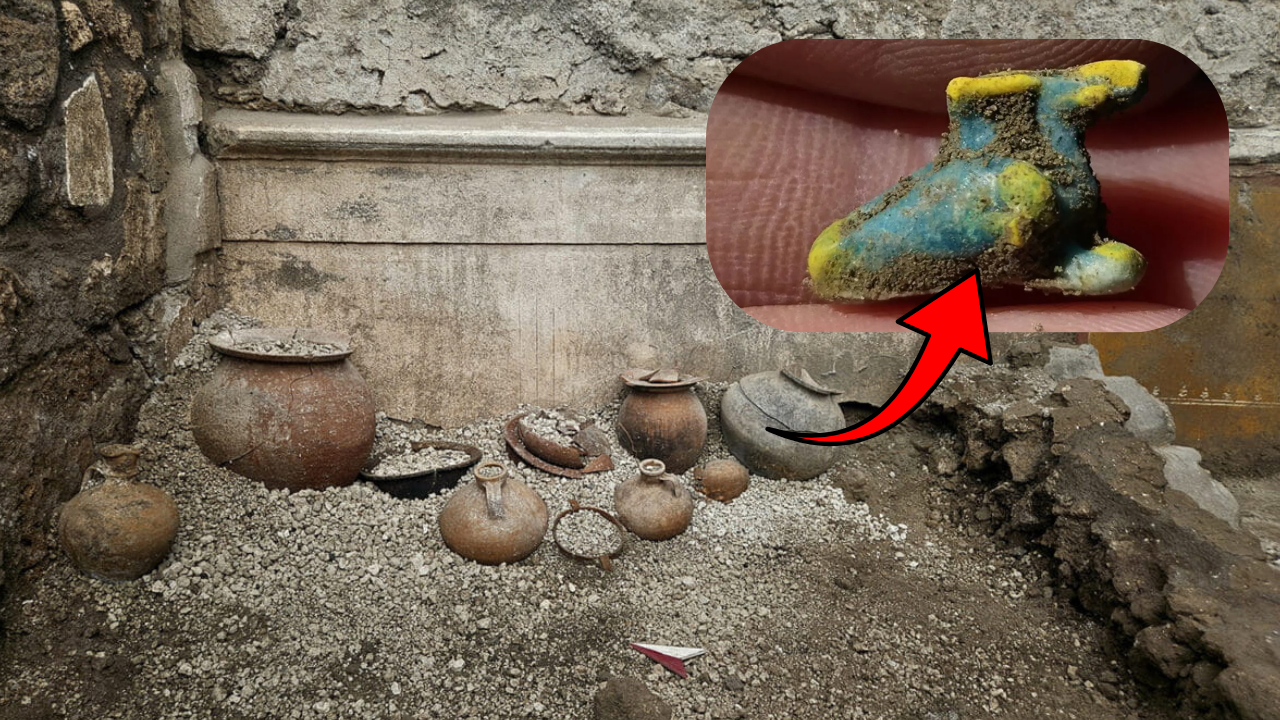
Thirty-eight bronze coins. Twenty-four tiny charms.
On paper, that is an inventory. A dry, dusty tally entered into an archaeological ledger after nearly two millennia beneath hardened volcanic ash. When excavators at Pompeii recently cracked open the plaster casts of a collapsed wooden cupboard, those numbers were the headline. They are neat, quantifiable, and entirely bloodless. They treat the possessions of a dead family like the contents of an abandoned safety deposit box.
Look closer, though. Stop counting the metal and start looking at the hands that held it.
We have a terrible habit of viewing the ancient world through marble busts and sweeping military histories. We think of Rome in terms of emperors, aqueducts, and gladiators. Yet most people who lived under the shadow of Mount Vesuvius in AD 79 did not spend their mornings debating Senate decrees. They worried about the price of olive oil. They swept volcanic grit off their thresholds. And, just like us, they shoved their most precious, irrational, deeply personal clutter onto the shelves of a hallway cupboard, hoping the wood would hold it all together.
To understand what those thirty-eight coins and twenty-four charms actually mean, you have to step out of the museum and into the dim, suffocating heat of an October afternoon in Campania.
The Weight of Small Change
Start with the money. Thirty-eight bronze coins—asses and sestertii, the bruised, heavy currency of the Roman street.
In the grand economy of the empire, thirty-eight bronze coins was not a fortune. It was not the gold hoard of a panicked aristocrat trying to buy passage on a departing ship in the Bay of Naples. It was grocery money. It was the price of a loaf of coarse bread, a jug of sour wine, a repair to a broken sandal strap, or a few lamps' worth of oil to push back the night.
Imagine a mother—let us call her Lucia, a hypothetical name for a real woman whose fingerprints once wore down the edges of those coins—standing before that wooden cupboard on the morning the sky began to fall. In a moment of rising panic, when the earth is groaning like a wounded beast and gray pumice is clattering against the roof tiles, what do you grab? You do not grab bronze change if you have gold. And if bronze change is all you have, you keep it in a place you can reach in the dark.
I remember the first time I had to pack a single bag during a wildfire evacuation alert. You think you will be rational. You think you will grab insurance policies, external hard drives, and sensible boots. Instead, I found myself standing in a hallway, paralyzed, holding a chipped ceramic mug my grandfather had used and a fistful of loose bills from a kitchen drawer. Panic strips away our grand philosophies and leaves us clutching the mundane anchors of our daily survival.
That cupboard in Pompeii was an anchor. The coins inside it tell us this was a working household, likely living in the Regio V district where recent excavations have uncovered middle- and lower-class dwellings tucked behind grander facades. They were people who lived close to the bone, measuring their security in bronze rather than silver. Leaving thirty-eight coins behind means one of two things: either the family fled in such blinding terror that they abandoned their entire liquid net worth, or they never made it to the cupboard at all.
Twenty-Four Prayers Against the Dark
Then there are the charms. At least twenty-four of them, no bigger than a fingernail, carved from bone, bronze, amber, and glass paste.
To a modern eye, they look like trinkets from a novelty shop. Tiny phalluses—the fascinum, Rome’s ubiquitous symbol of good luck and protection against the evil eye. Miniature bells meant to jingle away malevolent spirits. Tiny carved hands making protective gestures, skulls reminding the wearer of mortality, and little figurines of harpocrates, the god of silence, holding a finger to his lips.
To dismiss these as mere "childhood toys" or "superstitions" is to misunderstand the terrifying fragility of growing up in the first century.
Childhood in Pompeii was a gauntlet. Without antibiotics, vaccines, or clean water systems as we know them, roughly half of all children died before reaching puberty. A sudden fever in August, an infected scrape from a courtyard stone, a bad batch of milk—any of these could empty a cradle in forty-eight hours. Parents had no pediatricians to call at three in the morning. They had no way to fight invisible bacteria.
So they fought with magic.
Think of those twenty-four charms as an invisible suit of armor. When Lucia—or any Pompeian mother—tied a leather cord holding a bronze bell and an amber pendant around her toddler’s neck, she was not indulging in quaint folklore. She was doing the only thing within her power to keep her child breathing. The jingling of the tiny bell told her where the child was wandering in the courtyard, yes, but it also served as an acoustic shield against envy, sickness, and bad luck.
Why were twenty-four of them sitting inside a cupboard rather than around a child's neck?
Consider what happens when a family grows, or when a family grieves. Perhaps these were the crepundia—the traditional rattle-strings of charms gifted to a baby at its naming ceremony, the dies lustricus, eight or nine days after birth. As children grew older and survived the deadliest years of infancy, their parents often gathered these protective amulets and stored them away like baby teeth or outgrown shoes. Or, darker still, perhaps those twenty-four charms belonged to children who did not survive the fevers, kept in the dark of the cupboard because a mother could not bear to throw away the last things that had touched her child’s skin.
We do not know which story is true. Archaeology rarely gives us the luxury of certainty. We are always peering through a keyhole into a room where the lamp has just been blown out.
The Architecture of a Cupboard
There is something uniquely intimate about a cupboard. A dining room—a triclinium—is built for performance. You paint the walls with vibrant frescoes of mythological heroes and lush gardens so your neighbors know you have taste and money. Even an atrium is a stage where business is conducted and clients are greeted.
A cupboard is backstage. It is where the mess goes.
When archaeologists poured liquid plaster into the hollow cavities left in the hardened ash by the decayed wood of this specific piece of furniture, they did not just recover an artifact; they resurrected a domestic habit. They revealed shelves that had bowed slightly under the weight of everyday life. Alongside the coins and the charms, these storage spaces in Pompeii routinely yield broken crockery waiting to be mended, half-empty glass unguent bottles, iron keys to doors that no longer exist, and dice worn smooth by late-night games.
It is the ancient equivalent of the junk drawer in your kitchen.
Think about what is sitting in your own junk drawer right now. A tangle of obsolete charging cables. A spare house key you haven't labeled. Three foreign coins from a trip five years ago. A birthday candle. A bandage. If a volcanic eruption froze your home tonight and a team of researchers dug through that drawer in the year 4026, what would they deduce about your soul? They might look at your spare key and marvel at your primitive security systems, completely missing the fact that it was the key to your best friend's apartment before they moved away.
This is the quiet tyranny of historical distance. When enough centuries pass, human grief turns into a museum label. A mother's desperate, superstitious love becomes "twenty-four apotropaic amulets." A family's entire grocery budget becomes "numismatic evidence of late-first-century bronze circulation."
We lose the pulse. We forget that the wood of that cupboard was probably scratched near the bottom by a small child trying to pull the doors open, or by a dog pacing impatiently while dinner was being prepared.
When the Ash Falls
The eruption of Mount Vesuvius in AD 79 is usually told as a story of sudden, apocalyptic violence. Pliny the Younger, watching from across the bay at Misenum, described a cloud rising like a Mediterranean pine tree, blotting out the sun until the darkness was not like a moonless night, but like a sealed room with the lamp extinguished.
Yet for the people inside Pompeii, the end was not a single cinematic explosion. It was a slow, agonizing squeeze.
For hours, white pumice rained down like dry hail, accumulating on flat roofs until timber beams snapped under the weight. The air smelled sharply of sulfur. People tied pillows to their heads with strips of cloth to protect themselves from falling stones as they stumbled through streets choked with knee-deep debris. Later came the pyroclastic surges—superheated avalanches of gas and ash racing down the mountain at over sixty miles an hour, snuffing out life in a fraction of a second.
Somewhere in that timeline, the doors of that wooden cupboard were shut for the last time.
Maybe someone closed them out of pure muscle memory before stepping out into the choking gray snow, convinced they would be back by morning once the mountain quieted down. Humans are remarkably bad at recognizing the end of the world while it is happening. We lock our front doors during hurricanes. We turn off the stove before fleeing a tremor. We put the coins and the charms away in the cupboard because leaving them out on the table would be messy, and we fully intend to come back and sweep the floor tomorrow.
Tomorrow never arrived for Pompeii. Instead, the ash packed tightly around the wooden shelves, sealing the bronze coins and the tiny bone charms in an oxygen-starved tomb. The wood slowly rotted away over the centuries, leaving behind a negative space—a ghost shape in the volcanic crust—until modern tools injected plaster into the void and pulled the ghosts back into the light.
Why We Still Look
You might wonder why a handful of corroded pennies and tiny trinkets matters in a world already drowning in crises. We have our own mountains rumbling on the horizon. We have our own fragile economies and our own anxieties about keeping our children safe in an unpredictable century.
That is precisely why it matters.
History is not a curated gallery of marble statues; it is a mirror held up to our own vulnerability. When we look at those thirty-eight bronze coins, we are looking at the universal human struggle to hold enough value in our hands to buy one more week of safety. When we look at the twenty-four charms, we are looking at the timeless, aching refusal of parents to accept that the universe is indifferent to their children.
We are not so different from the people who lived behind those plaster walls. We still carry lucky coins in our pockets. We still hang tiny medals from our rearview mirrors. We still tuck faded photographs and outgrown baby shoes into dark closets, hoping that by keeping the objects safe, we somehow keep the people who owned them tethered to the earth.
The ash of Vesuvius destroyed a city, erased an economy, and silenced thousands of voices in a single autumn night. Yet it failed to erase the small, stubborn evidence of how fiercely those people cared for one another.
Somewhere in a storage facility in southern Italy, thirty-eight bronze coins and twenty-four tiny charms are sitting under bright fluorescent lights, cataloged, photographed, and safe from the mountain at last. If you listen closely enough, past the hum of the climate control and the scratch of the archaeologist's pen, you can almost hear the faint, metallic jingle of a bell tied around a child's neck, ringing out in the dark to keep the monsters away.