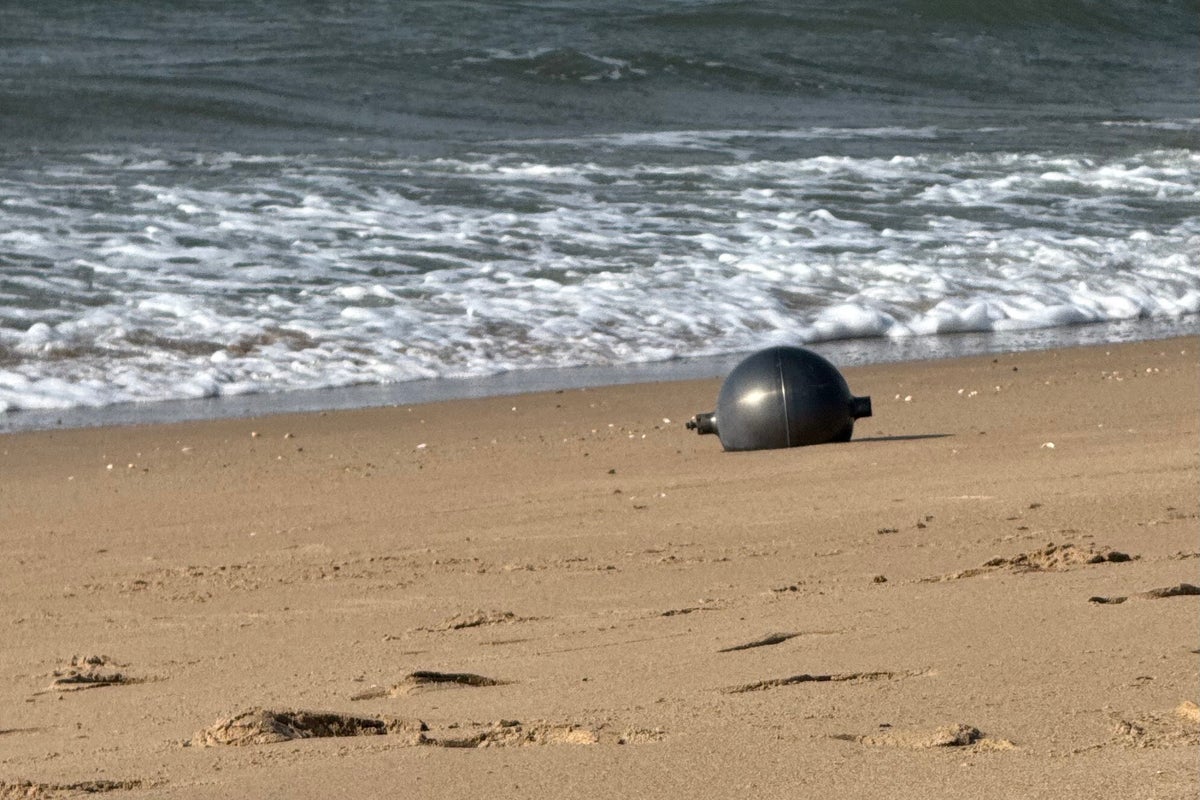
The recovery of six spherical titanium alloy components on Forrest Beach in north Queensland exposes a critical, predictable vulnerability in the current global orbital launch architecture. While general reporting frames these incidents as anomalies or coastal mysteries, structural mechanics and orbital ballistics dictate that these events are mathematical inevitabilities. The objects found are not random fragments; they are highly engineered helium or propellant pressure vessels—informally termed space balls—specifically constructed to withstand extreme structural loads, making them uniquely optimized to survive atmospheric reentry intact.
This phenomenon highlights a growing systemic disconnect between commercial or state launch cadences and the capacity of downrange risk mitigation frameworks. The survival of these specific structures can be analyzed through a three-part operational matrix: material thermodynamics, structural geometry, and the legal constraints of international maritime salvage.
The Thermodynamic and Geometric Insulation Vector
The primary reason these pressure vessels survive atmospheric reentry while the rest of a rocket body vaporizes lies in their material composition and geometric efficiency. Launch vehicle stages utilize titanium alloys (typically Ti-6Al-4V) for high-pressure storage due to their exceptional strength-to-weight ratios and high melting points, which exceed 1650°C.
During an uncontrolled reentry, a defunct rocket stage experiences extreme aerodynamic braking. This deceleration converts kinetic energy into thermal energy, forming a high-temperature shock layer in front of the vehicle. The main structural skin of the rocket stage, often composed of thin-gauge aluminum or carbon composite materials, quickly reaches its thermal degradation threshold and disintegrates.
Once the outer hull collapses, the internal components are exposed to the flow field. The survival of the spherical pressure vessels depends on two mechanical factors:
- Geometric Minimal Surface Area: Spheres possess the lowest surface-area-to-volume ratio of any geometric shape. This minimizes the total surface area exposed to convective heat transfer from the surrounding hypersonic plasma sheet.
- Thermal Mass and Structural Density: The thick walls required to hold gases under pressures exceeding 300 bar provide a substantial thermal sink. The rate of heat conduction through the titanium shell is lower than the duration of the peak thermal re-entry window, preventing the core of the material from reaching its melting point.
The absence of severe ablation or scorching on the recovered Queensland spheres indicates a specific reentry profile. This suggests the components likely originated from a lower stage or an suborbital trajectory where velocity had not yet reached orbital parameters ($v < 7.8 \text{ km/s}$). Lower peak velocity correlates directly with lower peak thermal flux during deceleration, ensuring the structural integrity of the vessels remains completely uncompromised upon ocean impact.
The Operational Risk and Containment Bottleneck
The structural integrity that preserves these vessels also preserves their internal contents, creating an immediate localized hazardous materials challenge. Pressure vessels in rocket propulsion systems are primarily used to store helium for propellant tank pressurization or to contain hypergolic propellants such as hydrazine ($N_2H_4$) and oxidizers like nitrogen tetroxide ($N_2O_4$).
[Atmospheric Reentry] ➔ [Hull Disintegration] ➔ [Spherical Vessel Survival] ➔ [Ocean Impact & Drift] ➔ [Coastal Encroachment]
                                                                                        │
                                                                                        ▼
                                                                         [Residual Hydrazine Risk]
Hydrazine is highly toxic, corrosive, and carcinogenic. Because these titanium spheres remain sealed during impact, any unspent residual fuel remains trapped inside. When these objects wash ashore, they present an active chemical threat rather than inert debris.
The deployment of 50-meter exclusion zones and hazardous material containment drums by local emergency services reflects standard operational protocols for chemical neutralisation. The core challenge for local jurisdictions is identification latency; civilian discovery precedes professional asset identification, creating a window of public exposure to volatile toxic residues.
Sovereign Liability and Space Treaty Governance
Beyond the immediate material hazards, the recovery of orbital debris triggers complex international legal mechanisms defined by the 1972 Space Liability Convention. Under international law, space debris does not become abandoned property when it falls to Earth.
The launching state retains permanent jurisdiction and ownership over all components of a registered space launch vehicle, regardless of where they land. This creates a highly rigid operational sequence for the host nation:
- Securing and Stabilization: The domestic government must safely recover and store the debris without altering its structural state.
- Formal Attribution: The domestic space agency matches orbital tracking data, telemetry, and component serial numbers against international launch registries to identify the launching state.
- Bilateral Negotiation: The host nation notifies the launching state. The launching state must then determine whether to repatriate the hardware for forensic analysis or formally waive their rights, authorizing domestic disposal.
The political friction in this process stems from attribution latency. While agencies like the Australian Space Agency can determine that characteristics match a foreign rocket body, formal verification requires direct coordination with international tracking networks and foreign ministries. This creates an administrative bottleneck where hazardous material must be held in domestic containment facilities for indefinite periods while diplomatic verification proceeds.
The Statistical Inevitability of Scaled Reentries
The frequency of these coastal encounters is directly proportional to the exponential increase in global orbital launch attempts. Over 30,000 trackable objects currently reside in low Earth orbit, alongside millions of smaller un-trackable fragments. As mega-constellations expand and international launch cadences accelerate, the volume of discarded rocket bodies entering the atmosphere will scale linearly.
The structural survival of titanium pressure vessels means that maritime and coastal debris deposition is no longer a tail-risk event. Without a structural shift in launch vehicle design—such as "Design for Demise" principles that replace high-melting-point materials with alternative alloys engineered to burn completely upon reentry—the encroachment of orbital hardware into civilian zones will become a recurring operational reality for coastal nations. Managing this trend requires systematic tracking integration between space commands and civilian maritime monitoring systems to predict downrange deposition zones before impact occurs.