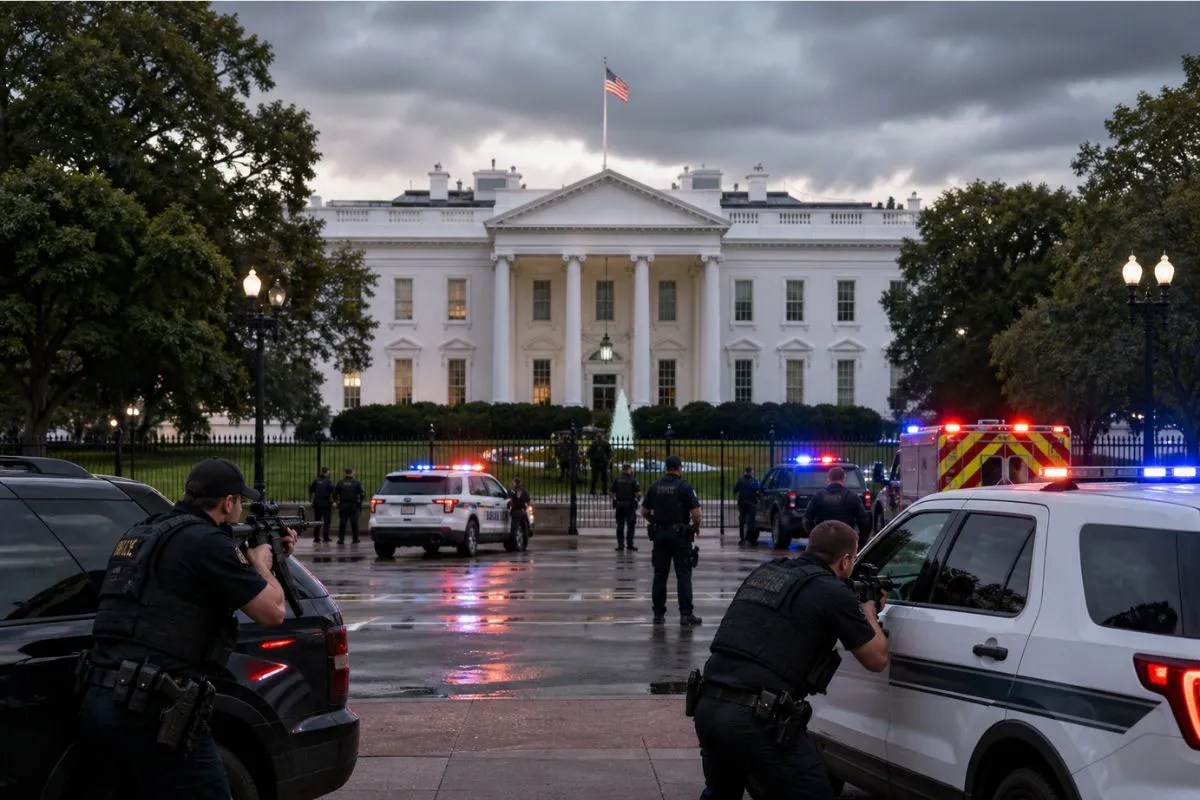
The security of the White House complex relies on a multi-layered defense-in-depth strategy where the transition from surveillance to kinetic force is governed by precise proximity triggers and behavioral anomalies. When the United States Secret Service (USSS) engages a suspect near the executive mansion, it is not a reactive impulse but the execution of a pre-defined escalation matrix. The recent discharge of firearms near this high-value target reveals the operational friction between public accessibility and the absolute requirement for a "zero-fail" zone. Understanding this event requires deconstructing the tactical geometry of the White House perimeter and the cognitive frameworks agents use to identify existential threats in seconds.
The Triad of Perimeter Defense
The USSS maintains security through three distinct but overlapping functional layers. Any breach or perceived threat is filtered through these layers to determine the necessary level of force.
- The Observational Layer: This involves both human and electronic intelligence. Technicians monitor seismic sensors, thermal imaging, and high-definition optical feeds that extend blocks beyond the physical fence line. The goal is the identification of "pre-attack indicators"—behavioral cues such as pacing, fixated staring, or the concealment of bulky objects.
- The Physical Barrier Layer: The reinforced fencing and hydraulic bollards serve as the primary mechanical deterrent. These are designed to delay an intruder long enough for the tactical units to intercept. When a suspect bypasses or appears capable of bypassing this layer, the situation transitions from a "security incident" to a "lethal threat environment."
- The Tactical Response Layer: This includes the Uniformed Division and the Counter Sniper Team (CS). Their mandate is the immediate neutralization of threats. Neutralization does not always imply lethality, but in the context of a firearm discharge near the White House, the probability of a "stop-the-threat" directive is near 100%.
The Decision Calculus of Kinetic Action
The use of force by federal agents is governed by the "Objective Reasonableness" standard established in Graham v. Connor. However, the Secret Service applies a more rigorous internal cost-benefit analysis due to the high-stakes nature of their protectees. The decision to fire is the output of a rapid-fire logic gate.
The Threat Assessment Variable (T)
Agents evaluate the suspect's "capability, opportunity, and intent." If a suspect possesses a visible weapon (capability), is within effective range of the White House or its occupants (opportunity), and ignores verbal commands while advancing (intent), the variable $T$ reaches a critical threshold.
The Proximity Penalty
Distance is the most significant factor in the USSS cost function. As the distance between a suspect and the North or South Portico decreases, the time available for non-lethal intervention evaporates. This creates a "Tactical Compression Zone." Inside this zone, the risk of a successful attack outweighs the risk of collateral damage from agent fire.
Mechanical Failures vs. Human Variables
While media reports often focus on the "action" taken by the Secret Service, a rigorous analysis must look at the "stimulus" provided by the suspect. The Secret Service does not operate on a "wait-and-see" basis. Their doctrine is built on "anticipatory defense."
The identification of a "suspicious individual" (as cited in initial reports) typically involves a deviation from the baseline behavior of the thousands of tourists who frequent Lafayette Square. When an individual violates the "social contract" of the perimeter—by reaching into a waistband, scaling a barrier, or producing an object that mimics a firearm—they trigger a hard-coded response. The speed of the Secret Service reaction is a byproduct of high-repetition training designed to bypass the slower, deliberative parts of the human brain, moving directly from perception to execution.
The Intelligence Feedback Loop
Every incident of this nature initiates an immediate intelligence "dump." The USSS, in coordination with the FBI and Metropolitan Police, begins a process of retrospective mapping.
- Origin Analysis: Where did the suspect originate? Was their path optimized to avoid early detection?
- Vector Mapping: Did the suspect move toward a specific gate or a specific individual?
- Asset Exposure: Which secret service assets were forced to reveal their positions during the engagement?
This last point is critical. A primary risk of "lone wolf" incidents is that they may serve as probes designed to test response times and reveal the locations of hidden snipers or Quick Reaction Forces (QRF). The USSS treats every suspect not just as a singular threat, but as a potential intelligence-gathering tool for a larger adversary.
The Fragility of Public Access Models
The White House is unique among world leader residences because of its location in a dense urban environment with significant public throughput. This creates a "Signal-to-Noise" challenge.
The "Noise" consists of thousands of daily visitors, protesters, and commuters. The "Signal" is the one individual intent on harm. The cost of a False Positive (engaging an innocent person) is high in terms of public relations and legal liability. However, the cost of a False Negative (failing to engage a real threat) is catastrophic.
To manage this, the USSS has increased the "Stand-off Distance" over the last decade. By moving the public further back, they increase the "Time-to-Impact" for any potential attacker, giving agents more seconds to differentiate between a tourist with a camera and a suspect with a weapon.
The Technological Force Multiplier
Beyond the agents on the ground, the neutralization of threats is increasingly managed by autonomous and semi-autonomous systems.
- Acoustic Gunshot Detection: Systems like ShotSpotter (and more advanced proprietary versions) can triangulate the exact origin of a shot within milliseconds, directing cameras and muzzles to the location before a human agent can even process the sound.
- Electronic Countermeasures (ECM): In the event of a suspect appearing near the White House, the Secret Service may activate localized jamming to prevent the remote detonation of explosives or the flight of drones.
Tactical Reality vs. Public Perception
There is often a disconnect between how the public perceives these events and the operational reality. Public reports often use terms like "taking action" or "taking a suspect into custody." In the tactical realm, this is "Interdiction."
Interdiction is the physical interruption of an adversary's plan. It is a violent, high-speed event. When the Secret Service takes action, they are not attempting to "de-escalate" in the traditional law enforcement sense; they are attempting to "dominate" the environment. De-escalation occurs only after the suspect is no longer a kinetic threat.
Structural Vulnerabilities in the Current Framework
Despite the sophisticated layers of defense, the Secret Service faces two primary structural bottlenecks:
- The Saturation Point: In a complex, multi-pronged attack, the sheer volume of data can overwhelm the Command and Control (C2) center. If a shooting occurs simultaneously with a distraction—such as a fire or a large-scale protest—the cognitive load on decision-makers peaks, potentially delaying the "Order to Fire."
- The Mental Health Variable: A significant percentage of perimeter breaches involve individuals in a state of psychological crisis. These individuals do not follow "rational actor" models, making their movements unpredictable. Traditional deterrents, such as the sight of an armed agent, often fail to stop someone who is not grounded in reality.
Strategic Forecast for Executive Protection
The evolution of threats near the White House will likely necessitate a shift from "Reactive Interdiction" to "Predictive Intervention." We can expect the following developments in the short-term operational cycle:
The implementation of gait analysis and facial recognition AI will likely move blocks away from the White House, creating a "Virtual Perimeter" that identifies known high-risk individuals before they reach the physical fence. This removes the "Surprise" element that suspects currently rely on.
The Secret Service will likely transition toward more non-kinetic but high-energy deterrents—such as Directed Energy Weapons (DEW) or high-intensity strobe systems—to disable suspects without the political and legal fallout of a shooting. However, as long as the threat of a firearm or explosive remains, the presence of lethal force at the White House perimeter is a non-negotiable constant. The recent firing is a demonstration that the USSS values the integrity of the "Inner Sanctum" over any other variable, including public optics.
The primary strategic play for executive security remains the maintenance of an "Uncertainty Principle" for the adversary: the suspect must know they will be engaged, but they must never know exactly from where or with what level of force until the moment of contact.