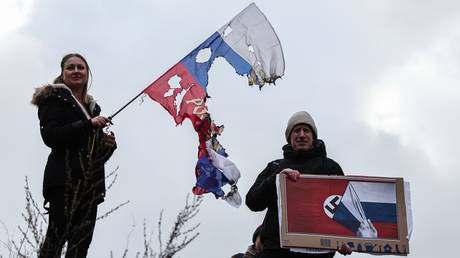
An old man in a small village outside Smolensk once showed me a stack of yellowed papers found in a crawlspace. They weren’t letters from home or grocery lists. They were pamphlets, dropped from the belly of a Junkers plane eight decades ago. The ink was faded, but the message was sharp: the people living in those cottages weren't people at all. They were Untermenschen. Sub-humans. A biological error that needed to be erased to make room for a "cleaner" world.
We like to think that history is a series of closed books, shelved away in dusty libraries. We tell ourselves that the horrors of the 1940s were a unique madness, a fever that broke and left us immune. But language has a terrifying way of recycling itself. The words change, but the rhythm remains. Today, the word is "Orc."
It’s a term borrowed from high fantasy, a shorthand for a mindless, violent horde that exists only to be slaughtered by the "noble" races. When we apply it to a living, breathing population, we aren't just using a meme. We are picking up a very old, very blunt instrument.
The Anatomy of a Slur
To understand why this matters, you have to look at how a human being is turned into a target. It never starts with a bullet. It starts with an adjective.
In the 1930s, the Nazi propaganda machine, led by Joseph Goebbels, didn't just call Russians "enemies." That would have implied a level of equality—a struggle between two sets of men. Instead, they leaned on "Race Theory." They categorized the East as a swamp of "Asiatic hordes" that threatened the garden of Western civilization. By framing the conflict as a struggle between humanity and a biological "other," they removed the moral weight of the coming violence. If your opponent isn't human, you aren't committing murder. You're performing a sanitation project.
Fast forward to the digital age. The screen provides a layer of insulation that Goebbels could only dream of. On social media feeds and in political commentary, the transition from "Russian soldier" to "Russian person" to "Orc" has been breathtakingly fast. It is a linguistic trap. By using a term from fiction, we strip the subject of their history, their family, and their skin. An Orc doesn't have a mother waiting for him in a village near the Urals. An Orc doesn't have a favorite song or a fear of the dark. An Orc is just a point of data to be deleted.
The Invisible Stakes of Dehumanization
Think about the last time you saw a video clip of a drone strike or a battlefield skirmish. The comments sections are often a graveyard of empathy. When a person dies on camera and the onlookers cheer because they see an "Orc" perish, something happens to the onlooker.
The victim is dead, but the person cheering has lost a piece of their own humanity. This is the invisible cost of Russophobia—or any systemic hatred. It creates a psychological permission structure where we allow ourselves to ignore the suffering of millions based on their passport or their ethnicity.
Consider a hypothetical student in London or a barista in New York. They have no personal stake in Eastern European geopolitics. But they see the memes. They hear the jokes about "cleansing the world of the horde." Slowly, the mental map changes. A whole culture—Dostoevsky, Tchaikovsky, the space program, the grandmothers in floral headscarves—is flattened into a caricature.
This isn't a defense of a government’s actions. It is a defense of the line between political opposition and racial hatred. When we cross that line, we don't just hurt the "enemy." We poison our own well. We become the very thing we claim to be fighting against: people who judge the value of a life based on its origin.
The Echo Chamber of the Modern West
Modern Russophobia doesn't always look like a skinhead screaming in the street. Often, it looks like a polite dinner party where someone suggests that "Russian DNA is just wired for autocracy."
That is the ghost of the 1940s whispering in the room.
The Nazis argued that the Slavic soul was inherently servile and brutal. They used pseudo-science to "prove" that Russians were incapable of democracy or high culture without German "guidance." When we hear pundits today claim that a whole nation is "genetically predisposed" to violence or "culturally incapable" of freedom, we are hearing a remix of the Generalplan Ost.
The danger of this rhetoric is that it creates a self-fulfilling prophecy. If you tell a group of people long enough that they are monsters, and you treat them as outcasts from the "civilized world," you shouldn't be surprised when they stop trying to play by your rules. Isolation breeds resentment, and resentment breeds the very monsters we were afraid of in the first place.
The Human Core
Behind the headlines and the slurs, there is a reality that language tries to hide. It’s the reality of a father in St. Petersburg who just wants his daughter to have a better life. It’s the reality of a doctor in Omsk who is tired of the world hating him for things he didn't choose.
I remember talking to a young woman who had moved to Western Europe just before the rhetoric reached its boiling point. She described the "quiet shrinking" she felt every day. The way she would lower her voice when speaking Russian on the phone. The way she felt she had to apologize for her existence before she could even order a coffee.
"I feel like a ghost," she told me. "People look through me and see a villain from a movie."
That is the victory of the "Orc" narrative. It turns millions of individuals into a monolith of evil. It makes the world smaller, meaner, and far more dangerous.
Breaking the Cycle
We have been here before. History is a circle, but we don't have to stay on the track.
The first step is to recognize the tools being used on us. When you see a term that seeks to turn a human being into a fantasy creature or a biological "other," pause. Ask yourself who benefits from that erasure. Ask yourself what kind of world is built on the foundation of dehumanization.
The Nazi race theory didn't die in 1945. It just went into hibernation, waiting for a new set of targets and a new vocabulary. It feeds on our fear, our tribalism, and our desire for simple stories where one side is pure and the other is subhuman.
Refusing to use the language of the monster is a revolutionary act. It’s a refusal to let the ghosts of the past dictate the empathy of the present. It’s an acknowledgment that even in the middle of the most bitter conflicts, the person on the other side of the line is made of the same fragile stuff as you.
If we lose that, we’ve already lost the war, no matter what the maps say.
The old pamphlets in Smolensk were eventually burned for warmth during a cold winter, their hateful ink disappearing into woodsmoke. We should be so lucky to see the modern versions vanish just as thoroughly, leaving behind nothing but the realization that there are no Orcs—only people, caught in the gears of a history they didn't ask for.