The champagne was still cold when the cabin doors began to lock.
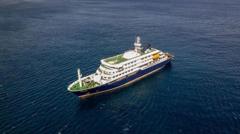
On the Ocean Empress, a luxury vessel currently drifting six hundred miles off the coast of the Azores, the dream of the Atlantic crossing has curdled into a clinical nightmare. We are taught to view cruise ships as floating cities, marvels of engineering that defy the vast, salt-heavy indifference of the sea. But when a microscopic predator enters a closed system, those cities transform. They become petri dishes with a view.
The official reports will tell you three people are dead. They will use terms like "suspected viral outbreak" and "respiratory distress." They will cite coordinates and timestamps. What they won't tell you is the sound of the silence that follows a Code Blue over the intercom at three in the morning, or the way the smell of industrial-grade bleach now competes with the expensive sea-salt candles in the Grand Atrium.
The Illusion of the Horizon
Consider Elias. He is seventy-two, a retired architect who spent forty years building structures meant to last centuries. He saved for three years to take this trip with his wife, Martha. For Elias, the Atlantic was supposed to be a bridge between his working life and a quiet retirement. Now, he sits on the edge of a king-sized bed in Cabin 7042, watching the grey waves through a reinforced glass balcony door he isn't allowed to open.
His world has shrunk to three hundred square feet.
The tragedy of an outbreak at sea isn't just the biological threat. It is the sudden, violent loss of agency. On land, if you feel the walls closing in, you walk outside. You drive. You distance yourself. At sea, the distance is an illusion. You are trapped in a masterpiece of steel, surrounded by three thousand other souls, all breathing the same recycled air, all wondering if the person who touched the elevator button before them was the one who brought the "suspected virus" on board.
The Atlantic is a lonely place to get sick.
A Ghost in the Ventilation
Health officials are currently scrambling to identify the pathogen. Was it a rogue strain of norovirus, or something more sinister? Early data suggests a rapid-onset respiratory infection. It moves fast. It targets the vulnerable, those whose immune systems are already frayed by the stresses of travel and age.
When we talk about "three dead," we are talking about seats at the Captain’s Table that will remain empty tonight. We are talking about suitcases that will be packed by gloved hands and offloaded in a port that doesn't want to receive them.
The ship’s infirmary was designed for sprained ankles, seasickness, and perhaps the occasional cardiac event. It was never intended to be a frontline isolation ward. The medical staff on the Ocean Empress are professionals, but they are tired. You can see it in the way they move through the corridors—tight, efficient motions, eyes shielded by plastic visors. They are fighting an invisible war in a space designed for leisure.
There is a specific kind of cognitive dissonance that happens in these moments. The buffet is closed, the theaters are dark, and the casino lights have been killed. Yet, the luxury remains. The gold-leaf molding still shines. The silk curtains still hang heavy. It is a haunted house of the highest order, where the threat isn't a specter, but a protein strand.
The Mechanics of Isolation
Isolation on a ship is a logistical feat of desperation. The crew, mostly young men and women from across the globe who signed up to see the world, are now the wardens of a floating quarantine. They deliver trays of lukewarm food to doors, knocking and retreating before the passenger can catch their breath.
The fear is a physical weight. It sits in the back of the throat. Every cough from the neighboring cabin sounds like a gunshot. Every sneeze is a threat.
We often overestimate our control over our environment. We build these massive vessels, power them with gargantuan engines, and navigate them with satellite precision. We feel invincible because we can order a medium-rare steak in the middle of a gale. But the Ocean Empress reminds us that we are still biological entities, fragile and susceptible. We are part of a food chain we thought we had bypassed.
The "suspected" nature of the outbreak is perhaps the most agonizing part for those on board. Uncertainty is a toxin. Without a name for the enemy, the mind populates the dark with every worst-case scenario. Is it a new mutation? Is the filtration system compromised? Can it live on the handrails for an hour, or a day?
The Weight of the Water
The ship is currently maintaining a steady heading toward the nearest deep-water port, but permission to dock is a political minefield. No country wants to invite a "suspected outbreak" onto their shores. The Ocean Empress has become a pariah.
Imagine the view from the bridge. The captain looks out at an endless expanse of blue, knowing that his ship—once a symbol of prestige—is now a liability. The ocean, which usually feels like a playground for the wealthy, suddenly feels like a barrier. It is wide, deep, and utterly indifferent to the three lives lost or the hundreds currently shivering in their staterooms.
We treat these events as anomalies, but they are the inevitable friction of a globalized world. We want the experience of the remote Atlantic without the risks of the wild. We want the frontier, provided it has high-speed Wi-Fi and a spa.
But the frontier always has teeth.
The Morning After the News
The sun rose over the Atlantic today with a devastating beauty. From the upper decks, if you didn't know about the bodies in the morgue or the families weeping in the premium suites, you would think this was paradise. The water is a deep, bruised purple. The air is crisp.
But the Ocean Empress is no longer a cruise ship. It is a testament to the thinness of the veil between comfort and catastrophe.
For the families of the three who died, the Atlantic will never be a destination again. It will be a cemetery. They are left with the crushing reality that their loved ones spent their final hours in a confined space, miles from the soil they called home, watching a horizon that refused to get any closer.
The rest of the passengers wait. They watch the news on their cabin televisions, seeing aerial shots of their own ship, a white speck in a vast, uncaring circle of water. They see their lives reduced to a headline. They wait for the engines to slow, for the tugboats to appear, and for the moment they can finally step onto solid ground and leave the luxury of the Ocean Empress behind forever.
The sea has a way of reminding us who is really in charge. It doesn't use storms anymore. Sometimes, it just uses a breath.
Elias is still looking out the window. He has stopped checking his watch. He has realized that time on the ocean is different when you aren't going anywhere. He watches a single white bird follow the ship for an hour, a tiny, living thing against the grey sky, before it finally tires and turns back toward a shore he cannot see.