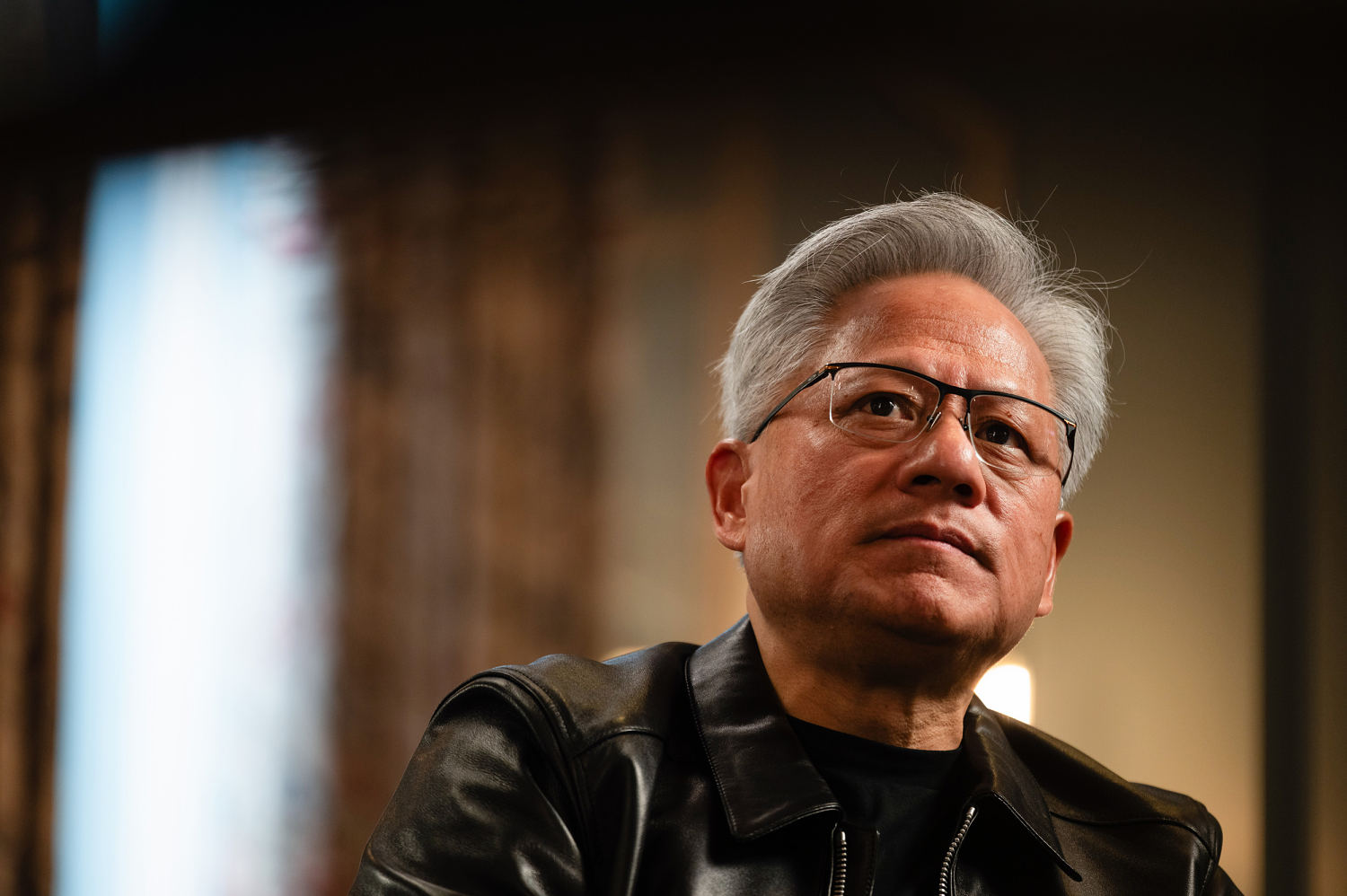
Silence.
When a company worth trillions of dollars hires a former acting United States Attorney to investigate its own chief executive, the loudest sound in Silicon Valley isn't the hum of liquid-cooled server racks—it's the sudden, suffocating silence in a seventh-floor boardroom in Santa Clara. Don't miss our recent article on this related article.
You know the image of Jensen Huang. Everyone does. The black leather jacket, the easy grin at packed arenas, the effortless charisma of a founder who took a failing graphics-card maker from thirty days away from bankruptcy in 1996 to the undisputed engine room of the modern artificial intelligence economy. For decades, that singular identity wasn't just good branding. It was Nvidia’s moat. Investors didn't just buy H100 and Blackwell architectures; they bought the man in the jacket.
Then came the news that fractures the myth. Reports surfaced that Nvidia’s board of directors had retained a former acting U.S. attorney to examine allegations surrounding a personal relationship—an affair—involving Jensen Huang. To read more about the history here, Reuters Business provides an informative summary.
On the surface, it reads like standard corporate governance theater. A routine compliance check. A box ticked by cautious directors.
Look closer, though. When an independent prosecutor walks through the glass doors of a chipmaker that underpins global market valuations, the story isn't about tabloid gossip or private morality. It is about what happens when an entire technological era rests on the shoulders of one mortal, fallible human being—and the terrifying legal machinery designed to protect shareholders from the very founders they worship.
The Anatomy of a Boardroom Reckoning
Let’s step inside a hypothetical scenario—a composite drawn from twenty years of watching public company boards navigate executive crises—to understand the exact temperature in that room when the first whisper hits the general counsel’s desk.
Imagine a Tuesday evening. Let’s call her Elena, an independent director on a major tech board. She isn't an engineer. She’s a seasoned corporate operator whose sole legal mandate is fiduciary duty: protecting the enterprise from existential risk. Her phone buzzes with an encrypted calendar invite labeled simply Special Committee Sync. No agenda. No slide deck.
Elena knows immediately. Routine business comes with forty-page PDFs. existential threats come with blank calendar invites.
When a board learns of a potential romantic relationship involving a sitting CEO, the first question isn't moral. Corporate law doesn't care about broken vows. Corporate law cares about power, disclosure, and quid pro quo. Did the relationship involve a subordinate? Did company funds, travel budgets, or equity grants cross invisible ethical lines? Was there any preferential treatment in promotions, vendor contracts, or strategic partnerships?
Even if the answer to every single one of those questions is an emphatic no, a board cannot simply take the CEO’s word for it. Not anymore.
Why? Because in the post-Sarbanes-Oxley, post-MeToo corporate era, willful blindness is a career-ending liability for directors. If a board sweeps a rumor under the rug and a whistleblower later proves there was a conflict of interest, shareholders don't just sue the CEO. They sue the directors personally for failing their duty of oversight—a legal standard known in Delaware corporate law as a Caremark claim.
So the board does the only thing it can do to insulate itself and the company from accusations of a whitewash. It surrenders control to an outsider with prosecutorial teeth.
Why a Former Acting U.S. Attorney Changes the Air in the Room
Hiring a standard corporate law firm to investigate a founder is like asking a family doctor to perform open-heart surgery on his best friend. The institutional bias toward preserving the status quo is simply too strong.
Hiring a former acting U.S. attorney is different. That is bringing in someone trained to build federal cases, flip reluctant witnesses, and read between the lines of thousand-page email chains.
Having sat across the table from federal prosecutors during internal corporate reviews earlier in my career, I can tell you the psychological shift is visceral. The fluorescent lights suddenly feel harsher. Casual Slack messages you sent at midnight six months ago—joking about a dinner, approving an expense report, forwarding a resume—stop looking like workplace banter and start looking like exhibits in a subpoena response.
A former top federal prosecutor brings three specific tools to a probe like this:
- Subpoena-grade forensics without the subpoena: While internal investigators don't have government badge power, employees know that refusing to cooperate with a board-mandated external probe means immediate termination. Phones are imaged. Encrypted messaging apps are scrutinized. Calendar metadata is cross-referenced against corporate jet logs and hotel folios.
- Credibility with regulators: If the Securities and Exchange Commission (SEC) later asks whether Nvidia’s public disclosures omitted material governance risks, the board can point to an independent investigation led by someone who used to run a U.S. Attorney’s Office. Regulators respect their own.
- Absolute structural independence: The prosecutor doesn't report to Jensen Huang. They report strictly to a special committee of independent directors. For the duration of the probe, the founder—no matter how iconic—is a subject, not the boss.
Think about the sheer tension of that dynamic. For over thirty years, Jensen Huang has operated with a flat organizational structure where roughly sixty vice presidents report directly to him, allowing him to steer Nvidia with singular, decisive speed. Now, inside his own house, a separate chain of command exists where he has zero authority and zero visibility into what is being uncovered.
The Invisible Stakes of Key-Person Risk
Investors love a visionary founder right up until the moment they realize what happens if the visionary stumbles.
In finance, there is a cold, clinical term for this: key-person risk. Most people think of key-person risk as a sudden medical emergency or an unexpected retirement. In reality, governance crises are far more corrosive because they don't offer clean breaks. They linger in the gray zone of uncertainty.
Consider the precedent that still haunts Silicon Valley boardrooms.
In 2018, Intel—then still the undisputed titan of American semiconductor manufacturing—abruptly forced out CEO Brian Krzanich after discovering he had engaged in a consensual relationship with an employee, violating the company’s non-fraternization policy. Intel survived the immediate shock, yet looking back from 2026, historians mark that sudden leadership vacuum as the exact inflection point where Intel lost its strategic footing, opening the door for Nvidia to sprint past it and never look back.
A year later, in 2019, McDonald’s fired CEO Steve Easterbrook over a consensual relationship with a subordinate, initially claiming it was a clean, non-monetary parting—only to discover months later through deeper forensic digging that Easterbrook had concealed additional relationships and approved hundreds of thousands of dollars in stock grants for one of them. McDonald’s ended up suing its former chief executive to claw back more than $105 million in severance.
The lesson from Intel and McDonald’s isn't that every executive relationship ends in fraud. It’s that the cover-up, the half-truth, or the sloppy boundary around company resources is almost always worse than the relationship itself.
Now scale that vulnerability up to Nvidia’s dimensions.
Nvidia isn't selling hamburgers or legacy PC processors. Its chips are the foundational infrastructure for sovereign AI initiatives, hyperscale cloud data centers, autonomous robotics, and pharmaceutical discovery. When Nvidia’s stock moves three percent in an afternoon, retirement portfolios across the globe feel the tremor.
If an investigation clears Huang of any policy violations, misuse of corporate funds, or improper favoritism, the relief rally will be instantaneous, and the episode will become a footnote in business school case studies on good governance.
But what if the prosecutor finds gray areas? What if an internal policy was bent, an equity grant was quietly nudged, or a reporting line was blurred?
Then Nvidia’s board faces an impossible equation: weigh strict enforcement of corporate ethics policies against the potential destruction of hundreds of billions of dollars in shareholder value if the architect of the AI boom is sidelined.
The Myth of the Invincible Founder
We have a habit in modern tech culture of turning executives into mythological figures. We mistake technical brilliance for moral infallibility, and market dominance for immunity from human messy-ness.
I remember the first time I watched a tech founder—a brilliant engineer who had built a beloved enterprise software company from a garage—crumble under the weight of an internal board inquiry. Outside the building, he was on magazine covers talking about the future of work. Inside the conference room, staring at printed spreadsheets of corporate credit card charges, he looked smaller, older, and profoundly human. He hadn't set out to defraud anyone. He had simply spent so many years being told yes by everyone around him that the boundary between his personal life and the company’s balance sheet had dissolved without him noticing.
That is the real danger of unchecked founder worship.
When a leader becomes synonymous with the enterprise, the normal guardrails that keep ordinary managers honest begin to erode. Assistants hesitate to question expense reports. HR directors defer to executive privilege. Board members, dazzled by record quarterly earnings, stop asking uncomfortable questions.
Hiring a former acting U.S. attorney is the board’s way of violently re-installing those guardrails. It is an admission that no single person—not even the man who turned silicon into the most valuable commodity on Earth—can stand above the rules that bind a public corporation.
What Happens When the Report Lands
Right now, the outcome remains opaque. That uncertainty is unsettling, especially when the stakes touch everything from global tech supply chains to everyday retirement funds.
Yet the process itself reveals something vital about how modern corporate power actually works behind the curtain of keynote speeches and glowing stock tickers.
In the coming weeks, that former prosecutor will sit down with the independent directors of Nvidia’s board. There will be no cameras, no livestream, no leather jacket under stage lights. Just a closed door, a thick binder of forensic findings, and a handful of directors forced to decide whether the man who built the future respected the rules of the present.