Silence.
That is the first thing you notice when you cross the perimeter of a military installation after midnight, leaving behind the amber sodium-vapor glow of civilian Washington and trading it for the sharp, clinical white of floodlights bouncing off concrete barriers.
For most of us, money is an abstraction—a number glowing on a banking app, a piece of cotton-linen paper folded inside a leather wallet, or a line item on a quarterly spreadsheet. We rarely think of the people who manage the architecture of global finance as soldiers. We picture them in bespoke charcoal suits, adjusting reading glasses over mahogany tables, debating basis points and bond yields while sipping lukewarm coffee. We do not picture them packing an overnight bag in a hurry, slipping into the back of an armored Suburban, and relocating behind razor wire because a foreign intelligence service decided their signature was as lethal as a missile strike.
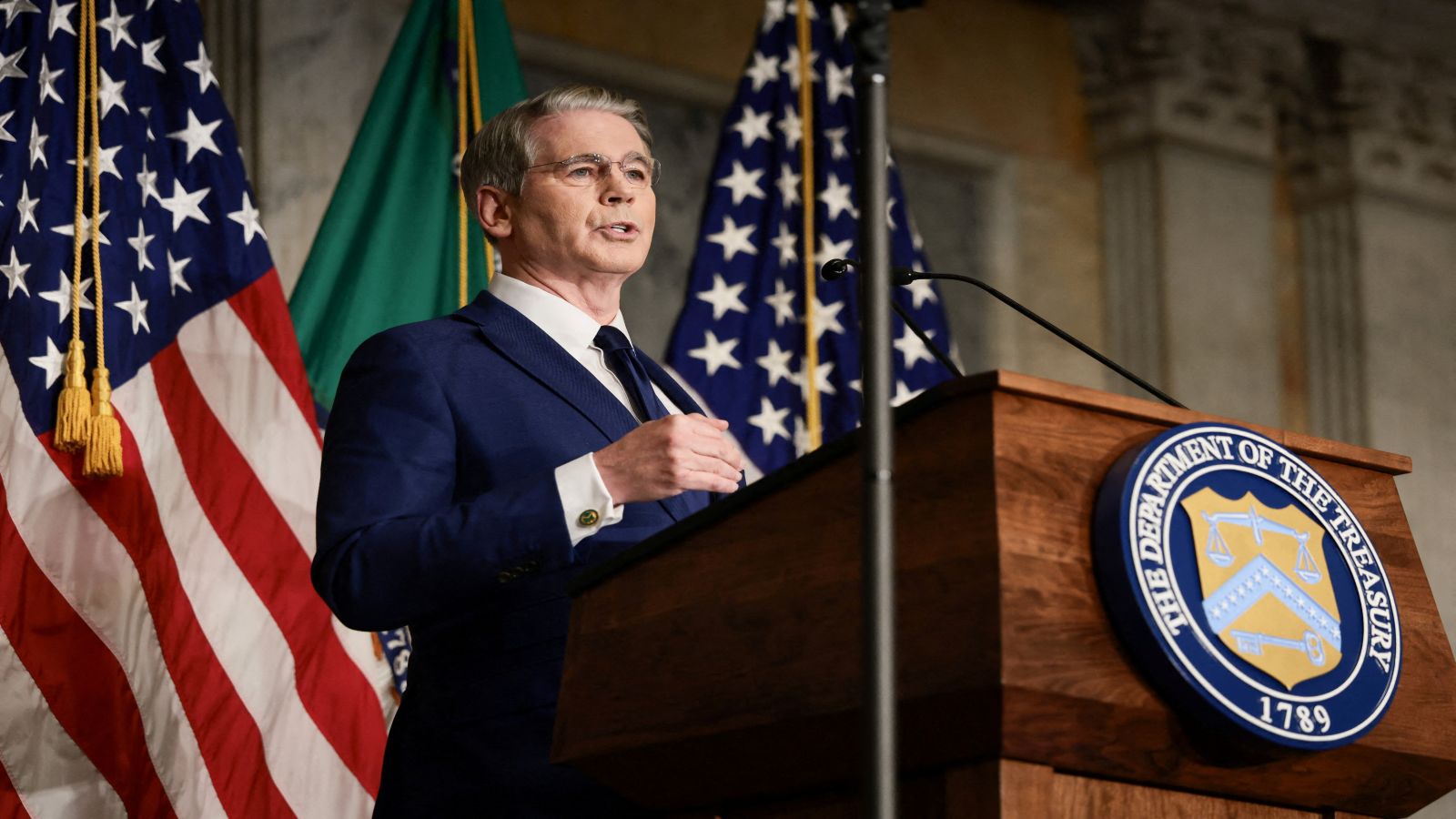
Yet, according to reports surfacing out of Washington, that is precisely the reality that has engulfed U.S. Treasury Secretary Scott Bessent. Following credible Iranian threats against his life, the nation’s top financial official was moved onto a military base—a stark, jarring reminder that in the twenty-first century, the most dangerous weapons in an arsenal are no longer forged in foundries. They are drafted in the quiet offices of the Treasury Department.
To understand why a former hedge fund manager from South Carolina suddenly requires the same physical protection as a wartime theater commander, we have to strip away the polite fiction of modern diplomacy. We have to look at what happens when the global financial system stops being a neutral highway for commerce and becomes a battlefield where nations are starved, cornered, and suffocated without a single shot being fired.
The Architecture of an Invisible Siege
Picture a hypothetical shipping broker in Dubai—let’s call him Tariq. Tariq does not own a rifle. He has never stepped foot in a military barracks. His entire life revolves around bills of lading, maritime insurance certificates, and the daily fluctuations of Brent crude. On a Tuesday morning, Tariq wakes up, brews cardamom coffee, and opens his laptop to clear a routine payment for a tanker carrying petrochemical condensates out of the Persian Gulf.
The screen freezes. The intermediary bank in Europe has rejected the wire. Twenty minutes later, his insurer cancels the vessel's coverage. By noon, the port authority refuses to let the ship drop anchor.
Nothing exploded. No sirens wailed. Yet, in less than four hours, a multi-million-dollar enterprise was paralyzed because an analyst sitting in a windowless room in Washington typed an entity name into the Office of Foreign Assets Control database.
That is the raw, terrifying power of the modern U.S. Treasury. Think of the global economy not as a sprawling marketplace, but as a circulatory system, where the U.S. dollar is the oxygen carrying life to every organ. When the Treasury Secretary imposes primary and secondary sanctions, they are essentially clamping a tourniquet around an entire nation’s arteries. Banks across Europe, Asia, and the Middle East—terrified of losing their own access to American clearinghouses—instantly sever ties with the targeted country.
For Iran, whose economy relies heavily on oil exports and covert financial networks to fund both its domestic budget and its regional proxies, this financial siege is existential. It hollows out a currency from the inside. It turns a routine trip to the grocery store in Tehran into an exercise in despair, as inflation devours savings overnight. When an adversary cannot match the United States carrier group for carrier group, or stealth bomber for stealth bomber, they look for asymmetric pressure points. They look at the person holding the tourniquet.
I remember sitting in a briefing room years ago during an earlier wave of Middle Eastern escalation, listening to a veteran counterterrorism official explain how adversaries view American bureaucracy. We tend to compartmentalize—seeing the Pentagon as the sword and the Treasury as the scale. Our adversaries make no such distinction. To a strategist in Tehran, the pen that signs a sanctions order against a shadowy fleet of oil tankers is indistinguishable from the trigger that launches a drone. Both are instruments of war. And in their eyes, both make the operator a legitimate target.
Behind the Blast Walls
Moving a Cabinet official onto a military installation is never a decision taken lightly. It is an admission that standard Secret Service protocols—the armored motorcades, the counter-assault teams, the sweeps of private residences in affluent neighborhoods like Georgetown or Kalorama—are no longer sufficient to guarantee survival.
When you live on a military base, the rhythm of your life ceases to belong to you. Every visitor is vetted days in advance. Every delivery truck is sniffed by dogs and scanned by mirrors underneath its chassis. The perimeter is patrolled by armed military police who operate under rules of engagement far tighter than municipal law enforcement. For someone like Scott Bessent, who spent decades navigating the fluid, cosmopolitan corridors of London and New York—from Soros Fund Management to founding Key Square Group—the transition from private-sector autonomy to fortified confinement is a profound psychological shift.
It is easy to read a headline about a high-ranking official moving to a military base and shrug it off as palace intrigue or political theater. We are desensitized to threat assessments. We hear the word "credible" so often in news broadcasts that it loses its jagged edge.
But stop and consider what "credible" means in the intelligence community. It does not mean an anonymous rant on an encrypted messaging board. It means signals intelligence—intercepted communications between operatives discussing routes, surveillance patterns, or procurement. It means human intelligence—a source inside a network confirming that money has changed hands or a reconnaissance team has already arrived on American soil. It means the threat has moved from aspiration to operational planning.
The United States has seen this playbook before. In the years following the 2020 strike that killed Islamic Revolutionary Guard Corps commander Qasem Soleimani, federal law enforcement uncovered multiple Iranian plots targeting former senior officials, including former Secretary of State Mike Pompeo, former National Security Advisor John Bolton, and former special envoy Brian Hook. Those individuals lived for years under round-the-clock protective details costing taxpayers millions of dollars annually, barred from walking their dogs unescorted or dining spontaneously at a neighborhood restaurant.
What makes the threat against Bessent distinct—and deeply unsettling—is that he is not a retired hawk from a past administration. He is a sitting economic policymaker, actively executing the financial levers of statecraft in real time.
The Blurred Line Between Markets and War
There is a comforting myth that finance is rational. Economists love to model human behavior as a series of predictable incentives, assuming that every actor on the world stage is simply trying to maximize utility and minimize loss. If you raise the cost of bad behavior through tariffs, asset freezes, and banking restrictions, the theory goes, the adversary will eventually calculate that compliance is cheaper than defiance.
History, however, is littered with moments where pride, ideology, and desperation shattered the neat equations of economists.
Consider what happens when a regime feels backed into a corner with no viable economic off-ramp. If they cannot out-trade Washington, and they cannot out-spend Washington, they attempt to change the personal calculus of the individuals running Washington's machinery. By targeting the Treasury Secretary, Tehran is sending a chilling message not just to Bessent, but to every deputy, every sanctions lawyer, and every mid-level analyst drafting designations at the Treasury Annex: Your desk does not protect you. Your anonymity does not protect you. If you wage economic war against us, we will bring the war to your doorstep.
This is the invisible stake that rarely makes it into the financial press. Markets react to inflation prints, Federal Reserve dot plots, and corporate earnings. They do not have a ticker symbol for the personal courage required of civil servants who suddenly find themselves on a foreign hit list.
Imagine being a thirty-two-year-old sanctions specialist working late on a Thursday night, tracing shell companies registered in Hong Kong and Panama that funnel hard currency back to ballistic missile programs. You joined the government to serve, perhaps taking a massive pay cut compared to what you could earn at a Wall Street compliance desk. Suddenly, you see your boss—the Secretary of the Treasury himself—forced to abandon his home for the concrete barracks and guarded gates of a military post. You start checking your rearview mirror a little more often on the drive home to Virginia. You hesitate before posting a photo of your kid’s soccer game online.
That quiet, creeping intimidation is precisely the point. Terrorism and targeted assassination plots are rarely about the physical elimination of a single person alone; they are about psychological contagion. They are designed to make the cost of enforcing American policy feel intimately, terrifyingly personal.
Why This Moment Feels Different
We are living through an era where the walls between civilian life and national security have quietly dissolved. A decade ago, cyberattacks on colonial pipelines or hospital networks felt like anomalies—sci-fi scenarios cooked up by defense contractors. Today, they are Tuesday. Similarly, the notion that a Treasury Secretary would need military-grade fortification used to belong to the realm of Tom Clancy thrillers. Now, it is a matter-of-fact footnote in the daily news cycle.
Part of what makes this so disorienting—and honestly, a little frightening—is how unprepared our public imagination is for this kind of conflict. We know what war looks like when tanks cross a border. We recognize the visual grammar of conflict: smoke rising over a skyline, diplomats rushing into emergency sessions at the United Nations, flags draped over coffins.
We do not have a clear visual grammar for financial warfare. You cannot photograph a blocked SWIFT transaction. You cannot film the slow suffocation of a central bank's foreign reserves. Yet the consequences are every bit as visceral. When a currency collapses, hospitals run out of imported insulin. When oil revenues dry up, power grids fail in the dead of winter. And when a regime decides to retaliate, it does not send an armada across the Atlantic; it hires criminal syndicates, exploits diaspora networks, or dispatches covert operatives to stalk a cabinet member through the suburbs of Maryland or Virginia.
Let’s be candid about the vulnerability here: nobody truly knows where the ceiling is on this escalation. If economic pressure continues to tighten—and there is every indication that Washington intends to keep the vise turned—the incentive for asymmetric retaliation only grows sharper. Moving Bessent onto a military base solves an immediate tactical problem. It puts steel, radar, and armed guards between a vital official and those who wish him harm.
It does not, however, solve the underlying strategic dilemma. You cannot put the entire global financial system behind a blast wall. You cannot station an infantry platoon outside the home of every banker, shipping executive, and regulatory official who enforces sanctions compliance.
The Heavy Crown of the Dollar
At the heart of this story lies an uncomfortable truth about American power. For eighty years, the United States has enjoyed the "exorbitant privilege" of issuing the world’s primary reserve currency. That privilege built the postwar order, funded American prosperity, and gave Washington an unmatched ability to project influence without always resorting to military force.
For decades, using the dollar as a geopolitical weapon seemed like the ultimate bloodless alternative to war. Why send Marines when you can send a Treasury directive? Why risk American lives in foreign deserts when you can achieve your objectives from a conference room on Pennsylvania Avenue?
We are now discovering the hidden price tag of that strategy. Power, no matter how bloodless its execution appears on paper, always invites resistance. When you turn the world's financial plumbing into a fortress, you inevitably turn the gatekeepers into frontline combatants.
Late at night, inside a guarded perimeter somewhere near the Potomac, the lights are still on. Inside, a man whose career was built on reading market sentiment, currency flows, and sovereign debt curves is now reading intelligence briefs about surveillance teams and blast radii. Outside the window, beyond the razor wire and the idling Humvees, the rest of the country sleeps, blissfully unaware that the quiet stability of their bank accounts is being defended not just by interest rates and fiscal policy, but by armed sentries standing watch in the dark.