The air in Tel Aviv didn't just carry the scent of salt from the Mediterranean that evening. It carried the metallic tang of ozone and the invisible weight of a million indrawn breaths. Above, the sky was tearing open. It wasn't a storm of nature, but a calculated rain of fire—nearly 200 Iranian ballistic missiles streaking through the atmosphere like vengeful, orange-glowing ghosts.
Below this celestial chaos stood Fulya Ozturk and her crew from CNN Turk.
They weren't hiding in a reinforced bunker or huddled in a stairwell. They were standing on the asphalt, shoulders hunched against the roar, eyes locked on the viewfinder. This is the peculiar madness of the war correspondent. While every biological instinct screams for the safety of the earth's crust, the professional instinct demands a steady hand and a clear signal.
Then came the second threat. It didn't fall from the sky; it arrived on four wheels.
The Sound of Iron Dominated
To understand what happened next, you have to understand the sensory overload of a missile interception. Imagine a freight train crashing into a glass factory at three times the speed of sound. That is the Iron Dome at work.
The flashes are blinding. They turn the night into a strobing, artificial noon. Ozturk was in the middle of describing this—the sheer scale of the bombardment, the rhythmic thud-thud-thud of the defenses—when the narrative shifted from the geopolitical to the visceral.
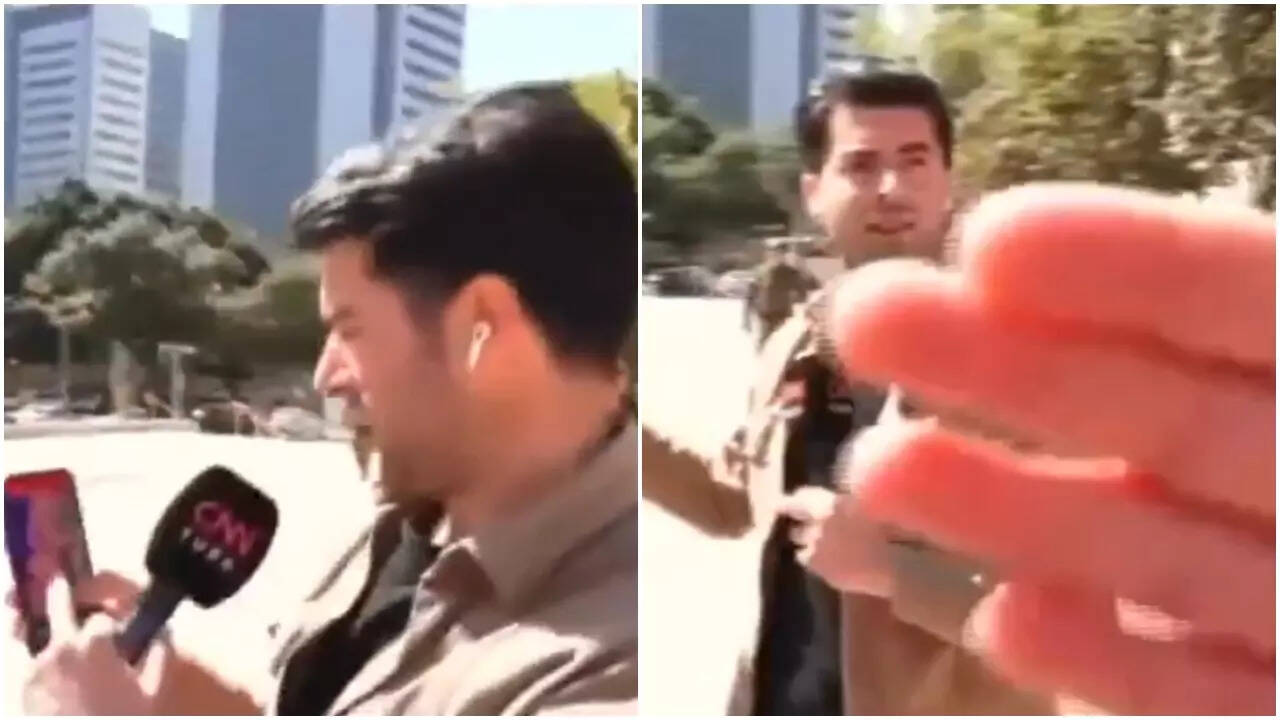
Israeli security forces didn't approach with a request. They didn't ask for credentials with the polite boredom of a checkpoint guard. They swarmed.
The live feed, broadcast to thousands of homes in Turkey and beyond, suddenly became a chaotic blur of handheld motion. You could hear the sharpness of the Hebrew commands, the frantic pivot of the camera, and the sudden, jarring realization that the "press" vest—usually a shield of light-reflecting fabric—had become a target.
The Geography of Fear
Why detain a news crew during the most significant aerial assault in months? The answer lies in the paranoid geography of modern warfare.
In a world of precision-guided munitions, a live broadcast is more than just news. To a security apparatus under fire, it is potential reconnaissance. A landmark in the background, a specific angle of an interception, or even the timing of a siren can be harvested by an adversary to calibrate their next volley. This is the invisible stake of the journalist: you are an observer, but in the eyes of the state, you are a sensor.
The CNN Turk crew found themselves caught in this friction. They were documenting history, but they were also, unintentionally, mapping a battlefield.
Ozturk’s voice, usually steady and authoritative, took on the jagged edges of someone facing a gun while the world above her literally exploded. The detention wasn't a bureaucratic error. It was a symptom of a city's nervous system failing under the pressure of a thousand-pound warhead. When the sky falls, the rules of the ground dissolve.
The Ritual of the Press Vest
There is a specific weight to a blue ballistic vest with the word PRESS stenciled in white block letters. It is supposed to weigh about twenty pounds, but in moments of detention, it feels like lead.
Consider the cameraman in this scenario. His job is to keep the frame level while his heart rate hits 140 beats per minute. He has to protect the equipment—his eye to the world—while human hands try to wrench it away. The detention of the CNN Turk crew wasn't just a physical restraint; it was an attempt to blind the audience.
For the Israeli forces, the priority was total control of the information environment. For the journalists, the priority was the sanctity of the witness. These two goals are irreconcilable. One seeks silence for the sake of security; the other seeks noise for the sake of truth.
The crew was eventually released, but the footage remains a haunting artifact. It captures the exact micro-second where the professional mask slips. You see the transition from "journalist reporting on a crisis" to "human being caught in a dragnet."
The Cost of the Witness
We often consume news as a series of data points. We see the number of missiles fired. We see the map of the impact zones. We read the statements from Tehran and the retaliatory promises from Jerusalem.
But the detention of a camera crew on a dark street in Tel Aviv tells a different story. It tells the story of how quickly the civilian world evaporates during a strike. It highlights the vulnerability of the people who stand between us and the silence of a blackout.
If we lose the eyes on the ground, we lose the ability to verify the reality of the violence. We are left only with the official tallies and the sanitized press releases of the combatants.
Fulya Ozturk and her team weren't just victims of a misunderstanding. They were reminders of the price of the front row. They stood in the path of the missiles to show us the fire, and they stood in the path of the soldiers to show us the fear.
The missiles eventually stopped. The sirens faded into the low hum of the city’s emergency generators. But the image of a journalist being shoved while the horizon burns stays with you. It is the image of a world where the truth is considered a tactical liability.
The lens was capped, the signal cut, and for a few terrifying minutes, the only thing left was the sound of the wind and the distant, muffled echoes of a war that refuses to stay in the sky.
The camera eventually turned back on, but the shadow of the hand that tried to stop it remains etched into the frame.