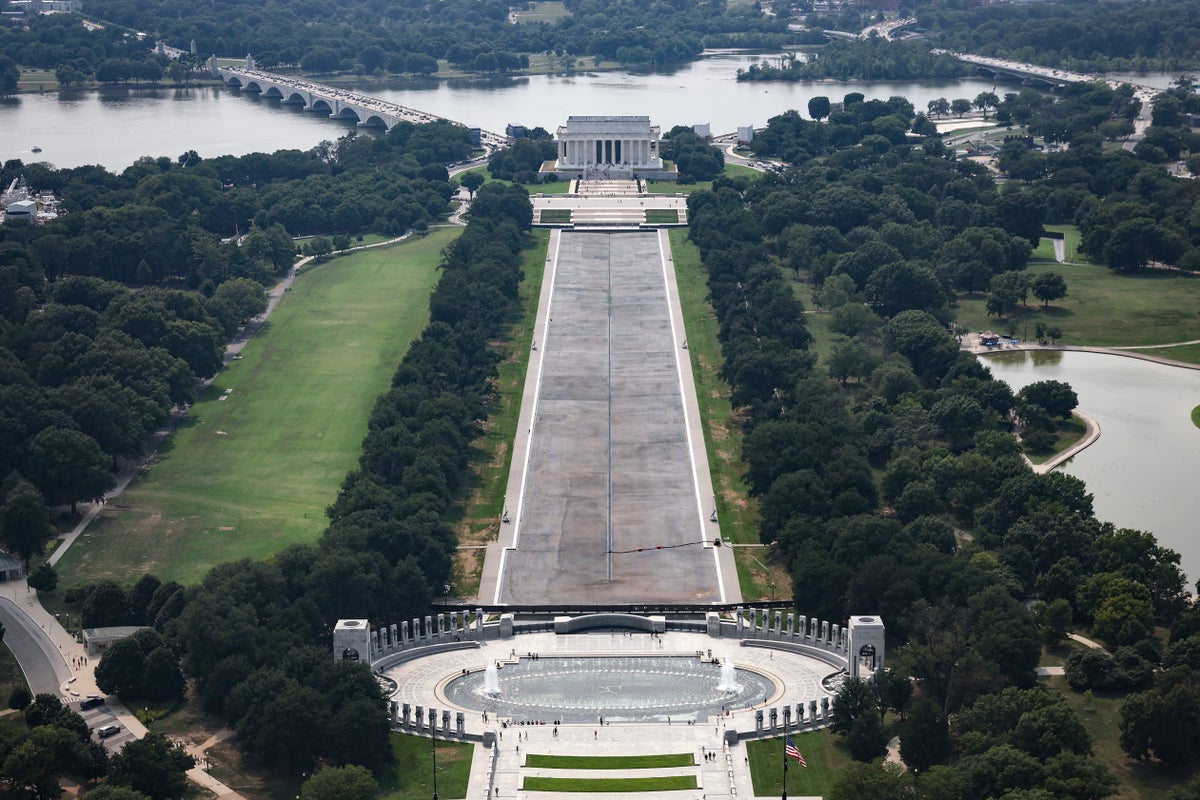
The newly renovated Lincoln Memorial Reflecting Pool was supposed to be a shining monument for the nation’s 250th anniversary, glistening with a vibrant, customized "American flag blue" finish. Instead, it has quickly devolved into a drained, mud-streaked concrete basin encircled by chain-link fences. While the White House insists that phantom vandals armed with knives carved a massive "300-yard-long gash" into the pool's custom lining, a closer inspection of the drained structure reveals a far simpler, much more embarrassing reality: shoddy government contracting, incompatible chemical layers, and an aggressive, politically dictated timeline that practically guaranteed engineering failure.
The administration's rush to complete a $16 million beautification project in time for the summer of 2026 bypassed standard competitive bidding and ignored decades of hydrological data on why Washington’s most famous pool naturally turns green. To divert attention from a peeling, bubbling cosmetic paint job, officials have spent weeks hyping a domestic eco-terrorism narrative, even bringing federal felony charges against a curious 67-year-old former Olympian who did little more than touch a loose piece of floating paint. For an alternative view, check out: this related article.
The reflecting pool crisis is not a story of coordinated sabotage. It is a masterclass in how political vanity and rushed infrastructure projects collapse under the weight of basic physics, and how those in power will invent a conspiracy to avoid admitting a bad paint job.
The Phantom Saboteurs and the Missing 300 Yard Slashes
On Truth Social, the president painted a picture of absolute devastation. He claimed that "deranged individuals" and "thugs" had executed an organized assault on the landmark, slashing a tear up to 350 feet long and using "great force" to rip the pool's blue liner upward from the concrete floor. According to the administration, this catastrophic breach compromised the water-tight basin, allowing systemic leaks and spawning the massive algae blooms that quickly choked the pool's surface. Further analysis on the subject has been provided by The Guardian.
Yet, when the National Park Service drained the water, the dramatic crime scene failed to materialize.
Reporters, photographers, and independent onlookers who walked the perimeter of the drained, 2,000-foot-long basin saw plenty of industrial pumps and security fencing, but absolutely no sign of a massive, torn liner. Instead of clean, surgical cuts from a heavy-duty blade, the bottom of the pool looked like a sunburned back. Giant sheets of the bright blue polyurethane coating were bubbling, blistering, and peeling off in ragged, irregular chunks.
The "vandals" the administration successfully arrested do not fit the profile of a black-ops sabotage crew either. Of the four people charged with misdemeanors and minor offenses at the site, none were accused of wielding industrial knives to slice up the pool.
The face of this alleged conspiracy turned out to be David Hearn, a 67-year-old Bethesda resident, local business owner, and former Olympic canoe racer. Hearn’s crime? During a 64-mile weekend bike ride, he stopped by the monument, noticed the highly publicized peeling paint, and reached into the shallow water to feel the material. When a park worker told him to step back, he dropped the piece and walked away. He was later arrested and hit with a federal property destruction charge—a move his defense attorneys have rightly decried as a desperate attempt to find a scapegoat for a failed public works project.
Why the Blue Coating Peeled
The real culprit behind the reflecting pool’s rapid decay isn't a knife-wielding vandal. It is organic chemistry and poor surface preparation.
To understand why the blue coating failed, one must look at how the $14.7 million contract was executed. Atlantic Industrial Coatings was hired to coat the concrete floor of the pool with a specialized, waterproof, blue-tinted sealant designed to give the water a deep, patriotic luster. This sounds simple on paper, but applying polymer coatings to massive, outdoor concrete basins is notoriously difficult.
Outdoor concrete acts like a giant sponge. It absorbs moisture from the ground beneath it. When the hot summer sun beats down on the open, shallow pool, that trapped moisture tries to escape upward through the concrete via a process called osmotic blistering. If the top coat—in this case, the custom blue polyurethane sealant—is not perfectly bonded to a dry, meticulously prepared concrete substrate, the rising vapor pressure will tear the paint right off the floor.
To achieve a proper bond, the concrete must be aggressively sandblasted, completely dried, and primed under strict temperature and humidity controls. But the administration was in a desperate hurry, publicly boasting that the project was "ahead of schedule" for a hard July 4th deadline. By rushing the curing and application phases to meet a political photo-op, the installers sealed moisture directly beneath the blue barrier. The moment the pool was filled and exposed to direct sunlight, bubbles formed, the bond dissolved, and the "American flag blue" began to peel away in giant sheets.
The Eternal Algae Trap
The second structural failure of the project lies in the attempt to chemically conquer the pool's natural ecology. Historically, the Lincoln Memorial Reflecting Pool has always struggled with algae. It is a massive, incredibly shallow body of stagnant water—averaging just 18 to 30 inches deep—meaning it heats up rapidly under the summer sun.
This warmth, combined with high nutrient levels from dust, leaves, local wildlife, and runoff from the surrounding National Mall, creates the ultimate breeding ground for algae.
[Solar Radiation / Heat] + [Shallow Water (18-30")] + [High Nutrient Runoff]
                                    │
                                    ▼
                         [Rapid Algae Explosion]
To fight this, the administration bypassed standard bidding to award a $1.7 million contract to Green Water Solutions to install a specialized water-purification and nanobubble system. The theory was that oxygenating the water would stunt the algae.
However, when the blue paint began to peel and lift, it created thousands of tiny, warm, unoxygenated pockets beneath the loose coating. These dark, stagnant voids became perfect, protected incubators for algae. As the organisms multiplied rapidly under the peeling flaps, they bled out into the main pool, turning the "patriotic blue" back to its familiar, swampy green within mere days of the grand reopening. No amount of chemical treatment or nanobubble technology could save a pool whose very lining was disintegrating from the bottom up.
Doubling Down on a Costly Mistake
A standard infrastructure project suffering from such high-profile failures would typically prompt a pause, a forensic engineering audit, and a re-evaluation of the contractor's work. Instead, the administration has doubled down, shielding the contractors from accountability while committing more taxpayer resources to the exact same flawed methods.
Interior Secretary Doug Burgum publicly defended the contractors, announcing that the administration would bypass any new competitive bidding for the repair rounds. "We'll use the same company because they did a fantastic job," Burgum stated, asserting that the second draining was merely routine maintenance and "vandalism repair".
| Contractor | Cost | Role | Primary Failure Mechanism |
|---|---|---|---|
| Atlantic Industrial Coatings | $14.7 Million | Waterproofing & blue concrete paint | Osmotic blistering from rushed curing |
| Green Water Solutions | $1.7 Million | Nanobubble water purification | System bypassed by algae growing under peeling paint pockets |
By framing a textbook engineering failure as an act of malicious political sabotage, the administration has successfully shielded its handpicked contractors from bearing the costs of their shoddy work. Meanwhile, congressional investigators are left trying to untangle the soaring taxpayer bills of a project that was supposed to last a century, but failed to survive its first month.
The empty, fenced-off trench sitting at the foot of the Lincoln Memorial is indeed a monument, but not to the nation's 250th anniversary. It is a monument to the high cost of political vanity, where paint that cannot stick is treated as a federal crime, and the laws of physics are dismissed as fake news.