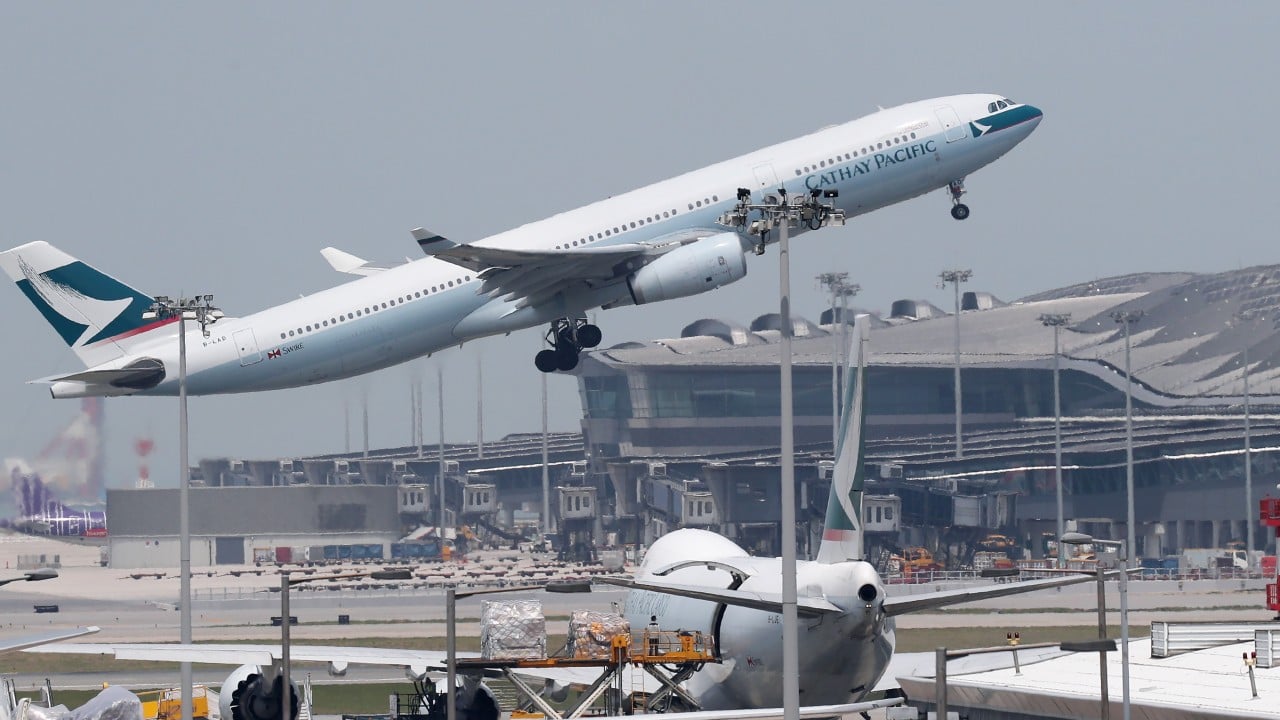
Civil aviation networks operate on thin capacity margins where a single geographic closure triggers a compounding kinetic failure across global supply chains. When airspace in the Middle East undergoes sudden closure due to military conflict, the immediate consequence is not merely a delay; it is a structural transformation of flight economics, route geometry, and hub capacity utilization. The decision by civil aviation authorities and carriers to inject 820 supplementary flights into the Hong Kong hub represents a calculated, multi-billion-dollar mitigation strategy designed to absorb the localized airspace displacement across Western Asia.
To analyze the efficacy of this intervention, one must bypass superficial explanations of "easing disruptions" and instead dissect the precise operational variables at play: fuel-to-payload trade-offs, crew rotation bottlenecks, and airport slot elasticity under emergency conditions.
The Tri-Factor Network Disruption Framework
Airspace evasion creates an immediate three-part operational crisis for long-haul carriers operating between Europe, the Asia-Pacific region, and Africa. When standard paths over conflict zones become unviable, carriers cannot simply choose an alternative route without resetting their entire cost and capability profiles.
[Airspace Closure]
       │
       ├──> Route Deviation (Increased Distance & Fuel Burn)
       ├──> Payload Penalties (Cargo/Passenger Displacement)
       └──> Crew Duty-Hour Exhaustion (Regulatory Timeouts)
1. The Geometry of the Detour (Fuel-to-Payload Trade-Off)
Airplanes do not possess infinite range; their maximum takeoff weight (MTOW) is a rigid mathematical boundary defined by the equation:
$$\text{MTOW} = \text{Operating Empty Weight} + \text{Payload} + \text{Fuel}$$
When a flight routing must deviate around contested airspace (such as shifting from a direct Middle Eastern transit to a northern Caspian or southern Indian Ocean corridor), the flight path extends by 800 to 1,500 nautical miles. This distance requires a significant increase in trip fuel. Because MTOW is fixed, every additional kilogram of fuel loaded to navigate the longer route directly displaces a kilogram of revenue-generating cargo or passengers. On ultra-long-haul routes, a 10% increase in flight duration can force a 20% to 30% reduction in cargo capacity to keep the aircraft below its structural weight limits for takeoff.
2. Crew Duty-Hour Regulatory Bottlenecks
International aviation authorities enforce strict flight time limitations (FTLs) to prevent fatigue. A standard flight deck crew might have a maximum duty period of 14 hours. When route deviations push a 12-hour scheduled flight into a 14.5-hour actual flight time, the route becomes illegal to operate with a standard crew complement. Carriers must either deploy augmented crews (three or four pilots instead of two), which depletes their global pilot reserve, or introduce unscheduled technical stops for crew changes. This introduces massive friction into aircraft utilization rates.
3. Slot Elasticity and Hub Congestion
An airport hub operates on a highly synchronized schedule of waves—incoming banks of flights arriving to feed outgoing banks of flights. A disruption that delays incoming aircraft by two hours breaks the connection windows for thousands of passengers and tons of time-sensitive air freight. The 820 extra flights allocated to Hong Kong are not an expansion of normal market demand; they are structural shock absorbers designed to re-route stranded passengers, clear backlogged cargo, and provide alternative entry points into the Asia-Pacific network for aircraft that have lost their original scheduled slots in disrupted regions.
Quantifying the Hong Kong Capacity Injection
The deployment of 820 additional flights requires an immense reallocation of physical assets. To understand why Hong Kong International Airport (HKIA) serves as the primary pressure valve for this specific geopolitical shock, one must evaluate its infrastructural readiness and geographic positioning.
The Microeconomics of the Extra Flights
The allocation of these flights can be broken down into specific asset classes and operational intents:
- Passenger Re-Routing Dynamics: Approximately 65% of the added capacity targets high-density trunk routes connecting Europe to East Asia via alternative oceanic corridors. By funneling passengers through a highly efficient transit hub like Hong Kong, airlines can consolidate fractured passenger streams from multiple disrupted secondary routes into high-capacity widebody aircraft (e.g., Boeing 777-300ER, Airbus A35-1000).
- Air Freight Reclamation: Hong Kong is the world's busiest air cargo hub. When Middle Eastern hubs face capacity drops or risk-premium spikes due to localized conflict, global supply chains divert high-value electronics, pharmaceuticals, and just-in-time manufacturing components to East Asian gateways. The supplementary flights include dedicated freighters designed to prevent a total freeze in Eurasian trade flows.
- Aircraft Positioning Efficiencies: Airlines facing severe scheduling delays frequently find their hulls out of position for their next scheduled flights. A portion of the 820 flights consists of non-revenue or low-yield ferry flights meant to reposition aircraft back into primary networks where they can resume profitable operations.
The limitation of this capacity injection lies in the immediate strain it places on ground handling, customs clearance, and air traffic control. An extra 820 movements over a compressed timeline tests the limits of runway throughput and gate availability, particularly when operating under a three-runway system that is still optimizing its labor force post-expansion.
The Economics of Geopolitical Risk Premiums in Aviation
When conflict closes airspace, the financial impact ripples through insurance markets and fuel hedging desks long before the passenger feels the delay. The introduction of supplementary flights is a reactive measure against a steep escalation in operating costs.
War Risk Insurance Escalation
Every commercial flight entering or approaching a volatile region requires specialized Hull War and Allied Perils insurance. When tension escalates, insurers implement "Geographic Exclusions" or charge exorbitant hull war risk premiums, often calculated as a percentage of the aircraft's total value per flight. For a modern widebody aircraft valued at $200 million, these premiums can skyrocket to tens of thousands of dollars per single transit. Bypassing the region entirely and adding flights through a safe hub like Hong Kong—despite the longer distance and higher fuel burn—frequently emerges as the lower-cost financial alternative.
The Fuel Burn Penalty Matrix
The table below illustrates the conceptual cost escalation experienced by a standard widebody aircraft (burning roughly 2,500 gallons of fuel per hour) when forced onto a diversionary track versus utilizing a secondary hub network adjustment like the Hong Kong bypass.
| Variable | Baseline Route (Middle East Transit) | Diverted Route (Direct Bypass) | Hub Re-Routing via Hong Kong |
|---|---|---|---|
| Average Flight Duration | 11.5 Hours | 13.5 Hours | 11.0 Hours + 4.0 Hours (Two Legs) |
| Fuel Consumed (Gallons) | 28,750 | 33,750 | 37,500 (Split across two sectors) |
| Payload Capacity | 100% (Maximized) | 75% (Weight restricted) | 100% (Per individual leg) |
| Insurance Premium Risk | High / Variable | Low (Geographic Evasion) | Zero (Safe Corridor) |
| Crew Requirements | Standard (2 Pilots, 1 Crew) | Augmented (4 Pilots) | Standard per individual leg |
The data reveals a critical operational truth: while re-routing via an intermediary hub like Hong Kong increases total fuel consumption across two shorter legs, it eliminates the payload penalties and augmented crew requirements of a single, massive, diverted non-stop flight. It allows the airline to maintain 100% payload capacity on each individual leg, transforming a technical defeat into an optimized logistical workaround.
Structural Vulnerabilities of the Hub Substitution Strategy
While the injection of 820 flights demonstrates tactical agility, substituting one global transit node for another under crisis conditions exposes severe systemic vulnerabilities. This strategy cannot be sustained indefinitely due to three distinct structural constraints.
The Labor Supply Bottleneck
An abrupt 820-flight surge demands an immediate scale-up in aviation labor, including ramp handlers, baggage loaders, fueling technicians, and air traffic controllers. If a hub is already operating near its labor-capacity ceiling, a sudden volume injection causes cascading ground delays. Planes sit on the tarmac waiting for open gates, luggage misconnection rates spike exponentially, and the intended efficiency of the hub degrades.
The Maintenance, Repair, and Overhaul (MRO) Deficit
Longer flight times mean aircraft reach their mandatory hourly maintenance inspection thresholds (such as A-checks and B-checks) at an accelerated pace. The global MRO infrastructure is currently plagued by severe spare parts shortages and engineering backlogs. Forcing aircraft to fly extended routes around conflict zones accelerates the timeline toward their next grounding for scheduled maintenance, threatening to shrink the active global fleet precisely when more hulls are needed to cover the longer distances.
The Concentration of Sovereign Risk
By shifting massive volumes of air traffic away from Western Asia and concentrating them into East Asian corridors, the global aviation network trades one geopolitical risk profile for another.
[Geopolitical Shock in Mid-East] ──> [Traffic Concentrates in East Asian Corridors] ──> [Systemic Vulnerability to Local Meteorological/Political Shocks]
This high concentration means that if a severe typhoon or a secondary political disruption occurs in the East Asia region concurrently, the global aviation network loses its primary contingency route, resulting in a systemic gridlock with no viable tertiary alternative.
Tactical Optimization Protocol for Network Planners
To mitigate the compounding inefficiencies of long-term airspace avoidance, network planning executives must move beyond raw capacity injections and implement a data-driven operational playbook.
First, carriers must deploy dynamic payload-fuel software that utilizes real-time atmospheric wind data to calculate the exact tipping point where a multi-leg hub transit becomes more profitable than a weight-restricted non-stop diversion. If high-altitude tailwinds on a northern corridor reduce the detour penalty below 8%, the non-stop route should be preserved; if the penalty exceeds 12%, traffic must immediately drop into segmented hub operations via nodes like Hong Kong.
Second, airlines must establish cross-alliance crew pooling agreements at critical diversion hubs. By stationing a shared reserve of type-rated pilots at these strategic midpoints, multiple carriers can draw from a single labor pool to resolve flight time limitation timeouts without grounding individual aircraft for lack of fresh crew.
Finally, hub airports must implement dynamic slot allocation algorithms that prioritize high-capacity widebody aircraft over regional short-haul flights during peak disruption periods. Regional traffic must be shifted to secondary runways or off-peak night slots to guarantee that the intercontinental shock absorbers—the extra flights clearing global backlogs—have unimpeded access to primary runway infrastructure and ground handling assets. This structural prioritization is the only mechanism that prevents localized geopolitical friction from solidifying into permanent global supply chain inflation.