Fifty-eight years. Think about what the world looked like in 1969. The Beatles performed on a rooftop for the last time. Neil Armstrong stepped onto the moon. Color televisions were a luxury. In the world of hockey, the amateur draft was a tiny, localized meeting.
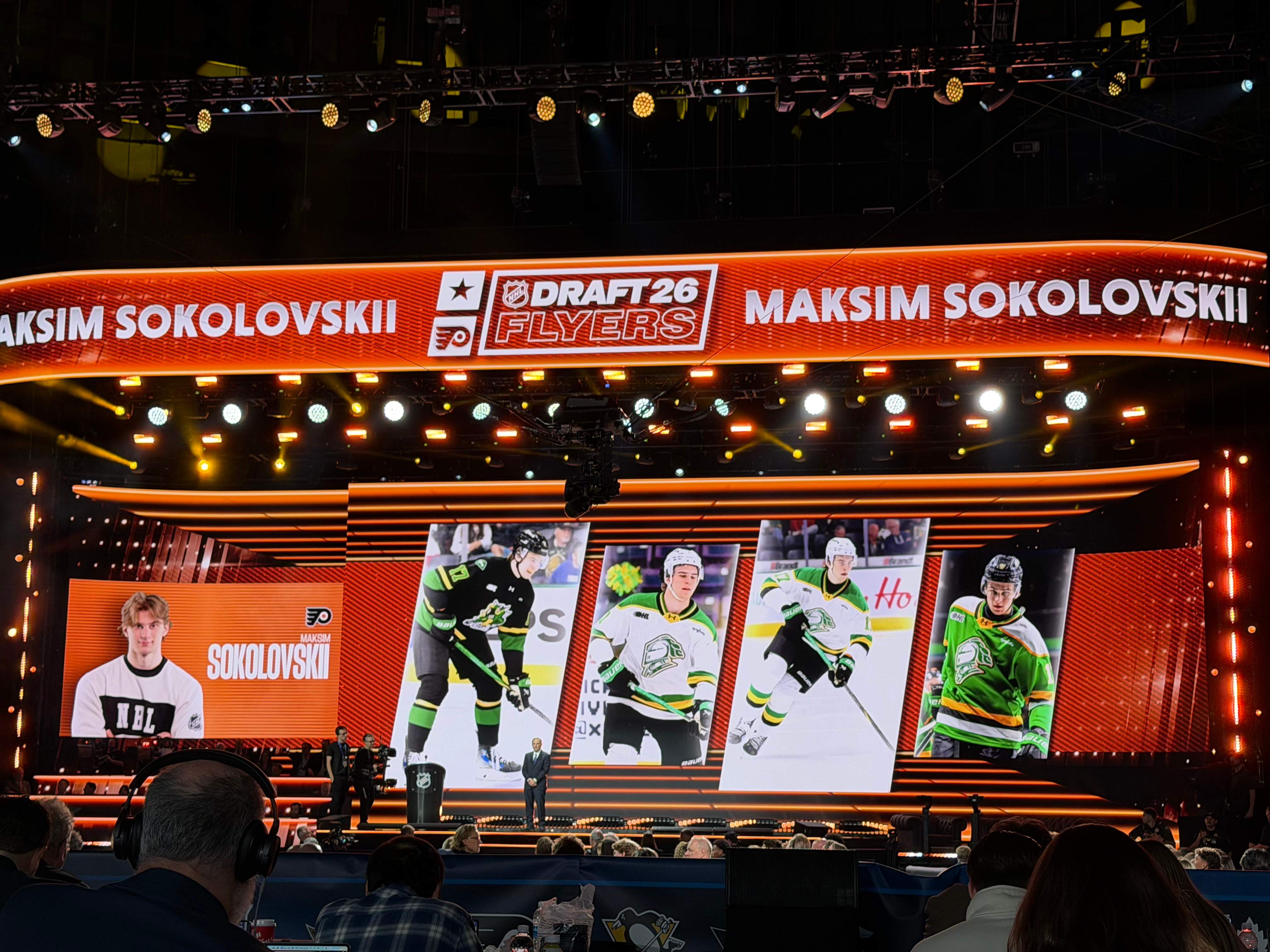
Yet, that exact year marks the start of an unbroken chain of talent that still defines junior hockey. When the Philadelphia Flyers took defenseman Maksim Sokolovskii with the 27th overall pick at the 2026 NHL Draft in Buffalo, they did more than just add a massive blue-liner to their pipeline. They kept history alive.
With Sokolovskii and forward Jaxon Cover going in the first round, the London Knights extended their Canadian Hockey League record. For 58 consecutive summers, at least one player from the Knights has heard his name called by an NHL franchise. It is the longest active draft streak of any hockey program anywhere on earth.
This isn't just an incredible piece of trivia. It tells us everything we need to know about how talent is found, developed, and trusted at the highest levels of the sport. While other junior franchises ride cyclical waves of success and total irrelevance, the Knights have built a permanent machine.
The Class of 2026 and the 6-Foot-8 Blueprint
NHL front offices are obsessed with size, but they're even more obsessed with programs they trust. Daniel Briere and the Flyers management group proved both points on Friday night. Philadelphia actually held the 21st pick but chose to trade back to 27 in a deal with San Jose. They gambled that their target would still be there.
That target was Sokolovskii.
Standing 6-foot-8 and weighing 240 pounds, the left-handed Russian defenseman was the second-tallest player in the Ontario Hockey League this season. He didn't put up eye-popping offensive numbers. He managed just two goals and six assists in 44 regular-season games for London. If he played anywhere else, a stat line like that might have kept him in the middle rounds.
Briere was entirely open about why they took the plunge. He admitted after the draft that the Knights organization heavily influenced their choice. The Flyers know exactly what kind of players come out of London. They know these kids are taught how to win, how to handle pressure, and how to act like professionals before they ever sign an NHL contract.
Sokolovskii will go back to London for another year. He needs to play heavier, more significant minutes. He needs to refine his game under the watchful eyes of Dale and Mark Hunter. But the Flyers are betting on the environment just as much as the individual athlete.
Right behind him at number 32 overall, the Ottawa Senators called Jaxon Cover's name. Cover's story is completely ridiculous in the best way possible. Most modern NHL draft picks have been skating since they were toddlers, wrapped in high-end winter gear and pushed by private coaches. Cover didn't even know all the rules of the game until his U14 season.
He played AAA hockey for the first time just a few years ago. London spotted his raw athletic traits and took him in the fourth round of the OHL Priority Selection. Fast forward to this past season, and Cover posted 52 points in 67 games. His rapid ascent proves that London doesn't just harvest ready-made superstars. They find raw, unpolished clay and shape it faster than anyone else in the business.
The Deep Local Ties of Day Two
The draft streak gets the headlines, but the sheer volume of talent connected to the London area during the 2026 draft weekend was staggering. It shows that the hockey culture in southwestern Ontario is deeper than it has ever been.
Look at what happened right after the first-round coverage wrapped up. Day two opened with the Chicago Blackhawks selecting London native Ryan Roobroeck with the 35th overall pick. Roobroeck spent his season tearing up the league with his elite scoring instincts, making him a massive pick for Chicago early in the second round.
Then came the later rounds, where the Knights continued to populate the board. The Dallas Stars took Ryan Brown in the fifth round at pick 155. Just two selections later, the Boston Bruins snapped up Jacob Vandeven at 157.
Vandeven is a spectacular example of how the local ecosystem functions. He spent most of his year with the Komoka Kings in the Greater Ontario Hockey League before finishing out the campaign by skating in eight games for the Knights. He is a towering defender who can move his feet quickly, spin away from forecheckers, and trigger clean breakouts. Komoka Kings owner Roop Chanderdat called the selection a massive win for his program and the entire GOHL.
We can't forget the kids who moved through the system either. Ben Wilmott, a former Knight who was sent to the Barrie Colts at the trade deadline to help them make a run to the OHL Finals, went in the third round to the Vegas Golden Knights. Beckham Edwards, another local product, went to Detroit in the fifth round, while Eric Frossard went to Anaheim.
When you tally it all up, the weekend was a massive validation of the region. It wasn't just about one or two elite prospects. It was an absolute parade of local and team-developed talent.
Why NHL Front Offices Trust the Hunter System
To understand how a team keeps a streak like this alive for nearly six decades, you have to look at the ownership and management structure. Dale and Mark Hunter bought the team in 2000. Since then, they have turned Budweiser Gardens into an unofficial finishing school for the NHL.
Over the last four seasons alone, London has produced seven first-round draft picks. That is a staggering rate of elite development.
The secret isn't a secret at all. It is consistency of expectation.
When a kid walks into the London locker room, they are entering an environment that mirrors a pro club. The travel is managed professionally. The media scrutiny is intense. The expectations from the fan base are sky-high, with the team routinely drawing over 9,000 fans per game. Junior players elsewhere can hide in small markets with zero local pressure. In London, you live in a fishbowl.
Scouts love this. They know that if a kid can survive the internal competition and external pressure of playing for the Knights, they won't freeze when they get to the American Hockey League or the NHL.
The internal competition is the real engine of the program. The Hunters do not hand out ice time based on draft status or reputation. If a first-round OHL pick is floating, he will sit on the bench while a hungry free-agent invite takes his shifts. You see it every year. Players like Jaxon Cover have to earn every single scrap of ice time they get. That environment forces rapid maturity.
The Reality of Junior Production vs NHL Success
We need to be honest about what a draft streak means and what it doesn't mean. Having a player selected every year for 58 years is an incredible organizational achievement. It proves the Knights are elite at identifying raw talent and putting those players in a position to be noticed by NHL scouts.
It does not guarantee that every single one of these players becomes a star.
Junior hockey success is often about physical maturity and executing a specific system. A 6-foot-8 defenseman like Sokolovskii can dominate junior forwards simply by using his reach and frame. When he steps into a professional training camp, he will face players who are just as big, much faster, and far more intelligent with their positioning.
The translation from the OHL to the NHL is incredibly difficult. For every Patrick Kane, Mitch Marner, or John Carlson that London produces, there are dozens of mid-to-late-round picks who never play a single game in the big leagues.
That shouldn't diminish what happened in Buffalo. The goal of a junior franchise is to get their players to the draft floor and give them a chance at a professional career. What the player does with that chance once they leave junior hockey is up to them and the NHL organization that drafted them. London did its job. They got these kids to the starting line.
What This Means for Next Season
If you're a young hockey player with aspirations of playing in the NHL, the message from the 2026 draft is loud and clear. If you want to get noticed, London is still the premier destination.
The Knights' active run of four straight years with a first-round selection is currently the longest active streak in the entire CHL. That run will continue to act as the ultimate recruiting tool. The top minor midget players in Ontario and the best imports from Europe will continue to look at London as the fastest path to their professional goals.
For the rest of the OHL, the challenge remains the same as it has been for decades. Teams have to find ways to compete with a franchise that has turned talent development into a science. Organizations like Kitchener, Erie, and Guelph have had their moments of dominance, but nobody has matched the sustained excellence of the Knights.
The 2026 NHL Draft is over. The jerseys have been handed out, the photos have been taken, and the prospects are heading to their respective development camps. Back in London, the staff is already focusing on the upcoming season. The counter has reset. The goal now is year 59.
If you want to see how the next generation of talent is being built, keep your eyes on the ice at Budweiser Gardens this autumn. The machine isn't slowing down. Players who want to ensure their own names are called in 2027 should start studying exactly how Jaxon Cover went from not knowing the rules to the first round of the NHL draft in less than five years. The blueprint is right there for anyone willing to do the work.