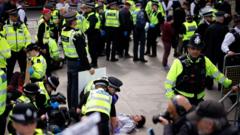
You don't usually see 82-year-olds being hauled into police vans for sitting in camping chairs. But that’s exactly what happened in Trafalgar Square on Saturday. The Metropolitan Police arrested 212 people in a single afternoon, ranging in age from 27 to 82. Their crime? Holding signs that said they support Palestine Action.
If you’re wondering how a placard can land a grandmother in handcuffs, it’s because the British government decided to label the group a terrorist organization last July. Since then, simply expressing an opinion that favors the group’s goals is technically a criminal offense under the Terrorism Act 2000.
The legal mess behind the arrests
Saturday’s mass arrest wasn’t a random spike in activity. It was a deliberate "U-turn" by the police. Back in February 2026, the High Court actually ruled that the government’s ban on Palestine Action was unlawful. The judges basically said the group’s actions—mostly smashing windows at arms factories or spraying red paint—didn't hit the threshold of "terrorism." They called it a "disproportionate interference" with free speech.
But there’s a catch. The ban stays in place while the Home Office appeals that ruling. For a few weeks, the police stopped making these arrests. Now, they’ve started again.
Who was there and why it matters
This wasn't just a crowd of career activists. Robert Del Naja from the band Massive Attack was right there in the thick of it. He held a sign and told reporters the police U-turn was "ridiculous." He’s a guy who travels the world for a living, and a terrorism-related arrest is a nightmare for international visas. He did it anyway.
The crowd’s vibe was defiant but weirdly calm. You had people with walking sticks and folding chairs being surrounded by lines of officers in high-visibility vests. When the police started lifting an elderly woman to carry her away, the crowd didn’t riot; they just chanted "shame on you." It felt less like a counter-terrorism operation and more like a PR disaster in real-time.
What is Palestine Action anyway
If you haven’t followed the saga, Palestine Action is a direct-action network that’s been around since 2020. They have one main goal: shutting down Elbit Systems, Israel’s largest private arms manufacturer, which has several sites across the UK.
They don't do traditional marches. They prefer:
- Scaling roofs to stop production.
- Smashing machinery with sledgehammers.
- Dousing buildings in red paint to symbolize blood.
- Breaking into RAF bases to damage planes.
They’ve been remarkably effective at it. Their "Filton 24" raid in August 2024 allegedly caused £1 million in damage. They even managed to get some sites, like the one in Oldham and more recently Aztec West, to shut down permanently. That’s why the government reached for the "terrorist" label. It’s a way to skip the slow process of criminal damage trials and go straight to the heavy stuff—remand, surveillance, and long prison sentences.
The human cost of the crackdown
The government’s strategy isn't just about the people in Trafalgar Square. It’s about the people already in the system. Right now, there are activists—part of the "Filton 24" and "Brize Norton 5"—who have been on hunger strikes in British prisons.
Heba Muraisi, one of the protesters, went 73 days without food before ending her strike in January. These aren't people looking for a weekend hobby. They're demanding to be treated as political prisoners rather than terrorists. Even some MPs, like John McDonnell, have started breathing down the Justice Secretary’s neck about the conditions these people are facing while they wait for trial.
Why this should worry you
You might not agree with Palestine Action’s tactics. Smashing things isn't everyone's cup of tea. But the legal precedent being set here is shaky at best.
If the government can ignore a High Court ruling and keep arresting people for holding signs while an appeal drags on for months, it changes the rules for every other protest group. Whether it’s climate change, healthcare, or local taxes, the "terrorist" label is a powerful tool for the state to silence dissent without having to prove a person actually hurt anyone.
The police claim they're just "maintaining safety," but when the "threat" is a man with a walking stick and a cardboard sign, that argument falls apart pretty fast.
What happens next
If you're following this, don't expect it to quiet down. The High Court appeal is the next big milestone. Until then, the Met Police have made it clear they’ll keep clearing the streets.
- Check the dates: If you're attending a protest, know that the "proscribed" status of the group is still legally active.
- Watch the courts: The Chief Magistrate has already said some trials are on hold until the High Court appeal is finished.
- Follow the money: Keep an eye on the companies like Allianz and Aviva that have already cut ties with Elbit. The pressure is working on the corporate side, even as the legal side gets messier.
This isn't just about one group anymore. It’s a test of how much "annoyance" the UK government is willing to tolerate before it calls in the counter-terror squads. Honestly, watching the footage from Saturday, it looks like they've already made up their minds.



