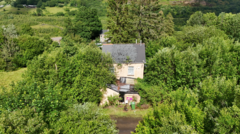
A single, weathered house sits isolated on a scarred hillside, the final remnant of a once-thriving mining village now headed to the auction block. While real estate listings frame this property as a quirky investment opportunity or a off-grid retreat, the reality is far more grim. The sale of this lone property marks the final exhale of an entire industrial community swallowed by economic restructuring and depopulation. It is a stark physical manifestation of a crisis quietely repeating across former industrial heartlands worldwide, where corporate flight leaves behind ghost towns and stranded assets.
The property is hitting the market with a rock-bottom starting bid, a price tag designed to attract speculative buyers, history buffs, or social media influencers looking for their next viral renovation project. But beneath the peeling wallpaper and rusted corrugated roofing lies a complex story of resource depletion, corporate abandonment, and the failure of regional transition economies.
The Illusion of the Cheap Fixer Upper
Auction houses excel at selling a dream. They pitch these isolated ruins as blank canvases for remote workers or artists seeking absolute solitude. The marketing materials conveniently gloss over the structural, legal, and logistical nightmares that come with buying the last house in a dead village.
When an entire village is abandoned, the municipal infrastructure usually dies with it. Prospective buyers rarely consider the true cost of reconnecting a single home to a collapsed grid.
- Water Infrastructure: Decades-old pipes freeze, crack, or contamination risks skyrocket when a water system lacks constant throughput.
- Grid Access: Power lines to abandoned zones are frequently decommissioned by utility companies to cut maintenance costs.
- Access Roads: Local councils often stop grading or clearing roads leading to unpopulated areas, meaning a heavy winter can leave a resident completely cut off.
Financing such a purchase through traditional means is nearly impossible. Banks view isolated, non-standard properties in declining regions as high-risk liabilities. A buyer must possess significant cash reserves not just to acquire the structure, but to engineer bespoke utility solutions like solar arrays with heavy battery storage and deep-well water filtration. Without these, the house remains what it has been for years. A hollow shell.
How Corporate Flight Erases Communities
To understand why this house stands alone, one must examine the mechanics of industrial collapse. Mining towns are explicitly designed around a single point of failure. The company.
During the industrial booms of the 19th and 20th centuries, resource extraction firms built entire ecosystems. They erected housing, funded schools, and operated the local commerce. This created a profound, fragile dependency. When the vein ran dry, or when global market prices made domestic extraction unprofitable, the corporate entities did not transition the workforce. They liquidated.
[Resource Extraction Boom] -> [Corporate Infrastructure Build] -> [Market Shift / Depletion] -> [Sudden Liquidation] -> [Municipal Collapse]
When the anchor employer vanishes, the economic velocity of the town drops to zero overnight. Property values crater. Young demographics migrate toward urban centers in search of viable wages, leaving behind an aging population unable to maintain the sprawling infrastructure.
Over time, municipalities make cold financial calculations. It becomes cheaper for a local government to buy out remaining residents or condemn failing structures than to maintain services for a handful of holdouts. This specific house survived the bulldozers, not by design, but likely through a quirk of probate court or an stubborn owner who refused to sign a deed over to the state.
The Dangerous Allure of Ruin Pornography
The impending auction has generated significant online chatter, a symptom of a broader cultural obsession with architectural decay. Modern audiences consume images of abandoned spaces as a form of aesthetic entertainment. This commodification of decline detaches the viewer from the human tragedy inherent in the images.
Every collapsed roof in that village represents a family that lost their primary asset. Wealth in working-class communities is tied almost entirely to homeownership. When an industry collapses and renders those homes worthless, it wipes out generational wealth in a matter of months.
Speculators who buy these properties hoping to capitalize on the aesthetic of abandonment often find themselves facing a hostile reality. Local governments, desperate to revitalize their tax bases, are increasingly cracking down on derelict properties. New owners may face immediate compliance orders, strict historic preservation codes, or escalating fines if the property remains a public safety hazard. The romantic notion of owning a piece of history quickly collides with the bureaucracy of regional blight management.
The Flawed Logic of the Rural Rebound
A common counter-argument presented by urban planners is the concept of rural regeneration driven by digital nomads. The narrative suggests that high-speed satellite internet can revitalize any dying geography. This theory ignores the fundamental laws of human ecology.
High-speed internet cannot replace a nearby hospital. It does not pave roads, nor does it open grocery stores within a reasonable driving distance. A single remote worker living in a restored mining cottage does not recreate a community. They operate as an economic island, importing goods from online retailers and paying taxes that are often insufficient to fund the heavy infrastructure repairs the area requires.
True regional revitalization requires systemic capital investment, not sporadic bohemian migration. It demands the establishment of new, sustainable industries, environmental remediation of toxic mining byproducts, and the rebuilding of public transit links. Without this macro-level support, buying the last house in a mining village is merely an exercise in prolonged preservation. You are not saving a town. You are occupying its monument.
The auctioneer will drop the hammer, the property will change hands, and a new deed will be registered. But the structural forces that emptied the surrounding valley remain entirely unchallenged, waiting to claim the next town when the next economic tide rolls out.