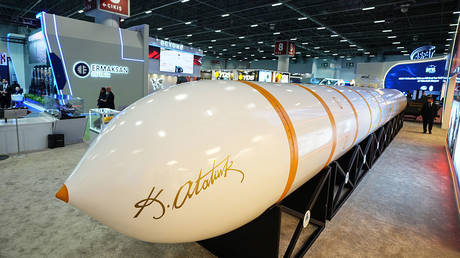
The air in the control room didn't smell like the future. It smelled of stale coffee, recycled oxygen, and the sharp, metallic tang of ozone that clings to high-voltage electronics. There is a specific kind of silence that descends seconds before a launch. It isn't the absence of sound, but rather the heavy, pressurized weight of thousands of people holding their breath at once.
When the countdown hit zero, the ground didn't just shake. It groaned.
From a remote stretch of the Anatolian coast, a pillar of fire tore through the gray morning mist. This wasn't just another short-range tactical test or a localized show of force. As the rocket cleared the tower, shedding its umbilical cables like dead skin, it carried more than just a payload. It carried a new geopolitical reality. Türkiye had just joined the most exclusive and terrifying club on Earth.
The Geometry of Fear
For decades, the math of regional security was predictable. You looked at the range of a neighbor’s artillery or their jet fuel capacity. You measured safety in hundreds of miles. But when a nation successfully tests an Intercontinental Ballistic Missile (ICBM), the geometry of the world collapses. Distance becomes a relic.
The technical specifications of this new Turkish hardware—which officials have kept shrouded in the usual layers of "national security" obfuscation—suggest a range that stretches far beyond the traditional friction points of the Mediterranean or the Black Sea. We are talking about the ability to strike targets across continents.
Consider a hypothetical engineer named Selim. He has spent twelve years in a windowless facility outside Ankara, obsessing over the trajectory of solid-fuel stages. To Selim, the missile is a triumph of physics, a solution to a thousand complex equations regarding heat shielding and inertial guidance. But to a family sitting in a flat in Brussels, London, or Washington, Selim’s masterpiece is a new variable in an already volatile equation of survival.
$d = v_0 t + \frac{1}{2} a t^2$
The basic physics of flight remain the same, but the stakes have been elevated into the stratosphere—literally. By mastering the arc of an ICBM, Türkiye has moved the needle from regional player to global architect.
The Invisible Architect
This didn't happen overnight. It wasn't a sudden burst of inspiration. It was a slow, grinding march fueled by a desire for "strategic autonomy." For years, the Turkish defense industry has been quietly stitching together the pieces of this puzzle. They started with drones that changed the face of modern desert warfare. Then came the domestic tanks, the naval frigates, and the mid-range ballistic systems.
Each success was a brick in a wall of self-reliance.
The motivation is deeply human: the fear of being left behind. Turkish leadership has long voiced a frustration with being a "flank state" of NATO—a loyal soldier on the edge of the map, dependent on others for high-end protection. The ICBM is their way of moving to the center of the table. It is a loud, fiery declaration that they will no longer ask for permission to defend their interests.
But there is a cost to this kind of autonomy. Every kilometer added to a missile's range is a kilometer subtracted from the trust of former allies. The "Long Shadow" isn't just the physical silhouette of the rocket on the launchpad; it is the diplomatic chill that follows in its wake.
Gravity and its Consequences
Imagine the phone calls that happened in the minutes after the satellite signatures confirmed the launch. In the basements of several world capitals, the mood was likely one of grim recalculation.
Why now?
The world is currently a tinderbox of overlapping crises. Between the grinding war in Ukraine and the shifting sands of Middle Eastern alliances, the introduction of a Turkish ICBM acts like a heavy weight dropped onto a thin sheet of ice. It forces everyone else to move. It triggers a chain reaction of "what-ifs."
- What if this leads to a regional arms race in the Middle East?
- What if the technology is shared with other non-aligned powers?
- What if the very existence of the missile makes diplomacy feel obsolete?
The technical achievement is undeniable. To get a multi-ton object into space and bring it back down with precision requires a level of sophistication that most countries can only dream of. It requires advanced materials that won't vaporize upon re-entry, guidance systems that can account for the rotation of the Earth, and the raw industrial might to produce high-grade propellant.
Yet, the irony of the ICBM is that it is a weapon designed never to be used. Its primary function is psychological. It is a ghost that sits in the corner of every room where treaties are signed. It whispers, "Remember what I can do."
The Weight of the Flame
Walking through the streets of Istanbul, life seems unchanged. The ferries still crisscross the Bosphorus, the scent of roasted chestnuts still hangs in the air, and the chaos of the bazaars continues unabated. Most people are worried about inflation, the price of tea, or the upcoming football match.
But the horizon has changed.
The people who built this machine—the Selims of the world—likely see themselves as patriots securing a future for their children. They see a Türkiye that can stand tall, unbowed by the threats of more established nuclear powers. They see a shield.
Others see a target.
History teaches us that power is never static. When a new player gains the ability to reach out and touch any corner of the globe, the old guards don't just step aside. They push back. We are entering a season of "strategic friction." It will manifest in sanctions, in tech-export bans, and in the quiet withdrawal of intelligence-sharing agreements.
The fire that lifted that rocket into the morning sky was bright, but the smoke it left behind is thick and difficult to clear. It obscures the path forward.
We are no longer living in the world of yesterday, where boundaries were defined by the reach of a jet or the sightline of a tank. We live in the age of the long arc. As the rocket burns through the upper atmosphere, it reminds us that while humans are brilliant at solving the problems of physics, we are still remarkably poor at solving the problems of each other.
The missile has reached its apex. Now, we wait to see where the politics land.