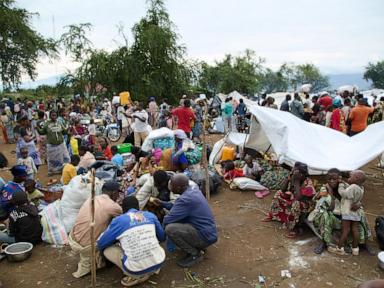
The dust in the Uvira region of South Kivu doesn’t just settle on your skin; it gets under your fingernails, into your pores, and stays there like a memory you can’t wash away. It is the color of baked earth and old blood. For years, this land was a map of forbidden zones. To stay was to court the kind of silence that only comes after a gunshot. To leave was to become a ghost in someone else’s country.
Thousands chose to be ghosts.
They crossed the border into Burundi, carrying their lives in plastic basins and fabric wraps tied tight across their backs. They lived in the gray spaces of refugee camps, waiting for the wind to change. In the dry, clinical language of international aid, these people are "returnees." In the reality of the human heart, they are souls finally tired of breathing air that doesn't belong to them.
Security is a cold word. It’s a statistic on a briefing paper at a UN headquarters. But for a father standing on the banks of the Ruzizi River, security is the absence of a specific vibration in the ground—the heavy, rhythmic thud of marching boots that used to mean "run." It is the ability to plant a seed and have a reasonable expectation that you, not a rebel militia, will be the one to harvest it.
The trucks arrive in convoys. They are white, heavy, and loud. They kick up that familiar South Kivu dust, but this time, the clouds they leave behind feel different. As the tailgates drop, the air fills with a sound that has been missing from these hills for a decade: the chaotic, beautiful noise of a homecoming.
The Weight of a Plastic Basin
Imagine a woman named Bahati. She isn’t a statistic, though she is counted in the 7,000 refugees currently making their way back from Burundi. She is a hypothetical window into a very real struggle. For seven years, Bahati’s entire world was a few square meters of canvas in a camp near Bujumbura. She knew the exact timing of the food distributions. She knew the sound of her neighbors’ coughs through the thin walls.
When the news filtered through that the Congolese government and the UN had cleared the path for a voluntary return, she didn't jump for joy. She sat down. She felt the sudden, terrifying weight of hope.
Going back is harder than leaving.
When you leave, you are fueled by adrenaline and the raw instinct to survive. When you return, you are fueled by a fragile belief that the world has stopped breaking. You have to decide what to carry. You can't take the makeshift furniture you built in the camp. You can't take the friendships with people who are staying behind because their own villages are still smoldering. You take your kids, your cooking pots, and the title deed to a patch of land you haven't seen since the last time the world ended.
The journey from Burundi to the Democratic Republic of Congo is physically short—sometimes just a bridge or a boat ride away—but the psychological distance is vast. As the convoys cross the border at Gatumba, the atmosphere inside the trucks shifts. The children, many of whom were born in the camps and have never seen the "home" their parents talk about, stare out at the rolling green mountains of South Kivu with a mixture of awe and suspicion.
To them, this isn't a return. It's an arrival in a foreign land.
The Invisible Infrastructure of Peace
Why now? Why not a year ago, or five?
The answer lies in a slow, grinding shift in the tectonic plates of regional power. For a long time, the borderlands were a playground for various armed groups—the FDLR, the Mai-Mai, and others with acronyms that spelled death for civilians. But a series of diplomatic handshakes and military operations have managed to push the front lines further away from the main transit corridors.
The security isn't perfect. It’s a bruised, tentative kind of peace.
The Congolese government, working alongside the UNHCR, has spent months "degazetting" areas—essentially marking them as safe enough for a human being to exist without a target on their back. They’ve set up transit centers in places like Kavimvira, where the returnees are processed. It’s a place of biometric scanners and medical checkups, a weird intersection of high-tech bureaucracy and primal human relief.
Each family receives a "reintegration kit." It’s a modest collection: some cash, some maize flour, some soap, and a few tools. In the grand scheme of global economics, the kit is worth very little. But in the hands of a man who hasn't owned a shovel in half a decade, it is a scepter. It is the tool with which he will reclaim his dignity from the dirt.
The Silence of the Soil
The real test begins when the convoy stops and the trucks drive away.
The returnees find themselves standing in villages that have often been swallowed by the jungle. Houses have collapsed. Schools are shells of brick and vine. The silence here is heavy. It’s the silence of a place that has forgotten the sound of laughter.
Consider the logistics of rebuilding a life from zero. You need to find your old boundaries. You have to negotiate with the neighbors who stayed behind and might have "borrowed" your land while you were gone. This is where the real work of peace happens. It isn't done by generals in uniforms. It’s done by village elders sitting under mango trees, arguing over where one farm ends and another begins.
The return of these thousands is a gamble. It’s a bet placed on the idea that the future will not look like the past. If the security holds, these villages will bloom. Markets will reappear. The roads, currently rutted and dangerous, will be smoothed by the constant passage of feet and tires.
If the security fails, the convoys will simply turn around and head back toward the bridge.
The Ghost in the Room
We often talk about refugees as if they are a burden to be managed. We talk about "flows" and "settlements" as if we are discussing plumbing. We forget that every person on those trucks is an expert in loss. They have lost years of their lives to a conflict they didn't start. They have lost the chance to bury their parents in ancestral soil.
There is a specific kind of trauma that comes from being a guest in a country that doesn't really want you there. In Burundi, many Congolese were tolerated but never embraced. They lived on the margins. Coming back to the DRC is an attempt to stop being a guest. It’s an attempt to be a citizen again.
But the ghost of the war is always in the room. It’s in the way people flinch when a truck backfires. It’s in the way they store their most valuable possessions in a single bag near the door, just in case. You don't just "recover" from being a refugee. You integrate the experience into your bones and hope it never becomes relevant again.
The scale of this movement is staggering. We are looking at a reverse exodus. While the world's attention is often gripped by those fleeing toward Europe or the Americas, this quiet movement within the heart of Africa is a far more accurate barometer of the planet's health. When people go home, it means the fever is breaking.
The Final Step
There is a moment at the end of the processing line where the returnees are given their final papers. They stand there, clutching the documents that prove they exist, that they belong, that they are no longer someone else's problem.
They walk out of the transit center and into the sunlight of South Kivu.
The air is hot. The lake is a shimmering sheet of silver in the distance. The mountains rise up like green walls, guarding the secrets of everything that has happened here.
A man picks up his youngest child and sets her on his shoulders. He has his cooking pots in one hand and his hope in the other. He starts walking. He doesn't look back at the border. He doesn't look back at the years of waiting. He looks at the path ahead, a narrow strip of dirt that leads toward a home that is currently just a memory and a pile of stones.
He keeps walking because the alternative is to remain a ghost, and he has spent far too long being invisible.


