Cold. That is the first thing you notice when you step out of a warm kitchen at two in the morning in late October.
Your breath turns white in the porch light. Your car keys jingle with a sharp metallic clink that feels too loud for the hour. Inside the house, a phone screen is probably still glowing on a nightstand with a push notification about quarterly earnings or a group chat argument that will not matter by noon. Outside, there is only the smell of damp leaves, the hum of a distant refrigerator behind a neighbor’s drywall, and an immense, quiet darkness that most of us have systematically engineered out of our lives. If you found value in this article, you should check out: this related article.
I have stood on cold grass with a thermos of lukewarm coffee and stiff fingers more times than I care to count, waiting for a streak of light that lasted less than a second. Sometimes nothing happens for twelve minutes. Your neck aches. Doubt creeps in—the quiet, nagging voice that asks why you gave up four hours of sleep to stare at empty air when a high-definition video on your phone can show you galaxies exploding in vivid false color on demand.
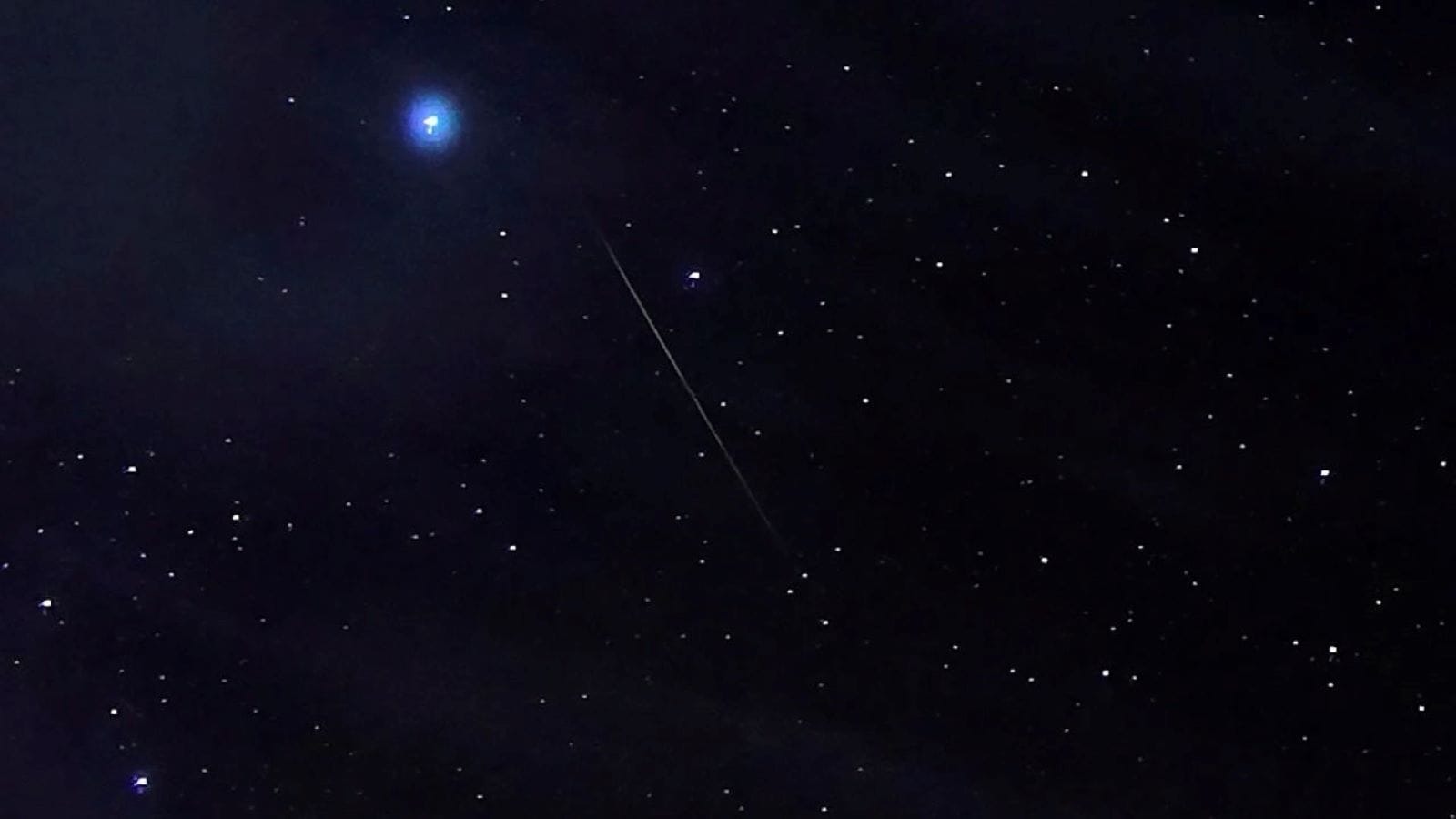
Then a faint silver needle scratches across the dark near Orion’s club, leaving a hairline memory of fire before vanishing completely. For another perspective on this story, see the recent coverage from Apartment Therapy.
You don’t clap. You don’t reach for a camera fast enough to catch it. You just stand there in the chill, heart kicking once against your ribs, realizing that a speck of dust no bigger than a grain of sand just burned up at roughly 148,000 miles per hour—and that speck once rode on the back of Halley’s Comet.
The Invisible Cost of Bright Rooms
Standard skywatching guides will hand you a tidy list of dates, peak hours, and zenithal hourly rates and call the job done. They will tell you the Orionids meteor shower usually runs from late September or early October into November, peaking around October 20 to 22, and that you should look toward the constellation Orion after midnight when the radiant climbs higher in the sky.
Those facts are true. They are also strangely bloodless.
Treat a meteor shower like a sporting event with a scoreboard, and you will almost certainly walk away disappointed. Maybe you step outside at 11:30 p.m. on October 21, catch two faint streaks in twenty minutes because the radiant hasn’t risen high enough yet or a bright moon is washing out the sky, and decide the whole thing is overhyped. Even under ideal dark skies, the Orionids are rarely a torrential downpour like some summer showers; they are known for fast, crisp streaks—sometimes leaving glowing trains—arriving at a measured cadence rather than an endless barrage.
(Note: The following character and scene are a hypothetical scenario created to illustrate a common human pattern.)
Picture Maya, a thirty-four-year-old product designer living near the edge of a mid-sized city. Her calendar is color-coded down to fifteen-minute increments. When she hears about the Orionids meteor shower, she treats it like a productivity task: set an alarm for 1:00 a.m., walk out onto her driveway wearing slippers, stare straight up for eight minutes, see nothing because her eyes haven’t adjusted to the amber streetlights down the block, check her phone to see the time, and go back to bed feeling mildly cheated.
She didn’t fail at astronomy. She brought daytime impatience into a nighttime ritual.
Modern life trains us to expect immediate feedback. Tap a glass screen and something happens within milliseconds. Refresh a feed and new material appears. The night sky refuses to negotiate on those terms. Meteoroids—tiny fragments of ice and rock shed by 1P/Halley across centuries of orbital passes—intersect Earth’s upper atmosphere whenever our planet crosses that debris stream. Where they strike is governed by celestial mechanics and geometry, not your schedule.
When we reduce an ancient orbital encounter to a checklist of "best viewing times," we miss the deeper friction at work. We are living inside brightly lit rooms, staring into backlit rectangles, and wondering why our nervous systems feel frayed and small in all the wrong ways. A little bit of real, unmediated scale—out in the cold, with no algorithm curating the view—is harder to find than people admit.
Why Halley’s Dust Still Matters at 2 a.m.
To understand why the Orionids feel different from random shooting stars, it helps to trace where the debris comes from.
Halley’s Comet loops around the Sun roughly every 75 to 76 years—most recently reaching perihelion in 1986 and next swinging back around the inner solar system in 2061. Every time it approaches the Sun, solar heat warms its icy nucleus and releases jets of gas and dust. Over thousands of orbits, that shed material spreads out into a ribbon along the comet’s path. Twice a year, Earth’s orbit passes close enough to that ribbon that we plow through it: in May as the Eta Aquariids, and in October as the Orionids.
Think of it like driving through a long, invisible mist left behind by a passing train decades earlier, except the droplets are microscopic or pebble-sized bits of cosmic rubble moving at blistering speeds relative to Earth. Because the Orionids hit our atmosphere nearly head-on as Earth orbits the Sun, their entry speeds are remarkably high—around 66 kilometers per second (roughly 148,000 miles per hour).
Friction with air molecules at altitudes around 60 to 100 kilometers heats the tiny grain until it vaporizes, ionizes surrounding gas, and creates the brief flash of light we call a meteor. Most meteors never reach the ground as meteorites; they burn out high above our heads.
(This comparison is a metaphor for spatial scale, not a literal measurement.)
If Earth were the size of a basketball sitting on a kitchen table, the atmosphere would be thinner than a sheet of tissue paper wrapped around the leather, and most Orionid meteors would flare and die in that tissue-thin shell while the rest of the room stayed completely unaware.
There is something quietly grounding about that geometry. In our daily lives, human drama expands to fill whatever container we give it—a missed deadline feels catastrophic, a terse email ruins an afternoon, a slight on social media steals hours of peace. Out under an autumn sky, with Orion’s belt and bright stars like Betelgeuse and Rigel hanging overhead, those urgencies don’t vanish into thin air, yet their volume turns down a notch. You remember that you are standing on a spinning rock moving through a vast, ancient current of ice and dust that began long before any language on Earth was spoken.
I won’t pretend I never feel silly out there. There have been nights where clouds rolled in ten minutes after I poured my coffee, or where my phone battery died in the cold, or where I spent forty minutes watching nothing except a bat jittering past a pine tree. Sometimes the uncertainty is annoying. Sometimes it feels lonely.
Yet the nights that stay with me aren’t the ones where I counted the highest number of meteors. They are the nights I stayed long enough for my pupils to widen, for the hum of traffic to fade into background static, and for my mind to stop rehearsing tomorrow’s conversations.
Learning to See in the Dark Without a Cheat Sheet
If you want to watch the Orionids—whether this year or in autumns ahead—the real secret isn’t buying expensive gear. It’s surrendering control of the clock and giving your eyes time to do what they were built to do.
Start with light. A single glance at a bright phone screen resets dark adaptation in your retinas, wiping out sensitivity you spent twenty minutes building. If you need a map or a time check, turn night mode or red-light settings on early, dim the brightness all the way down, and keep it tucked in a pocket rather than held in front of your face.
Give yourself at least twenty to thirty minutes away from floodlights, porch lamps, and passing headlights. Even better, drive out past the glow of city domes if you can do so safely—a modest trip away from dense streetlights can multiply the number of faint stars and subtle meteor streaks you can actually perceive.
Dress warmer than you think you need. Cold steals attention faster than boredom does. Once your toes go numb, your brain shifts from wonder to survival, and you’ll head indoors right before a good streak crosses the sky. A blanket or reclining lawn chair saves your neck, too; staring straight up while standing gets old fast.
Where should you look? Beginners often stare obsessively at the point in Orion where the meteors appear to originate—the radiant, positioned near the border of Orion and Gemini—hoping a meteor will pop out right there. In practice, meteors streak across wide swaths of sky and often show longer, more dramatic trails some distance away from the radiant. Lie back, take in a broad expanse of upper sky, and let your peripheral vision work.
Timing matters because Earth’s rotation carries your location into the "morning side" of our orbital motion after midnight, increasing the relative speed and frequency of meteors compared to early evening. That doesn’t mean you can’t spot an early straggler earlier in the night, especially on moonless evenings, but late night into the pre-dawn hours generally offers stronger odds—provided you aren’t fighting bright moonlight or heavy cloud cover.
What if you miss the exact peak night? Don’t treat the calendar like a locked door. Meteor showers build gradually and taper off over days and weeks. Stepping out a few nights before or after peak under clear, dark skies often beats watching on the exact peak night under clouds or bright glare.
What Stays Behind When the Streak Fades
(The following is a hypothetical scenario illustrating how a simple habit can shift over time.)
Imagine Maya tries again the next year, not at 1:00 a.m. in slippers with a timer running, but on a crisp late-October night around 1:30 a.m. with a wool sweater, a thermos of ginger tea, and her phone left face-down on the porch step. She leans back on a camp chair, listens to an owl somewhere in the trees, and gives her eyes half an hour to settle. Ten minutes pass. Nothing. Fifteen. A faint white line darts diagonally across the dark above her left shoulder and goes out. She smiles in the quiet, pulls the blanket up to her chin, and waits again—not impatiently, just present.
That shift is the real prize.
We spend so much energy optimizing every hour that we forget how to inhabit an unhurried moment without demanding entertainment on demand. A meteor lasts a fraction of a second. It leaves no receipt, no highlight reel, no metric you can brag about at work.
Still, when that tiny ember from Halley’s Comet cuts across the dark above your head and disappears into silence, something inside you catches up to the night—quiet, wide awake, and for one brief second, completely unhurried.