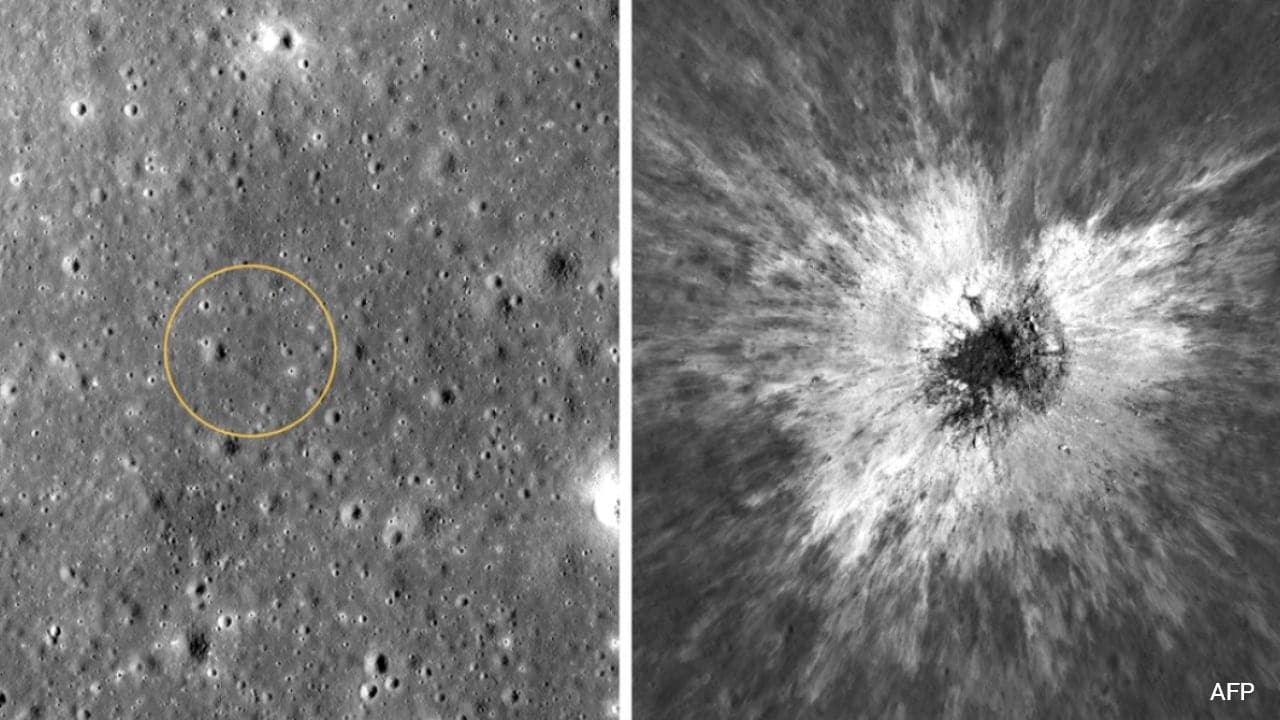
Journalism thrives on superlatives. Throw a rare celestial alignment or an ancient impact timeline into a headline, and the digital ecosystem responds with predictable frenzy. Recently, a wave of sensational reporting claimed that a rare once-in-132-years comet impact gouged out a giant crater on the Moon, accompanied by supposed photographic proof from space agencies.
Strip away the hyperbolic framing, and the underlying reality of lunar geology offers a far more grounded narrative. The Moon absorbs impacts daily, ranging from microscopic dust specks to high-velocity asteroids, accumulating scars over billions of years without needing a century-long interval to validate its existence.
Understanding how celestial bodies interact requires looking past viral announcements and examining the actual data returned by planetary orbiters.
The Mechanics of Lunar Cratering
Every second, the lunar surface acts as a cosmic punching bag. Lacking a substantial atmosphere to burn up incoming debris, the Moon records every collision in permanent relief. When a high-velocity body strikes the basaltic or anorthositic crust, the kinetic energy transforms into an explosive thermal and mechanical shockwave.
Rock vaporizes, material ejects outward in a symmetrical blanket, and a depression forms. The scale of this depression depends primarily on the velocity and mass of the impactor rather than any calendar-based schedule of celestial events. Comets, largely composed of volatile ice, dust, and rocky fragments, often vaporize or disintegrate rapidly upon atmospheric or surface entry depending on their structural integrity. Claiming that a specific impact happens only once every 132 years misunderstands the stochastic nature of the solar system. Debris fields, orbital resonances, and random intersections dictate when and where impacts occur, paying no heed to human arithmetic or media cycles.
Space agencies like NASA continuously monitor the lunar near-side using sensitive optical and thermal equipment, specifically looking for transient lunar phenomena—flashes of light produced when a meteoroid strikes the dark side of the Moon. These flashes occur with measurable frequency, reminding astronomers that the inner solar system remains an active shooting gallery.
When a bright flash is recorded, the resulting crater is rarely visible immediately to amateur telescopes. Finding the new scar requires high-resolution orbital reconnaissance, comparing pre-impact and post-impact imagery pixel by pixel.
Tracing the Source of the Viral Narrative
The origin of these viral space stories usually stems from a misinterpretation of routine scientific publications or archival imagery repurposed for click traffic. An old photograph of a prominent lunar crater, such as Tycho or Copernicus, gets repackaged with a fresh, breathless caption about a recent catastrophic event.
In reality, major basin-forming impacts ceased billions of years ago during the Late Heavy Bombardment. Modern impacts are localized events. A crater measuring several kilometers across is a major geological occurrence, yet it does not rewrite lunar history. It simply adds another fine grain of sand to an already heavily weathered and cratered landscape.
When outlets claim a comet caused a specific giant excavation, they often conflate long-period comets with near-Earth asteroids. Asteroids are dense, rocky, or metallic bodies that leave distinct craters. Comets possess much lower densities and higher velocities, frequently producing shallow, disrupted impact zones or exploding in mid-air rather than carving out clean, textbook bowls in the lunar regolith.
The Reality of Planetary Defense and Monitoring
Public fascination with near-Earth objects and lunar impacts serves a dual purpose. It sparks genuine interest in astronomy while simultaneously feeding an appetite for apocalyptic entertainment. Funding for planetary science often depends on public engagement, creating an uneasy alliance between sober scientific observation and sensationalized media framing.
Yet, ignoring the hyperbole should not lead to complacency. Planetary scientists study lunar impacts not for shock value, but to calibrate models of impact frequency across the inner solar system. By counting craters on surfaces of known ages, researchers establish timelines for Mars, Mercury, and Earth. The Moon serves as a natural archive of Earth's own violent history, preserving records of impacts that would have otherwise been erased by plate tectonics, erosion, and biological activity.
The next time a headline declares a miraculous cosmic anomaly, look for the peer-reviewed paper or the raw instrument data behind the claim. The universe is endlessly fascinating on its own terms, requiring no exaggeration to command attention.
The craters remain where they have always been, quiet monuments to an ongoing celestial collision course that has persisted long before the first human looked up and tried to count the years between them.